




The myth of 'serumpun'
It is official: Pulau Batu Puteh shall from now on be known as Pedra Branca following the rulings by the International Court of Justice (ICJ) on the dispute between Malaysia and Singapore over its sovereignty.
Well, Malaysia is not entirely unused to losing. Just recently, our national badminton team was defeated (again) by China at the Thomas Cup semi-finals, and the rankings of our universities are persistently poor compared to other countries.
It is official: Pulau Batu Puteh shall from now on be known as Pedra Branca following the rulings by the International Court of Justice (ICJ) on the dispute between Malaysia and Singapore over its sovereignty.
Well, Malaysia is not entirely unused to losing. Just recently, our national badminton team was defeated (again) by China at the Thomas Cup semi-finals, and the rankings of our universities are persistently poor compared to other countries.
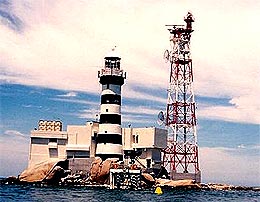 However, it would seem perfectly alright for Malaysia to lose, provided the winner is not Singapore. The frenzy caused by the loss of our sovereignty over the “tiny dot” on Selat Tebrau is therefore only natural.
But Malaysia is not without its moments of sweet victory. In December 2002, the ICJ ruled in favour of Malaysia concerning the sovereignty over Pulau Ligitan and Pulau Sipadan. Ironically, the basis of Malaysia’s win against Indonesia forms precisely the legal reasoning on which Pedra Branca is granted to Singapore.
According to Chandran Jeshurun, an international historian and whose latest book Malaysia: Fifty Years of Diplomacy 1957-2007 I am also currently reviewing, our foreign minister, in submitting the dispute to the ICJ in May 1997, hoped that the Special Agreements between Malaysia and Singapore would “set a precedent for other countries to follow… whatever be its outcome”.
And who was the foreign minister concerned? None other than Abdullah Ahmad Badawi. In expressing such hope, I am sure the now embattled prime minister did not foresee his very own words would one day come back to haunt him.
No 'win-win' solution
It is hard to imagine Malaysia’s loss of sovereignty over the islets would not give more fodder for Dr Mahathir Mohamad to launch another round of attack on his successor, especially when Singapore is involved. The Malaysia-Singapore relations did go through its highs and lows since the bitter estrangement in 1965, but it is fair to say they deteriorated further during the Mahathir administration.
Years of media war and tit-for-tat between the two countries have poisoned the minds of the populaces on both sides of the border. Today, not only Malaysians, even Singaporeans who see themselves as more “world-savvy and broadminded” refuse to believe there is such thing as “win-win” solution to many of the bilateral disputes.
Singapore has, down through the years, been portrayed by Umno as an Israel in Southeast Asia (no elaboration needed), a conduit for western interests (especially those of the United States), and the PAP a Chinese chauvinistic party (which is quite true to some extent, but the detractors of Singapore often forget Umno and its cohorts are not much better either).
Things would be different if the dominant community in the island republic was not Chinese. In Thailand, the Malays in the south have long been denied their right to cultural and religious revival under the policy of assimilation promulgated since the 1970s. I felt an enormous sense of loss when I tried to strike up a communicable conversation – in bahasa - with a southern Thai Malay selling teh tarik at the famous Chatuchak Weekend Market in Bangkok recently. It somehow pained me to see him struggle for simple phrases.
Still, Malaysia-Thai relations are among the most cordial in the region, despite the common perception of Thai hegemony imposed on the Malay communities in the southern provinces.
Malaysia is also generally on good terms with the Philippines. While the Muslim separatist movement does create some hiccups between KL and Manila, they never escalate into major obstacles that make international headlines.
 Following the ICJ rulings on Pedra Branca, Matthias Chang, Mahathir’s former political secretary, could not wait to come up with an
article
to capitalize on the issue.
Following the ICJ rulings on Pedra Branca, Matthias Chang, Mahathir’s former political secretary, could not wait to come up with an
article
to capitalize on the issue.
To his credit, Chang provided a fairly strong analysis as to why Malaysia lost, but most significant is his pandering to the stereotype of the Jewish conspiracy. I am sure Mahathir must be well pleased.
But is Singapore the only country in this region that serves the agenda of the West in general, and that of the US in particular?
In line with US agenda
Since the election of Yudhoyona Susilo Bambang as Indonesian president in late 2005, the US has been cautiously and steadfastly seeking to make Jakarta one of its strategic partners in Southeast Asia. The geo-strategic location and the rich natural resources that Indonesia is endowed with (and under-exploited, so to say) decides the country will remain the dominant regional player for decades to come. Asean aside, Indonesia’s powerful presence in the Muslim world and the Organisation of the Islamic Conference (OIC) is undisputed.
Over the last two years, the US has been working profusely to bring about joint military exercise with the world’s largest Muslim country, especially in the Malacca Straits. Offers have also been made by Washington to supply Jakarta with logistical support, including radar equipment and military personnel for retraining purposes. This overture by the US was well received by Rear Admiral Agus Suhartono, commander of the Indonesian Navy’s Western Fleet, who revealed last June that 10 radar systems, donated by Washington, would be installed from Sabang at the northern tip of Aceh Province to Bengkalis for monitoring purposes. One should never forget the Malacca Straits is one of the busies sealanes in the world.
To top it all, plans are made to invite Indonesian government servants at all levels to the US for training and joint scientific and humanitarian projects, with a view to making the country a model for the Muslim world in terms of democratic elections.
In short, the Indonesian leadership is caving to the demands of the US that are popularly seen by Umno elites as compromising the nation’s sovereignty in the long run, but we are yet to hear their complaints, not to mention displeasure.
If Singapore, with sizeable numbers of its civil servants being US-trained, is seen as hanging on to the US’ coattail, what about the future generations of Indonesian officials who may reasonably likely be strong advocates for policy decisions – domestic and international alike – that are in line with US agenda?
Quite clearly, Indonesia is spared the usual strong suspicion that Malaysia harbours towards Singapore is because the former is perceived as “serumpun”, and this is, strangely, in spite of the historical fact that Jakarta once vowed to crush Malaysia in the early 1960s. From time to time, the hostile elements within Indonesian society will still remind us of the bitter days of Konfrontasi.
It is just unfortunate that Malaysia-Singapore relations have been guided by too much emotion but not enough rationale in the past. While it is true that Asean as a whole is being confronted with myriad challenges in the new century, so long as the member states are shackled by historical burdens and unable to move on, things will not look bright for the regional grouping indeed.


Are you sure you want to delete this comment?
This action cannot be undone.