




Rudd awakening for Australia
Seven months after he led the Labor Party to victory in last November’s election - stunningly dislodging the arch-conservative John Howard and his Liberal-National coalition from power - Kevin Rudd surely must know that his honeymoon is over.
How? He’s on the voters’ noses.
More and more voters say, damningly, that Krudd, as he has been dubbed, is just a lot of hot air. Prime Minister Rudd is a spin master.
From tall chimneys, Rudd has been billowing undecipherable and often-contradictory policy smoke-signals. So much so that voters have begun to wonder if they voted for a wimp to lead them.
Seven months after he led the Labor Party to victory in last November’s election - stunningly dislodging the arch-conservative John Howard and his Liberal-National coalition from power - Kevin Rudd surely must know that his honeymoon is over.
How? He’s on the voters’ noses.
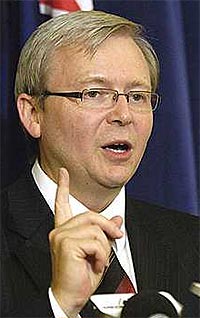
More and more voters say, damningly, that Krudd, as he has been dubbed, is just a lot of hot air. Prime Minister Rudd is a spin master.
From tall chimneys, Rudd has been billowing undecipherable and often-contradictory policy smoke-signals. So much so that voters have begun to wonder if they voted for a wimp to lead them.
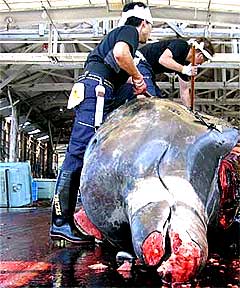
The latest about-face is his stance against the brutal, cold-blooded murder of whales by the Japanese in the South Pacific.
The Japanese have always claimed the killing of scores of whales is strictly for research purposes. It’s a blatant lie, given that whale meat and fins end up in Japan’s rich wet markets as delicacies. Rudd called it so last year.
This year, though, he hinted he would challenge Tokyo in the International Court. He still says he would. But that’s about as certain as saying maybe. It’s all a Krudd swagger - populism at its best. On his first official trip to Japan in early June, Rudd suddenly changed his tune. He said the whaling issue is merely a “disagreement amongst friends”.
Rudd has sold out the whales to the murderous Japanese.
Why the about-face? The conservative Opposition complained Rudd has downgraded Japan’s centrality to Australia’s regional diplomacy and strategic alliance for China.
After all, China is hurtling ahead of Japan in international trade and finance. China is now the world’s number two economy, having displaced Japan. And the pea-sized Australian economy, built around farm and minerals exports, is heavily dependent on Chinese demand.
Voracious appetite
But Australia’s exports to Japan total US$14,000 million whilst imports are just US$9000 million. Japanese foreign direct investment to Australia is US$1275 million, the 12th largest, and far greater to China’s. However, China’s economic presence in Australia is multiplying so fast that it must worry the Japanese, especially if China’s voracious appetite for Australian mineral resources may price the Japanese out of the market down the track.
That’s hardly a sensible concession to make to the Japanese over whales. And there goes Rudd’s ‘green’ credentials. The litmus test of Rudd the environmentalist will come when – and if – Rudd has the spine to push the Chinese into reducing its global carbon footprint. If Rudd has backed down over Japan’s whale murder, what are the odds that the Chinese will also slap him down over their greenhouse emission, regardless of how wonderfully he may swoon his Chinese audience with his proficient Mandarin-speaking skills?
Rudd’s influence over Chinese policies is laughable, and none more so than over China’s growing environmental dilemma and its catch-up economy. The most assertive influence may come from the United States. But lame-duck President George W. Bush has been an environmental hypocrite at home and abroad. So what hope does Bush, let alone Rudd, have of getting the Chinese to climb aboard their newfound environmental bandwagon?
That’s not the only reason why Rudd is on the nose of Australian voters. Gasoline prices in Australia are firing up voters’ angst. Petrol prices are closing in on AUD1.70 a litre. Projections are that gasoline pump prices will hit AUD2.00 within three months. With higher fuel prices also in part driving up food prices, voters are pouring scorn on Rudd telling them that there is nothing he can do about gasoline prices at home. It’s true that the Organization of Oil Exporting Countries (OPEC) have a choke-hold on world crude price, which is closing in on US$142 a barrel. That’s one problem.
But Australia, like Indonesia, has become a net oil importer and buys Tapis oil, refined in Singapore, at roughly 5-7% higher than Brent crude’s price. That’s another problem. Thing is, Australian consumers understand that. What they don’t understand is Rudd’s backflip from his election promise. He had said then that he would move heaven and earth to reduce gasoline prices in Australia. How?
Fuel watch
Rudd introduced the most farcical scheme, stupidly called FuelWatch. All petrol companies must tell FuelWatch 24 hours in advance their retail prices for the next day. The prices will be listed on FuelWatch’s website and consumers will be enlightened by this information. If the idea is that FuelWatch will act as a market-price reversing mechanism that will save consumers some five cents a litre, then Rudd is as delusional as he is naïve. Or just playing dumb politics.

Unless he can break the power of the oil cartel in Australia, he stands no chance of winning over riled-up voters. FuelWatch is about as effective as the other government body, the Australian Competition and Consumers Commission. Both are effectively toothless tigers whose influence over market practices will be about as effective as Zimbabwe’s Robert Mugabe’s attempt to bring down the 1000% inflation rate that his people face every day.
Here’s the thing: Just how many Australians have access to the Internet to look up FuelWatch’s price watch? Even Rudd has difficulty getting reliable broadband spread throughout the country, let alone into some capital cities. For example, Sydney and Melbourne have ADSL 2-Plus cable but pitiful Adelaide in South Australia does not. Nor do Perth, Darwin and Hobart. Only sections of Brisbane do. Never mind the cities’ country cousins, who could do better by sending pigeons for information.
But here’s the best bit. The Rudd government, like the Howard government, creams Australians to the tune of almost AUD57 cents per litre in tax at the pump. And not once has Rudd offered to reduce the tax to ease the burden for consumers. If oil prices head up sharply, as they will, food prices will shoot up by another whopping 20% within months.
 Then again, perhaps Australians should also look at their own bad fuel habits instead of whining. Most gasoline consumers don’t want to see past their own noses. Even if, by some miracle, that they do, it will not mean Rudd’s problems will vanish. In fact, they’ll just have begun, because the ‘miracle’ Australian economy is slowing.
If it does, so soon after taking office, Rudd will have a damn tough time proving his economic management skills that he had promised voters last November, many of whom are so high up their noses with personal debt. And you know what that means.
MANJIT BHATIA, currently living in Australia, is an academic and writer with specialisation in international economics and politics. His writings have been published in The Wall Street Journal, Business Times Singapore, International Herald Tribune, Financial Times, The Australian, The Australian Financial Review and elsewhere.


Are you sure you want to delete this comment?
This action cannot be undone.