




Mass transit taking us nowhere? Pt 1
In view of the increased petrol prices, the government should have heeded the warnings beforehand and invested in public transportation projects, with long term focus - not just quick solutions.
 Sadly, the government has been lacking even in quick solutions – enforcement lacking for bus lanes and bus bays (to keep cars and trucks from blocking traffic), or the creation of temporary bus lanes (using the red and white road dividers) as an immediate solution. They have said nothing about reducing the number of touts at the Puduraya bus station or keeping the Metrobuses moving in the city centre and the suburban hubs.
In view of the increased petrol prices, the government should have heeded the warnings beforehand and invested in public transportation projects, with long term focus - not just quick solutions.
 Sadly, the government has been lacking even in quick solutions – enforcement lacking for bus lanes and bus bays (to keep cars and trucks from blocking traffic), or the creation of temporary bus lanes (using the red and white road dividers) as an immediate solution. They have said nothing about reducing the number of touts at the Puduraya bus station or keeping the Metrobuses moving in the city centre and the suburban hubs.
I suppose that the announcement of the Kota Damansara-Cheras line and the extensions of the Ampang LRT and Kelana Jaya LRT were meant to be cheerful updates, however that was in 2005 and they have been silent on the proposals since. These costly long term projects do little for the people today except to give them hope that the future may be better - small comfort if you are standing at a crowded bus shelter or in a packed train.
People need to know details, benefits and costs of these long term projects Are these projects part of a master public transport plan for the Klang Valley?
The proposed line extensions are part of a government plan but it is not a 'master plan' for the Klang Valley.The federal government has been short on specific information about the lines. The thinking seems to be corporate in nature - building the extensions and the new line to tap markets for potential commuters and increase the use of the existing lines.
Compare government plans against the KL Structure Plan 2020 or the current KLCity2020 Draft Local Plan, both provided by the Kuala Lumpur City Hall. They don’t match and this is a cause for concern.
How have the people been consulted on these projects?
The ethos is “if we build it, they will come,” followed by “how could they refuse” and “they better be grateful.”
Little is done to find out what people really want.
The solution for public transport seems to be LRT at all costs.
This single-minded, almost obsessive attitude reminds me of American Admiral David Farragut who famously after having one ship from his fleet blown in a minefield area said “damn the torpedoes (mines), full steam ahead!”
Mutually sustaining
 How many passengers are these lines expecting to carry initially? How much room for expansion is in-built?
This is a very important question, because the initial passenger projections will determine whether the line will be successful and able to stand without additional government support. Including long-term expansion into the initial planning gives room for the line to grow and gives room for development to occur around the line.
The line provides a good location for development projects and provides mobility for residents, workers and visitors. The developments will provide the passengers who will support the line and give people reasons to move around. Thus the line and the development become mutually sustaining.
But look at our experience so far: the PUTRA and STAR lines were both money losers making government bailouts necessary. PUTRA has since recovered and is profitable - partly because RapidKL and the government have been slow to invest in providing enough carriages and trains to meet the demand. The STAR is still a money loser on the Seri Petaling stretch.
The line is, according to RapidKL, only at 70% capacity and has room for growth. The extension of the Ampang line westwards from Seri Petaling is designed to increase the number of passengers using the LRT and thus increase returns for RapidKL.
When large amounts of money are invested into mass transit there must be room for future expansion in order to get significant passenger returns now and gain passenger numbers in the future.
As described above, the Ampang LRT is 70% under capacity. These lower passenger numbers are occurring because the line passes through very low density areas that do not justify the cost of the LRT. But at the same time, we must understand that the 30% unused capacity is room for future growth. If we fill all that space up today, where will we put future passengers?
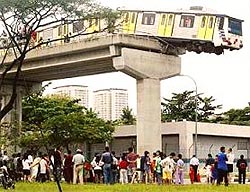 That is precisely the question we see with the Kelana Jaya line. It is already 40% over capacity during peak hours. Doubling the number of carriages will reduce excess capacity to 20%, which is still beyond acceptable levels.
Have you ever wondered why the line was built to such a small capacity and why it is already overcapacity. It is just too small for the communities that it is already serving – so why are we compounding the problem with this proposed extension?
A 'heavy' cost
The proposed extension to Subang Jaya will increase passenger numbers, but the Kelana Jaya line has no room for growth and an extension will likely overwhelm the line.
Do the benefits of these lines justify the costs of planning, land acquisition, design, engineering, construction and maintenance?
We call them ‘light’ rapid transit lines and they are certainly 'light' in terms of passenger capacity. The Kelana Jaya line can carry 9000 passengers per direction per hour with two carriage trains and 18000 passengers per direction per hour with four carriage trains. In contrast, a line with 'heavy' passenger capacity will typically carry 20,000-50,000 passengers per direction per hour.
Lest anyone feel envious of other cities, it could be pointed out that at least the engineering, design and construction costs for our LRT lines were 'heavy' at approximately RM200-250 million per km.
Of course there are more questions, but there is only so much space available. I do invite the government to provide answers to the rakyat so that these questions can be properly explained and addressed, one by one. But until then, please accept my answers above in lieu of answers from the government.
The Klang Valley has 'light' capacity rapid transit lines that bear 'heavy' costs – in terms of land acquisition, planning, design, engineering, construction, and maintenance and operations costs.
The future of public transport appears to be more of the same. Hence my concerns – the government has not used our resources wisely in the past – can we trust them to do so in the future?
Part Two: Little justification for Kelana Jaya LRT extension
MOAZ YUSUF AHMAD, a regular user of public transport, is deeply concerned that government plans to encourage the use of public transport will ultimately fail because of poor planning and lack of public support.


