




Can Anwar really lead and govern?
The opposition icon believes it is vital to effect change now: "No country can be sustained with this sort of incompetence and negligence".
Good leadership is about providing a catalyst for a better tomorrow. And like any good leader, Anwar Ibrahim seems to understand what Dr. Martin Luther King called, "The fierce urgency of now".
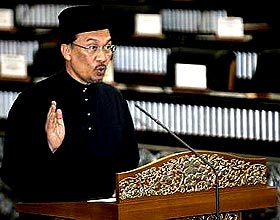
This is especially so in a Malaysia where the cost of living is on the rise, where people are finding it harder to do business and to make ends meet. A Malaysia where people are asking if the rule of law is really under threat, and where confidence in the judiciary is perceived to be low. Anwar promises to address these issues and to rectify them. But can he really do it?
"I am," he tells proudly, "an incorrigible optimist!". As such the term ‘impossible’ does not belong in his vocabulary. "People said that it was impossible for the Barisan Nasional (BN - the ruling coalition in Malaysia) to be denied a two-thirds majority. They said it was impossible for three parties to work together in five states, but that’s happening despite them not receiving any support from the federal government."
To him, the results of the 12th general elections where the opposition managed to deny the ruling coalition a two-thirds super majority in Parliament as well as gain control of five states is, "a clear proof that people want change." Because of this yearning, the notion of the invincibility of the ruling party has been demolished like the statue of Ozymandias in the desert.
Furthermore, the elections also showed a desire for change in the economic system. "Malaysia is generally a very rich country," he pointed out. "We are an emerging economy with a wealth of natural resources, and we are also a net exporter of petroleum.
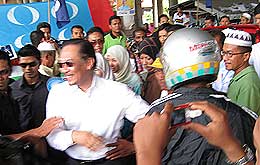 However," and here his voice became more determined, "a Morgan Stanley report has stated that around RM300 billion has been lost due to corruption over the past 30 years. And PEMUDAH (the government-appointed task force commissioned to look at means of improving efficiency) has also made reference to the fact that RM10 billion is wasted a year from public funds."
For Anwar, the situation is quite clear and so too is the direction needed. "This cannot be tolerated," he told us, "No country can be sustained with this sort of incompetence and negligence." And this is where his fierce urgency of NOW comes into play.
New challenge
"The country," he told us, "cannot afford to wait the next four to five years for a general election before the agenda for change is implemented." With the socio-economic-political situation as it is today, it is easy to understand his line of thinking. Of course, the change will be constitutional, legal, and peaceful - done through the crossing over of conscientious MPs. The process, he told us, has already started - albeit slowly.
Furthermore, he realises that an Anwar Ibrahim inside Parliament would be a bigger asset than one outside it - no matter how vocal or determined he might be. "A lot of my friends in Parliament from the other side (i.e. BN MPs) have told me that they want to see me back in Parliament before crossing over.
And this is why, I will be announcing my candidacy in a by-election in the coming days." Since the interview, he has announced that he would be running for the Permatang Pauh Parliamentary seat, which incidentally was his previous seat before he was removed owing to his previous conviction.
Thus the symbolic and actual significance of Anwar’s return to Parliament cannot be denied. However, he is now facing new challenges - one of which is a latest round of allegations of sodomy against him - which has in turn resulted in concern being expressed by world leaders.
On his part though, he does not seem too overtly concerned by the current situation, as he is determined not to let such matters distract him from his platform. And this is why he is even able to make light of the situation, relating to us a tale of how some well-meaning friends gave him some advice.
"They told me, ‘After what happened last time, you should not hire any young, good looking men in your office.’ To which I replied, ‘I cannot hire young good-looking men because of that. I also can’t hire old men because Dr Munawar Anees (who was co-accused in the 1998 case) was a man in his 50’s, and I can’t hire young girls because my wife definitely won’t let me. Who am I going to hire then? An 80-year-old woman in a wheelchair?"
Light laughter filled the room as he finished his quip. We could see that famous Anwar charm, and that equally famous Anwar determination, which is based on the principle that right makes might.
Maturing with age
Perhaps what sets human beings apart as species is that we are able to develop with age and experience. And this holds true for Anwar. It has been a tendency for his detractors to bring up his past actions especially his leadership of Muslim youth organisations, which later led to the politicising of Islam in the country.
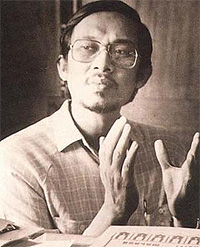 Summoning the ghost of Anwar’s past has thus been a popular hobby of late, with the implications quite clear. And they are that 30 to 40 years ago, Anwar was a firebrand who held views that could be deemed as extremist, and therefore he cannot be trusted.
But times change, people change, and so too do the circumstances. When we gave him the opportunity to exorcise the past, he gave us a reply that was neither apologetic nor defensive, but rather explanatory.
"I was part of a generation that was seeking legitimacy and identity in the turbulent days of the 1970s when the country was in a state of flux - lacking vision and direction. And for a long time the political choice was to be either on the right-wing or the left-wing."
"So a group of us," he continued, "began to study and re-look at Islam’s position in the socio-political context. I am not going to deny that I was very Malay and Islam-oriented in my youth. But what has not been pointed out was that when I was the President of the Malaysian Youth Council, I worked closely with non-Malay and non-Muslim organisations. Also, growing up in my hometown in Penang meant that I had many non-Malay neighbours. So that was a very important experience."
 Thus, he was rightfully concerned about the issues of his community, especially the feeling that the Malays were - on a whole - ignored and marginalized while only a selected few benefited from the policies.
However with the experiences of life and of the people around him, he has managed to shape his thinking to look at the bigger picture. And that was, as he said, "to see the problems affecting the Malays as part and parcel of the wider economic problem."
At the end of the day, Anwar is not apologetic about his past. As he said, "the issue here should not be what I did at sweet seventeen." After all what is important is not the youth from 40 years ago, but the man of today. And he hopes that people see that the man of today has demonstrated the capabilities of a true Malaysian leader.
Like any intelligent person, he has evolved and matured through the years and through experience. Of course the fundamental belief is still there - the belief in a better Malaysia. And this is why he will not give up or be cowed into submission.
Pledge to Malaysia
Of course, owing to the fact that the business community is notoriously conservative and wary of change, some corporations might not take the idea of a change in government too well. Anwar has anticipated this reluctance and wariness, which is why he told us that his government would practice "Clarity and transparency in policies, which will lead to the promotion of growth through free market economics. We will give incentives to attract business, and we will ensure that costs are open and aboveboard, and tenders are open-ended."
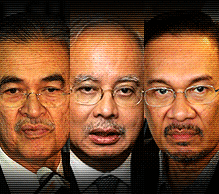 Concluding his vision for the business environment in Malaysia, he extended an invitation to the corporate world to play a part in building a new Malaysia by being more involved in corporate social responsibility.
This being the month of Merdeka, we wondered what would Anwar want to say to our readers in view of this auspicious season? He gave a pledge to Malaysia and Malaysians, saying, "I want to promise a new dawn for all Malaysians. We must have a sense of confidence and trust that this is a great country, which will be able to provide for all. (And in order for that to happen) We must demand changes in the system."
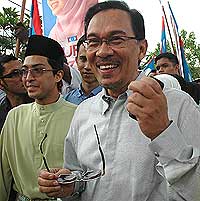 Malaysians are of course a patient lot. It is a blessing and a curse. We have lived the past 50 years with this fear of change, and in doing so have accepted a status quo that has seen our motherland devolving rather than evolving. But as the old saying goes, "it only takes a spark to get a fire burning."
And this is why Anwar’s importance cannot be denied. Because he is that spark that has the lit the flames of desire for change in the hearts of millions of Malaysians.
2008 is certainly his year as no other single individual has stirred so many different mixed emotions in Malaysians and the rest of the world for a Malaysian cause.
Everyone is talking about Anwar Ibrahim and his concepts. He has gotten Malaysians to talk about politics and the future of our country in a way that has never been done before.
Fear him, admire him, hate him, love him, respect him, denounce him, whatever ... you cannot deny he certainly is the Man of the Year.
Yesterday: Anwar's New Malaysia
The above article first appeared in the August edition of Passions magazine.


Are you sure you want to delete this comment?
This action cannot be undone.