




A Bush-el of contradictions
While the Bush era is drawing to a close, the events over the last few days show that the most unpopular president in modern American history still retains the ability to wreak havoc.
The raid on Syria that happened last Sunday not only compromised negotiations over a Baghdad- Washington security pact, which President Bush had been eager to push through before he steps down, it also aroused strong mistrust among the Gulf population.
While the Bush era is drawing to a close, the events over the last few days show that the most unpopular president in modern American history still retains the ability to wreak havoc.
 The raid on Syria that happened last Sunday not only compromised negotiations over a Baghdad- Washington security pact, which President Bush had been eager to push through before he steps down, it also aroused strong mistrust among the Gulf population.
Attacking a sovereign Syria in the name of driving out terrorists will only reinforce impressions of Bush’s arbitrariness and self-importance.
It has got the Iraqi leadership thinking the US would use its bases within Iraq to launch offensives against other "hostile" forces in the Middle East, such as Iran, to the detriment of the war-torn country and the region as a whole.
Instead of governing the United States with intelligence and tact, Bush and his cohorts have mismanaged the US economy levels unseen since the Great Depression.
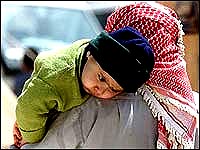 Professor Wang Ming, a Chinese national currently teaching at Cornell University, laments that the reckless war on Iraq in 2003 and the chaos that followed have taken a toll on the economy, while Washington’s tendencies to resort to saber-rattling has contributed to the decline of US influence worldwide.
"Throughout his presidency, Bush has consistently disregarded diplomacy, and pursued his foreign policy goals in a haphazard, counterproductive and even disastrous manner," Wang opines bluntly - which is unusual for visiting scholars.
Little wonder that many in Iraq would want to renegotiate the security pact after the new administration is formed in Washington, preferably with Barrack Obama at the helm.
Ignores cruel friends
On one hand, Bush vowed to topple each and every dictatorial regime, while tolerating on the other some of the worst behaviours of those that are seen as friendly to the US.
For instance, many dissidents that demanded democratic reform in Saudi Arabia were put in jail, but hardly anything was done by Washington to secure their release.
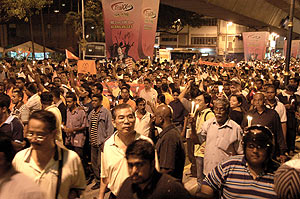 In Malaysia, some 68 people are now detained under the notorious
Internal Security Act
, and the US is largely silent because Malaysia is a small but relatively friendly country. Most importantly, most of the detainees are so-called "Muslim terrorists" linked to Jemaah Islamiyah, whose names probably sound too unpalatable to the Bush administration.
In Malaysia, some 68 people are now detained under the notorious
Internal Security Act
, and the US is largely silent because Malaysia is a small but relatively friendly country. Most importantly, most of the detainees are so-called "Muslim terrorists" linked to Jemaah Islamiyah, whose names probably sound too unpalatable to the Bush administration.
(Side-note, the Democratic Action Party is guilty as well of moral selectiveness when it chooses to champion the cause of Chinese and Indian detainees while maintaining its 'elegant' silence on the Muslim ones.)
Iran’s nuclear conundrum is another ‘fine’ example of Bush’s many contradictions. Since his election as president, Mahmud Ahmadinejad has been portrayed as a fanatic by the White House and an easy target of criticism due to his stated goal of peaceful nuclear development.
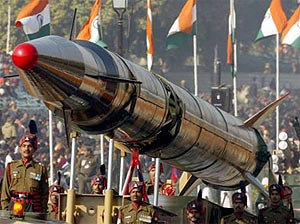 However, the House of Representatives in Washington has just approved a deal to expand nuclear cooperation with India despite the latter not being a member of the Nuclear Non-Proliferation Treaty (NPT).
Israeli nuke threat
Meanwhile, Israel has, for decades, been known to possess nuclear arms. In February this year, terrorists attacked Israeli city of Dimona, which houses the largest nuclear reactor in the Jewish state.
The Dimona Nuclear Complex was built in the 1950s for "research and peaceful purposes". Still, the facility has produced materials sufficient for 200 nuclear weapons, according to the Federation of American Scientists.
Al Jarida, a Kuwait newspaper, also reported that a senior employee, named Moshe, at Dimona was arrested on suspicion of leaking information about the reactor to foreigners, including those who had planned an attack on the facility.
Had the plot not been foiled, a nuclear disaster of unimaginable magnitude would have happened.
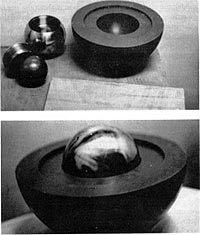 Hence, it is unfathomable that no effort has been made by the White House to pressure the Israelis to sign up to the NPT, although the International Atomic Energy Agency (IAEA) has been closely scrutinising Iran’s nuclear ambitions.
All the attempts by the IAEA to inspect Tel Aviv’s nuclear facilities have also been turned down with the connivance of the Bush administration, which clearly casts aspersions on Israel’s claim of nuclear technology for civilian use.
Back in the US, Bush and the Republicans often associate Israel-friendly foreign policy with increased Jewish support at home. Interestingly, Obama is poised to win the Jewish vote come next Tuesday.
A variety of double standards, Guantanamo Bay, the rejection of the International Criminal Court and the rising death tolls in both Afghanistan and Iraq still stir deep resentment, with less and less people seeing America under Bush and his hawkish allies as a "force for good".
As he bids farewell, Bush is also searching in earnest for his legacy. Alas, he is most likely to find nothing in the end.


Are you sure you want to delete this comment?
This action cannot be undone.