




Tackling Sudan: Obama's priority
In a Democratic presidential debate last December, then Senator Barack Obama related a visit that he made to Africa, during which he was told by businessmen there that “the presence of China is only exceeded by the absence of America in the entire African continent”.
Although Obama did not elaborate on his African policy, it was already clear that China’s aggressive effort to enchant and embrace the African continent and President George W Bush’s failure to make similar advances in this regard had not lost on the presidential hopeful at the time.
In a Democratic presidential debate last December, then Senator Barack Obama related a visit that he made to Africa, during which he was told by businessmen there that “the presence of China is only exceeded by the absence of America in the entire African continent”.
Although Obama did not elaborate on his African policy, it was already clear that China’s aggressive effort to enchant and embrace the African continent and President George W Bush’s failure to make similar advances in this regard had not lost on the presidential hopeful at the time.
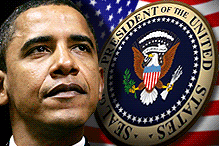 Now that Obama is the president-elect with real power being transferred to him faster than envisaged, how his new administration is going to navigate, or even impede, China’s involvement in Africa will be highly indicative of US policy directions in the next four years.
That Washington has suffered severe setbacks in Africa since 2000 is as plain as the disillusionment of the American public with the jingoistic Bush.
The White House’s overemphasis on the war on terror effectively sanctioned military action as an instrument to achieve foreign policy goals and has produced more foes than friends. As American influence was waning, much progress was being made and goodwill forged between Beijing and African countries.
Many American and European analysts of Africa watched in disbelief the phenomenal growth of Chinese influence among the Africans, but were feeling utterly helpless.
While I have never dismissed the gross human rights violations in Darfur, western Sudan, as fantasy, I am nevertheless of the view that the strong criticism targeted at the Chinese leadership over its cosy relationship with Sudanese president Omer al-Bashir has often been driven by anxiety and even fear on the part of western countries over a resurgent China seeking to “dominate” an important continent for energy needs.
In a move that was instructive of Beijing’s pro-active stance, Liu Guijin, the Chinese special envoy dispatched to Sudan, has been working his butt off to ensure a “soft landing” over the deepening crisis in Darfur, as judges from the International Criminal Court (ICC) are contemplating whether or not an arrest warrant should be issued against al-Bashir for genocide, war crimes and crime against humanity.
The Chinese effort has, for now, paid off. Two days ago, al-Bashir announced an immediate ceasefire and is now reportedly ready to disarm the militias which have been ravaging Darfur.
Ending genocide
The announcements are significant, as they came as a strong rebuff to a report by Richard Williamson, the US special envoy for Sudan, which condemned Khartoum’s objection to any peaceful solutions between the warring factions. Washington later broke off the bilateral talks on a peaceful settlement.
But to blame the pro-Khartoum Janjaweed for the mass killings is one-sided, for the intervention by the Ethiopian military intervention in Blue Nile state, eastern Sudan, Blue Nile, has also complicated the situation and resulted in massive waves of refugees.
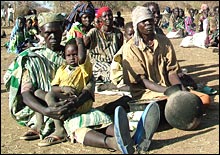 Early last year, the UN High Commissioner for Refugees launched a US$56.1 million appeal for its operations to help tens of thousands of southern Sudanese refugees and internally displaced people return home and reintegrate in their communities, with residents from Blue Nile being among the major recipients of this assistance.
I am not too sure if arresting al-Bashir alone would help Sudan out of the crisis, for a radical move as such could potentially hinder the humanitarian initiatives of UNHCR, the African Union and the UN African Union Mission in Darfur, and even lead to more international aid workers being attacked by extreme forces.
Moreover, it might serve as an impetus to a significant growth of separatist movements in Sudan, supported by other fanatics such as al-Qaeda and others. This is especially so when the US itself has been questioning the legitimacy of the ICC to conduct trials on American soldiers stationed abroad.
Any insensible interference will only create more antagonism between the negotiating parties, especially the central authorities and the rebel groups, and the localised conflict, too, could escalate into a full-scale civil war in Sudan, to the detriment of the general population.
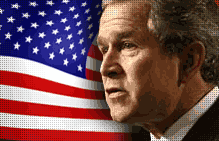 Given the stark failures of the Bush administration in other conflict zones, al-Bashir’s populist stance that sees western intervention as a colonial plan and an attempt to create another Iraq would go down well with much of the Muslim communities worldwide, again to the benefit of no-one but the radical forces in Sudan.
In this particular situation it will be quite reasonable for the Islamic world, represented by the Organisation for the Islamic Conference (OIC), to engage in the further negotiation process between Khartoum, Beijing and the West. Greater involvement by the OIC and the UN would also, to some extent, keep the tendencies by major powers to dominate the process at bay.
Knowing that he could not avoid the tricky issue of Darfur, Obama released a statement in April saying that only “decisive and concerted action” would end the genocide in western Sudan. It did signal his willingness to pursue a multilateral approach in resolving the Darfur crisis, but the proof of the pudding is in the eating.
It remains to be seen if Obama will make good of his promise on a more engaged and constructive role in Sudan.


Are you sure you want to delete this comment?
This action cannot be undone.