




Wheels set in motion
One can’t help but have a sneaking admiration for Prime Minister and Umno president Abdullah Ahmad Badawi for treading in territory none had dared to enter before.
Despite the great odds stacked against him and the abuse he had to endure, he has loosened executive control over the anti-corruption body and returned the judiciary to its original independent existence to win back public confidence. He has also attempted to overhaul the government's delivery system.
One can’t help but have a sneaking admiration for Prime Minister and Umno president Abdullah Ahmad Badawi for treading in territory none had dared to enter before.
Despite the great odds stacked against him and the abuse he had to endure, he has loosened executive control over the anti-corruption body and returned the judiciary to its original independent existence to win back public confidence. He has also attempted to overhaul the government's delivery system.
He comes from a state where the Malay population is not as large in other, except for Perlis - a decisive factor in Umno politics. It is also common knowledge that Abdullah is no match for Permatang Pauh MP and Pakatan adviser Anwar Ibrahim, where oratorical skill and charisma are concerned.
Also bear in mind that Abdullah has been marinated in the Alliance and the Barisan Nasional environment for 40-odd years. To emerge from that type of soaking to defy the odds is no small achievement.
Another major handicap he has faced is the gaping hole in our political culture - the freedom for a new captain to pick his own team. This must have been the heaviest ball-and-chain weighing down Abdullah’s attempts to achieve his targets.
Yet he has been drawing on his own strengths, which include bureaucratic experience as well pragmatism. His canniest move has been to swing public opinion to his side by making room for dissent after decades of tight control.
 Abdullah was alert enough to recognise the distinct signs of a changing environment in which information technology sets the agenda and shatters the monopoly on information exercised by autocratic governments.
Apparently his peers have paid little attention to this emerging phenomenon.
That there was resistance within the cabinet to his recent moves is not surprising, for these must have struck fear in the corridors of power both in the public and private sectors.
One huge albatross hanging round Umno's neck - which the party is trying to shake off - is the euphemistically termed ‘money politics’. The leadership itself has acknowledged that money politics is indeed corruption and this disease reportedly also infects other BN component parties.
Greed with its insatiable appetite is the mother and father of corruption. There's little doubt left that the demon has sunk its fangs bone-deep into the nation.
 Flashback to when former police chief Hanif Omar made a startling exposure in his column in
The Star
that, based on lifestyle alone, 40 percent of top police officers could be arrested on sight. Shortly after his comments, several high-level civil servants were charged with corruption.
Flashback to when former police chief Hanif Omar made a startling exposure in his column in
The Star
that, based on lifestyle alone, 40 percent of top police officers could be arrested on sight. Shortly after his comments, several high-level civil servants were charged with corruption.
So, the passage of the Malaysian Anti-Corruption Commission ( MACC ) Bill in Parliament is timely and will hopefully prove to be an effective purgative for the deadly disease. This could spell the beginning of the end for the patronage system, which has plagued the country.
Systemic failures
The latest depressing example of failure of the delivery system - which Abdullah had set out to cure - is that of Sultan Iskandar Customs, Immigration and Quarantine (CIQ) complex in Johor Baru.
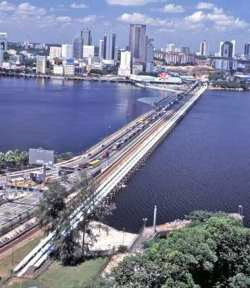 Commuters have described the daily torture of clearing Malaysian immigration, overcoming hurdles like going up and down escalators and then walking a considerable distance, before getting caught in an uncontrolled crush of people trying to re-board the buses.
As I recollect it, the purpose of the CIQ was to replace the British-built causeway (left) which had become too old to cope with the ever-increasing volume of traffic. After millions of ringgit being spent, we have a situation which appears to be far worse than the original problem.
The baffling aspect is whether a computer simulation of the glitches that might arise was ever run, as the design was taking shape. Obviously not, from what has been reported. The follow-up question would be - and why not?
The issue will fester and fan anger, as the economy raises stress levels. The people are becoming worn out with the seeming inability of politicians to come to grips with challenges facing the nation. The mood in the streets is most foul, reflecting the dark clouds above.
There's also another fear stalking the streets - that what little Abdullah has managed to roll out might be taken away when he departs the scene. It is apparent that a tug-of-war is being waged between the future and the past. Anything is possible in such an atmosphere.
However, my own feeling is that the worldwide economic crisis has undermined old ways of doing things. The circumstances demand a halt to continuing down the road to disaster - no country can afford to handle its resources in cavalier fashion.
It may not have sunk into politicians that the rakyat no longer cares about colour or ideology or rhetoric or even policy. What matters now are results. The campaign for the next general election commenced when the last polls results were announced.
History should judge Abdullah more kindly than his peers. For, he put the nation's welfare before his party's or his own. The wheels he has set in motion will continue to roll. The younger generation will see to that.


