




Old rivals, new rivalries
The killing spree of innocent civilians in Mumbai must be condemned by all civilized peoples. But what's more, every effort must be made by all states, including Muslim ones, and their institutions, to get rid of such groups.
The killing spree of innocent civilians in Mumbai must be condemned by all civilized peoples. But what’s more, every effort must be made by all states, including Muslim ones, and their institutions, to get rid of such groups. Just as the world stood as one with the United States after the 9/11 attacks there, and with Indonesia and Spain and Britain, the world must again stand together with India now. What’s scary is that, like the immediate post-9/11 days, the response to solidarity has been thinner this time around, principally from the world’s Muslim countries everywhere. Not that this comes as any surprise. After all, Indian and US relations have been creeping closer and closer since the collapse of the Soviet empire, with India now playing a role in the so-called ‘war on terror’ in Afghanistan, in provinces that straddle Pakistan’s terrorist-infested northwestern border regions.
 Although the US-led excursions into Iraq, under false pretense, and into Afghanistan, but under the right motivation, look increasingly like losing these battles against Islamic extremists, it’s clear that a new and formidable power has entered the fray. The problem is that this new power, India, will, potentially, face off yet again another regional power, Pakistan. So what? For starters, both these states are armed with nuclear weapons. For another, India and Pakistan have their variants of vermin. India has Hindu extremists, led by the so-called nationalists, the resurgent Bharatiya Janata Party (BJP). Pakistan has the Talibanized Islamists that rule provinces from the northwestern borderlands that buttress Afghanistan to the India-disputed Jammu and Kashmir that buttress India. That’s not all. The crooks in Pakistan, principally the all-powerful Inter-Intelligence Services (ISI), back these militant Islamists. Worse, the terrorists and the ISI are unhindered by the pitifully lame-duck regime of the newly-installed president, Asif Ali Zardari, who was jailed for seven years by ex-military dictator and president Pervez Musharraf, and whose wife, the ousted prime minister Benazir Bhutto, in her attempt to win power again, was murdered by Pakistani Islamic terrorists late last year.
Growing evidence of Pakistan's involvement
 And therein lies the inherent danger. British Prime Minister Gordon Brown, after having told his parliament that his economic policies in the face of the global financial crisis have just ‘saved the world’ - no doubt a Freudian slip - made a whirlwind visit to New Delhi and Islamabad in his latest bid to halt both sides from inching towards war. The visit came as Pakistan claimed Indian fighter jets had again made incursions into Pakistani sovereign territory. Whether true or not, it says an awful lot of the situation after the Mumbai attacks: both sides are at tenterhooks, and powerful elements in India want vengeance against what they consider is Pakistani state-sponsored terrorism, even if London and Washington would not quite call it such. It would not be the case if the BJP and Hindu fundamentalists use their terrorist tactics, including death threats, to intimidate ethnic and religious minorities in states like Rajasthan, Orissa and Gujarat.
There’s growing evidence, anecdotal and otherwise, of Pakistani involvement in the terrorist attacks in Mumbai. There’s growing evidence of Pakistani ISI’s hand in the terrorist-led murders. Most of the evidence seems to be coming from the sole terrorist who was captured alive, Ajmal Amir Kasab, who has asked the Pakistani embassy in Delhi for legal aid. It flies in the face of Zardari’s blatant denial that the terrorists were Pakistanis and indeed linked and trained by the Islamist Lashker-e-Taiba (LeT). LeT is a militant outfit with links to Al-Qaeda, the Taliban, and gets funding from regional Islamist groups from Asia to Africa, including Saudi Arabia and other Arabist Middle Eastern states. But Zardari, in his suddenly acquired infinite wisdom, not only denied LeT’s involvement but also the hand of his ISI in LeT in Jammu and Kashmir against India and in the Mumbai attacks.
In fact, writing an Op-Ed in The New York Times , Zardari attempted to distance his regime’s growing lack of control over the ISI and its secretive operations that harbour and succor the Al-Qaeda and Taliban-linked groups like LeT. Conveniently, he called them “non-state actors”. Zardari is only as good as his word, and his word is as lousy as he is: pathetic and weak, like his regime, and like the previous regimes of his late wife’s, Nawaz Shariff’s, Musharraf’s, he is useless at halting Pakistan’s descent into anarchy. Indeed, it is neither Iraq nor Afghanistan that are the epicenter of global Islamic terrorism but Pakistan. And unlike the US, India has been saying this, often loudly, and much to the ISI’s chagrin.
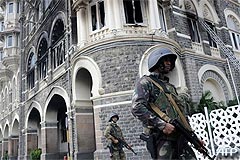 LeT, through its main sponsor ISI, has been spoiling for a fight with India for as long as Jammu and Kashmir was carved up between Pakistan and India. Both are no-go zones to tourists. What once used to boast as amongst the most beautiful tourist sites in the world, with an old-world charm, is now stands idle, an in infrastructural and environmental ruin. But Zardari isn’t helping the cause to avert war with India by his denials and flippant and contradictory remarks, including not handing over arrested LeT leaders to India for indictment, and, more recently - wait for it -the lack of evidence of support to LeT by ISI and, indeed, that ISI’s support of LeT and the Taliban were developed “in the old days when dictators used to run the country”.
Zardari is too afraid to deal with the ISI
Clearly, Zardari is too afraid to deal with the ISI, who calls all the political and geostrategic shots in an increasingly unruly Pakistan, despite Zardari’s claim that “democracy rules Pakistan.” Pigs might fly too. Zardari’s regime is a hopelessly weak one, hammered on one side by radical and militant Islamist groups, by old rival Nawaz Shariff and the highly factionalised military, led by the ISI. At the same time the Pakistan economy is collapsing around Zardari’s ankles, decimated by mountainous foreign debt spawned by chronic balance of payments crisis, drastically falling domestic and foreign investment and consumer spending that has all but halted. In mid November, the International Monetary Fund gave Pakistan a $US7.6 billion emergency loan. This comes on top of the decade-long $US 100 billion military and economic aid from Washington, which the Musharraf regime has either squandered or stolen.
Brown needn’t have worried about Pakistan and India going to war. With both states armed with nuclear medals, Islamabad and Delhi understand mutual deterrence well and have done everything to avoid a nuclear standoff at all costs. But that does not necessarily rule out lower-level conflict, perhaps in the Jammu and Kashmir region. But an all-out war won’t happen. What may happen is India waiting for the Zardari regime to wilt under the weight of its own hype and hubris. Delhi sees it as pointless in trying to deal with a miserably weak leader who isn’t completely in charge of the country and who has a penchant for making contradictory policies, often on the run. It further destabilises Pakistan as much as the highly volatile South Asian region. Zardari knows he needs the ISI and the military on his side. As long as he gets a modicum of support from the ISI, his reign is protected, albeit temporarily. But the longer Pakistan descends into chaos, as Ahmed Rashid has detailed in his new book of the same title, the greater the possibility of yet another military coup and rule. To be sure, Zardari is living by a short hair’s breath.
But the Manmohan Singh Congress government is equally weak. It rules by dint of a loose coalition, and with the resurgence of Hindu fundamentalism through the BJP, it’s slack security against Islamic terrorist attacks has highlighted that India’s security agencies have long been asleep. In recent provincial elections, the BJP has suffered setbacks in Rajasthan, the state it has controlled. It’s a telling sign that people in that state have had enough of the Hindu fundamentalist, although the electoral backlash would have come more from the more decent-minded Hindus and certainly the ethnic and religious minorities who have long been marginalized and threatened with violence by the BJP. But Congress cannot yet break free from rickety coalitional support until it can be seen to deal far more effectively with national security, deal with Islamic terrorists, including rooting out their India-based cells, and secure the economy as it wobbles from the fallout of the global economic crisis. Until then, even Manmohan Singh would be shaking in his boots, but not as much as Zardari would be frantically sweating.


