




When in grief, cry hubris
There is a formulaic response that becomes standard in the face of a dire crisis. Most of the world’s so-called leaders have tried this at one time or another. It also applies to Malaysia. Remember Mahathir Mohammad’s outcry against the Jewish billionaire investor George Soros in the midst of the late 1990s Asian crisis?
There is a formulaic response that becomes standard in the face of a dire crisis. Most of the world’s so-called leaders have tried this at one time or another. It also applies to Malaysia. Remember Mahathir Mohammad’s outcry against the Jewish billionaire investor George Soros in the midst of the late 1990s Asian crisis?
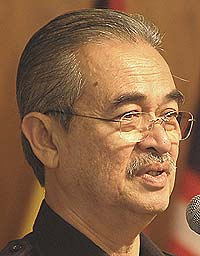
And so now there’s Ahmad Abdullah Badawi, the outgoing prime minister who’s scampering from national politics this month. The heat in the kitchen just got too much for him.
In Jakarta this week for the World Islamic Economic Forum (WIEF), leaving behind for just a while a sinking Malaysian economy that’s being battered right and left by the global economic crisis, Abdullah said it was the fault of "unbridled greed".
 Such catch-cries are standard — and predictable.
Australia’s prime minister Kevin Rudd has done the same thing. He blames "extreme capitalism", of the neo-liberal variety, for all the problems that the world now faces.
Yet, ideologically, and even pragmatically, just how Rudd’s economic (and political) policies are starkly different from those of his predecessor, the champion of neo-liberalism, former premier John Howard?
None whatsoever. It just seems to smack of hypocrisy. And Rudd is good at hypocritical bleatings, as he is at producing spin.
Now it’s Abdullah’s turn. There’s no Soros to blame this time around, though. All the same, there are scapegoats. And there is even more hypocrisy by Abdullah.
Here’s a sample of what he said at the WIEF in Jakarta. "We have inherited a system where people can trade what they do not own and the resulting inflationary pressure in the global market has caused immense damage to the economic well-being of the world’s poor."
But that’s not all that he said. "Such is the impact of unbridled greed in the financial system that there is no accountability on money lending. The world is beginning to appreciate the need for alternative financial arrangements."
Greed? Whose greed?
The first thing that’ll strike you is that this call is not dissimilar from his arch enemy and critic, Mahathir, his former boss who elevated Abdullah to his ministry and then installed him as his successor. And from day one Mahathir has poured scorn on Abdullah every step of the way. They’re as bad as each other.
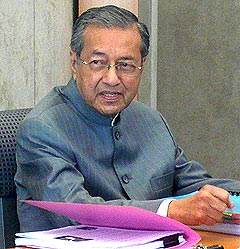 Notice one thing, though. Not once, either during the last Asian crisis or at any time during this one, did Mahathir question the ‘unbridled greed’ that has been rampant, and embedded, in Malaysia’s political economy.
But since Mahathir became prime minister in 1981 and quickly launched his privatisation campaign, more and more Malay, Chinese and some Indian cronies, with alleged links to those in power, became rich almost overnight.
With the government’s complete control of the mainstream media and given the sycophancy of their editors to their political masters, none of them would have the guts, or the moral decency, to raise questions of unbridled greed in Malaysia.
It’s all very well for Abdullah to preach in front of Muslim business people in faraway Jakarta — away from the poorer Malays, Chinese, Indian and others have to eke out a living to combat inflationary pressures.
They may not have ready access to the media, to hear their great leader say how this ‘unbridled greed’, rooted in Western society, has enlarged their suffering. And yet the regime has done precious little to lift them out of their abyss whilst it enriches its cronies.
Abdullah is arguably Malaysia’s worst prime minister. He has been Malaysia’s weakest link. Mahathir should have tossed him out on his ear a long time ago.
But Mahathir had chosen to play power politics then. He wanted power unto himself. Like the typical coward, like Malaysia’s best friend, Zimbabwe’s Robert Mugabe, he surrounded himself with ‘yes’ men and women.
Abdullah inherited this structural power from his predecessor. Only he weakened it, but not so weak that it gave opportunities to real democracy to bloom in Malaysia. Like Mahathir, Abdullah deceived Malaysians about the changes he said he would bring to post-Mahathir Malaysia. Nothing happened. Zilch. Nada. Kosong .
In fact, Malaysia turned backwards, politically. And nastier. And more and more racist by the day. Under Abdullah’s tutelage, Malaysia has continued to show the hypocrisy of the past that is embedded in the (re)configurations of 1946 and 1969.
In these last days of Abdullah’s premiership, should he be showered with accolades for a job done so incompetently? No. Obviously.
MANJIT BHATIA, an academician and writer, is also research director of AsiaRisk, a political, economic and risk analysis consultancy in Australia. He specialises in international economics and politics, with a focus on the Asia-Pacific.


Are you sure you want to delete this comment?
This action cannot be undone.