




Ka Ting: I will not interfere in new leadership
“I’ll not interfere in the new leadership. The political journey, the road ahead will be tough and party veterans can only give moral support to the party leadership as a whole and not to any individual leaders,” former MCA president Ong Ka Ting said at a formal farewell dinner given in his honour at Dewan San Choon, Wisma MCA in Kuala Lumpur last night.
“I’ll not interfere in the new leadership. The political journey, the road ahead will be tough and party veterans can only give moral support to the party leadership as a whole and not to any individual leaders,” former MCA president Ong Ka Ting said at a formal farewell dinner given in his honour at Dewan San Choon, Wisma MCA in Kuala Lumpur last night.
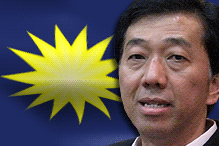 Ka Ting’s promise to Tee Keat’s leadership was a similar message the former president had received when he received the leadership baton from Ling Liong Sik in 2003.
That message was interpreted as significant, even likely to be treasured in view of the unsettling internal scenario within the party especially when the going gets tougher, a reminder of the relationship between the current president and his deputy Chua Soi Lek.
Some would even picture a comparison to Umno’s current scenario of a long retired party president who stubbornly keeps shoving his unwanted views against an incumbent Abdullah Ahmad Badawi leadership.
It was an evening worth remembering at the 1,000-people appreciation dinner hosted by president Ong Tee Keat and his central committee, and mainly attended by divisional chairmen, secretaries and youth and wanita leaders.
Offering words of advice, Ka Ting also said that the party rank and file must share the same vision and wavelength with the top leadership for any sort of reforms to be successful.
Failed to push for real reforms within MCA
The formal farewell dinner indeed marked the closing chapter in the party’s history of Ka Ting’s role as the seventh MCA president, a milestone punctuated with some lasting achievements but also some unforgettable and unsettling party happenings as he failed to push for real reforms within the party.
The March 8 political tsunami rocked the party leadership with accusations thrown against Ka Ting for the party’s failure. MCA only managed to capture 15 parliamentary and 31 state seats. This led to his voluntary stepping down as party president and he also declined to join the BN cabinet line-up under the Abdullah administration.
Among the legacy of Ka Ting’s rein as president are the niine-point plan programme, notably the life-long learning campaign and limiting the tenure of top leadership posts. But he achieved little success in his “xin ger” (changing mindsets) within the party in tandem with the Chinese community organisations.
But the serious spoiler of Ka Ting’s legacy included catch-phases like the “Ong-Ong dynasty”, (a criticism directed at the partnership with his brother Ka Chuan), and alleged undemocratic management of the party affairs.
His leadership image and integrity was undermined by controversial and unproven accusations of a “snoop squad” allegedly linked to him and which spies upon political rivals.
But the biggest blow to his leadership role was his opponents in MCA blaming him for the humiliating electoral defeat in the March 8 general elections. He was also blamed for wrongly selecting candidates and failing to actively voice the concerns of the Chinese community.
Despite putting in place a recovery plan for the MCA before its party’s October 2007 elections, political rivalry pushed through a “Save MCA Campaign” against Ka Ting’s leadership. However, he made a voluntary decision to step down to shoulder the electoral disaster and to appease the accumulating disquiet within the party’s rank and file.
Souvenirs for the party veterans
In 2008, Ka Ting stopped short of his maximum third term as party president when he decided not to re-contest the president’s post in the MCA elections in October last year and metaphorically urged the party to unite as he took away all the “old baggage” (grievances) along with him to his retirement.
Under those circumstances, Ong Tee Keat was elected as the 8th new president when he defeated his opponent Chua Jui Meng with 1,429 votes compared to the latter’s 917 votes.
It was a quiet appreciation dinner and with little surprises as many participants seemed more interested in exchanging news on the latest political events.
Souvenirs were also presented to party veterans in recognition of their past contributions. Among those presented with souvenirs were Chan Kong Choy, Fong Chan Onn, Ch’ng Toh Eng, Tang See Hang, Yew Teong Look, Beh Heng Seong and Wong Kam Hoong.
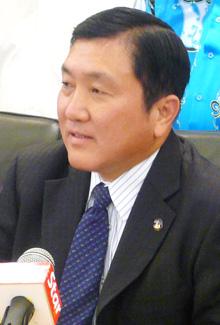 Ong Ka Chuan, a former secretary-general during Ka Ting’s tenure but currently holding the housing and local government ministerial portfolio was also presented a souvenir and joined the veterans at the stage.
There was little emotional display at the farewell dinner and the gathering was entertained with cultural performances and songs like “Shanghai Bund” and the “Power of Love” including a short stroll down memory lane through a slideshow presentation on Ka Ting’s leadership legacy from humble beginnings in the early 80s and on to his political climb to the highest level in the party and government posts.
But perhaps, Madam Chiang Kai-shek (popularly known as Soong May-Ling) best described a politician’s journey when she once said: “We live in the present, we dream the future and we learn eternal truths from the past.”
And the sad truth is, in most cases, politicians only learn the eternal truths (wisdom) only after their retirement (stepping down from the pinnacle of power).


Are you sure you want to delete this comment?
This action cannot be undone.