




'B-Day': Tests for Najib and Anwar
While Prime Minister Najib Abdul Razak has opted to attend the Formula One race in Sepang, his political future has been playing out on the ground in the three by-elections in places such as the Chinese fishing village of Sepetang.
While Prime Minister Najib Abdul Razak has opted to attend the Formula One race in Sepang, his political future has been playing out on the ground in the three by-elections in places such as the Chinese fishing village of Sepetang.
Collectively, these three contests will illustrate whether Najib and his newly elected team have the support of the Malaysian people. Surprisingly, and unlike the two earlier by-elections of Permatang Pauh and Kuala Terengganu, few of the Umno leaders and Najib himself have campaigned actively in these contests, purposefully lowering expectations in these outcomes and sending the signal that they are not confident to directly test their public support.
The results will tell whether this strategy of relative disengagement will yield a needed positive boost for the new PM or be a wash-out like yesterday’s Formula One.
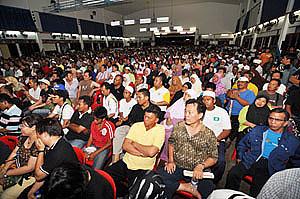 Taken together, the ‘B-Day’ contests are the type of constituencies that will determine the future of both BN and the opposition. These polls are in ethnically-mixed rural and semi-rural areas, in pre-March 2008 ‘safe areas’ that have moved toward the opposition. They are all now highly competitive ‘grey seats’.
They contain significant pluralities of voters from different ethnic communities – Malay, Indian, Chinese, and Iban – that will show whether BN and Pakatan Rakyat are meeting the expectations of different communities and achieving multi-ethnic cooperation.
Voters feel the pain of neglect
Each of these constituencies are also on the periphery of development, with high numbers of lower-class voters facing serious daily challenges for survival and limited gains from the largesse of funds that were supposed to be allocated to these communities.
Voters in these areas are feeling the pain of years of relative economic exclusion and a New Economic Policy that has not reached many of the targeted populations it was touted to reach.
From the fishing villages and estates to the longhouses, these areas have not been an integral part of Malaysia’s economic success. Concerns about land permeate each of these contests as voters in these semi-rural/rural areas that comprise the overwhelming majority of seats in Malaysia struggle with how they can maintain basic economic security on monthly incomes less than RM1,000.
 Yet, simultaneously – through March 2008 –these constituencies have been taken for granted politically by BN as victories were secured through dolling out electoral patronage and election-related development promises.
Up until last year’s tsunami, BN has managed to win over these areas by carrying out this election ritual of patronage politics faithfully. There is little substantive BN engagement with these areas that have been largely ignored in between elections.
The opposition also has a limited local presence. As historically secure areas for BN, the opposition grassroots and political organisation have not developed, and even today the opposition machinery in these areas is relatively weak.
Referendums with local flavour
As such, it is thus not a surprise that the ‘B-day’ polls will ultimately come down to how effectively party coalitions mobilise their supporters and win over the large number of “swing voters’.
Despite the plethora of independents (a record in a by-election in Bukit Selambau), these contests are face-offs between the BN and Pakatan, and proxies for an intensifying battle between Najib and Anwar.
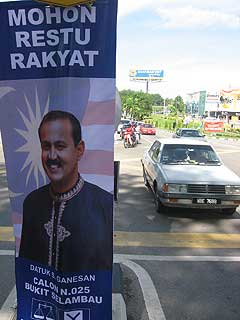 Given the national representativeness of these constituencies, make no mistake about it, the coalition which emerges as victor in at least two of these contests will have the potential to secure the majority in the next general elections.
Each contest has its local dynamics.
In Bukit Selambau, concerns over shrinking jobs in manufacturing/service sector, low commodity prices and land development predominate.
Most of the voters living in the constituency are older, but many of the younger ones have had the opportunities to study in nearby Penang or further through the sacrifices of their families. There is a clash of expectations occurring on the ground as older voters are being challenged by their children to demand more from the government.
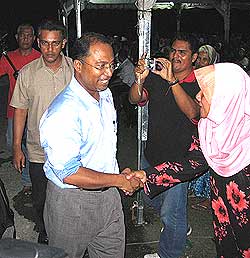 In Bukit Gantang, the Perak state government issue is center stage. With more BN banners of Zambry Abd Kadir (
right
) than local candidate Ismail Suffian, who is contesting against Mohd Nizar Jamaluddin, it is no surprise that the themes of ‘derhaka’, alleged ethnic bias in land allocation, ethnic betrayal, abuse of power and political instability resonate.
In Bukit Gantang, the Perak state government issue is center stage. With more BN banners of Zambry Abd Kadir (
right
) than local candidate Ismail Suffian, who is contesting against Mohd Nizar Jamaluddin, it is no surprise that the themes of ‘derhaka’, alleged ethnic bias in land allocation, ethnic betrayal, abuse of power and political instability resonate.
Of the three contests, Bukit Gantang is the most tied to national issues, as Najib’s and Anwar’s leadership records are intertwined with local interpretations of what occurred at the state level.
In the more remote seat of Batang Ai, land rights, personality politics and factionalism within the Iban community persist alongside long-term concerns about the tenure of Chief Minister Abdul Taib Mahmud.
The local is likely to matter more in this latter contest; this has been the pattern consistently in Sarawak elections due in part to geography as well as the strength of local parties dominated by strong personalities and personal infighting, especially in rural areas.
Test of multi-ethnic representation
These local issues pale, however, compared to the larger tests that both BN and Pakatan face. Foremost is the ability to these coalitions to meet expectations across races. All of these seats are mixed - even Batang Ai, which has a handful of Chinese voters, but ethnic divisions within the Iban.
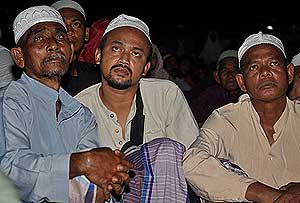 The viability of BN and Pakatan as multi-ethnic coalitions is being tested. Both will feel heat in their weaknesses to cross ethnic divides. The non-Malay parties within BN are weak, and they have lost Indian and Chinese voters in droves.
Among the Chinese, MCA managed to stem the tide in Kuala Terengganu, but their heads are on the chopping block this time round, especially in Bukit Gantang. Chinese support for the opposition will be an integral part of any victory and the level of support for the ‘bulan’ among the Chinese in these tight communities that never had the presence of green flags is very high.
 Among the Indians, it is a do-or-die contest for MIC chief S Samy Vellu in Bukit Selambau. While the man is likely to find another political reincarnation, a loss for MIC will only serve to reinforce the message of March for need greater attention to Indian issues.
Yesterday’s release of two Hindraf detainees has not ameliorated the injustice that the Indian community feels. Pakatan’s alternative, however, is not adequately strong to pull in new Indian voters enthusiastically since the candidate is a greenhorn and an alternative Indian leadership has not gelled.
Whether Indian voters respond to promises of MIC reform or inclusion in Pakatan will be played out in both Bukit Selambau and Bukit Gantang and be decisive in these competitive races. The reality is that BN is not yet seen to recover its multi-ethnic representativeness, and faces the disadvantage compared to Pakatan post-March 2008.
Test of electoral viability
Connected to the ability of the coalitions to reach across communities is whether the component parties within the coalition are individually viable as a coalition. The opposition faces this head-on.
The open campaigning of DAP for PAS and vice versa is a marked departure from the past, even from the by-elections post-March. The level of opposition platform sharing is high and reflects a consolidation of Pakatan between its extremes.
 It is risky, however. A loss for Pakatan – particularly in Bukit Gantang – will devastate the collaboration among the opposition, and potentially splinter the opposition. It will provide fodder for those within the opposition who are resistant to cooperation across races and parties.
The divisions among the opposition especially remain an obstacle in Sarawak, where infighting continues within individual parties and in the opposition as a whole. Cooperation spills over into effective campaigning and has hampered dynamics on the ground in Batang Ai.
Long term, the opposition’s future will rest of whether it is seen as able to effectively work together. Malaysians want leaders who can compromise and move beyond petty differences to address real concerns for voters.
Test of credibility
Viability is tied to credibility. BN had a real credibility gap in March 2008 as voters rejected the unfulfilled promises of reform.
Najib continues to face a credibility challenge. Although he has asked for time to deliver, he is being tested just days into office. The timing is unfair, but ultimately it was BN which decided the timing of these polls.
 BN and Najib cannot escape from the problems of trust that have deepened. The concerns about Najib’s leadership run deep among opposition supporters and many fence sitters. While Najib is likely to win back many traditional core supporters of Umno as he builds an image (notably using Mahathir Mohamad) of a stronger, more decisive party, he will have to address the suspicions, disappointments and allegations that have permeated public discourse by Tuesday.
The credibility gap continues, and potentially will not give Najib the boost that he needs to win back a seat. Unlike Abdullah Ahmad Badawi when he assumed office, Najib will have to earn credibility, as he has not inherited a honeymoon. This has already spilled over into the campaigns, undermining the promises of BN.
Test of mobilisation
Given the difficulties of the terrain for both BN and opposition, the ultimate test will be how many supporters the respective parties bring to the polls.
Every vote will count. BN has a stronger campaign than in recent elections. For example, the BN’s campaign in Bukit Gantang has shown greater sophistication through is subtle ‘yellow’ messaging on the issue of the role and relationship to the sultan and newly packaged messages of unity and stability.
While their poster’s call of ‘62 years of unity’ harps back to when Umno (not the Alliance, the precursor to BN) was formed - there is innovation in the messaging.
 The same is not quite true elsewhere, as campaigning is more traditionally tied to “promises” and money. These techniques have worked more effectively in rural areas, however. The main new dynamic is Najib’s ascendency to the premiership. As such, BN has framed this contest, making the opposition respond to the issues they have laid out, rather than the other way round.
Essentially, given the previous opposition attacks on Najib in previous contests, the opposition has not offered anything new, relying on the messages of last March. Essentially, they are calling for a protest vote, a negative vote against the BN.
Given this reality, the question is whether either side will be able to bring voters to the polls in high numbers. The fact that the elections are on a working day, a Tuesday, in areas where there is a large share of voters outside of the constituency, this issue of mobilisation may prove decisive.
The side that will bring more of their core supporters out and win over the large share of fence sitters will emerge victorious. Voters turnout will be crucial.
Final upshot
All of the contests are competitive as the close margins in March last year showed. The ground has shifted since March as new players have taken leadership positions, and the economic climate has changed.
Both BN and Pakatan are relying on their records and honed techniques of mobilisation to win them victories. When the votes are counted, Najib is likely not to have received the mandate he desperately needs.
There will be shifts in voting – among different ethnic communities in particular – but, as it looks from the ground, not likely enough to fundamentally alter the reality that existed before Najib took office.
 DR BRIDGET WELSH is associate professor in Southeast Asian studies at John Hopkins University-SAIS, Washington DC. She is in Bukit Gantang and Bukit Selambau to observe the by-elections.


Are you sure you want to delete this comment?
This action cannot be undone.