




The Tiananmen challenge
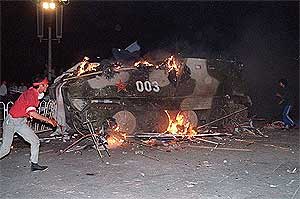
Few days ago, I received a SMS that urged people to wear white on the 20th anniversary of the Tiananmen Massacre, which fell on yesterday. I was keen to, really.
But I knew I had to wear black also to continue to protest the rape of democracy by Barisan Nasional (BN) in Perak four months ago. As a compromise, I ended up wearing white during the day and changing into black before dusk.
Few days ago, I received a SMS that urged people to wear white on the 20th anniversary of the Tiananmen Massacre, which fell on yesterday. I was keen to, really.
But I knew I had to wear black also to continue to protest the rape of democracy by Barisan Nasional (BN) in Perak four months ago. As a compromise, I ended up wearing white during the day and changing into black before dusk.
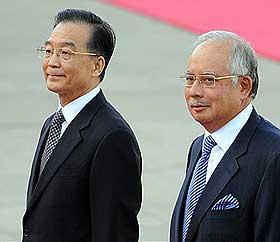 Prime Minister Najib Abdul Razak is currently in Beijing, greeted by the Chinese leadership that continues to ensure the 1989 bloody crackdown on the bare-handed students remain a taboo in society. Two decades on, the entire nation of China has succumbed to a severe memory loss following the state-enforced erasure.
Najib must surely be aware of the significance of the incident, but he, as all other pragmatic leaders rushing to pay homage to the ruling elite in China, will not utter a word on the highly sensitive issue. After all, our prime minister, beset with a host of scandals himself, is ill at ease whenever the issues of the Perak coup, Altantunya and the May 13 race riot are raised at home or internationally.
So both sides are silent on each other's problems: you scratch my back and I scratch yours for the sake of the so-called Third World solidarity.
Authoritarians prefer historical amnesia
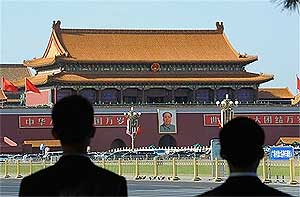 Openly, the Chinese leaders praise the friendship of the two countries, yet they must be wondering how BN as a hegemonic coalition could have surrendered nearly half of the electorate to the opposition front in the general election last year, and quietly contemplating the future of the ruling Chinese Communist Party (CCP).
Najib also would like all questions related to Chin Peng banned while he is in China, the country that once sheltered the general secretary of the Communist Party of Malaya, and the Beijing government knows it is best to look beyond this most awkward chapter of the bilateral relations.
Most authoritarian regimes prefer historical amnesia to rational discourse when it comes to state violence, for they know what they did was wrong even if they believe it was right. Hence, the Chinese leadership chose marketisation over the failed collectivism to expand the Chinese economy. When people see their purchasing power grow, they forget the days of scarce resources and material dearth, lending greater legitimacy to the ruling elite.
Or so they hope.
 In defending the Tiananmen massacre, some argue vigorously that "the Western model of democracy is not suitable for China". Ma Yingjeou said the same thing in 1986 when Taiwan was ruled by Kuomintang dictatorship. Today, he is the democratically elected president of the island state. Since the Beijing leadership insists Taiwan is part of China, how on earth the people there enjoy immense freedoms across the board?
 Another view holds that the crackdown has successfully prevented the country from descending into anarchy and thwarted a "Western agenda" to subvert communist rule, eventually bringing the economic prosperity of today. China is now a quasi-superpower and the end justifies the means. Period.
Maybe. But there is no direct causal link between the brutal suppression of the peaceful movement and the rise of China as a 21st century economic giant. Deng Xiaoping, the supreme leader, was dead against any reverse course against capitalism, and would press on with it at all costs. If anything, the massive protest only strengthened his will to ensure the success of the Chinese economy so that the benefit of the reform policy could trickle down to even the lowest rungs of society.
M'sians are easy to be persuaded
I am certain Najib shares the same sentiments with the Chinese leaders to a considerable extent. He too harbours hopes that things would start going his way once he has turned the Malaysian economy around. As the economy continues to expand, the forgetful Malaysians will be confident enough to vote BN again. The Perak debacle and the series of financial scandals such as the Port Klang Free Zone fiasco will become a distant memory by then.
But are the people still as docile and malleable as in the 1990s, an era characterised by the stock market frenzy and skyrocketing property prices? I am yet to be convinced.
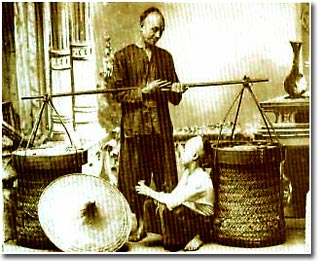 Despite the effort by the Chinese press in this country to highlight Najib's visit to China, the majority of the Chinese Malaysians are more interested to know why granting JPA scholarships in a fair manner is still a challenge, and why many gigantic constructions seem to be made of clay. China is no longer a myth that aroused endless curiosity as it was 30 years ago, and Malaysia is no more a country where information was exclusive to the ruling elite as was the case when Abdul Razak was prime minister.
While it is undeniable that China has made huge and impressive economic progress since 1989, all this is achieved at the expense of civil liberties and healthy social development. The sophisticated urbanites have indeed seen a tremendous increase in their material wealth, and many can now enjoy modern lifestyle on pars with the elites in Greenwich Village of New York or Notting Hill of London, these "benefits" are indeed beyond the reach of the majority of the Chinese population.
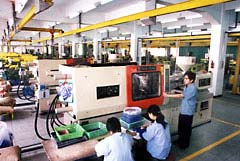 Two changes have emerged in post-Tiananmen China: first, the country now has a distorted model of reform that emphasises solely on economic growth. Given the extremely low level of welfare protection, it has engendered a symbiotic relationship between the ruling party and the social elite. The monopolisation of wealth is perhaps the most serious since the 1930s when the corrupt Kuomintang was dominant.
Second, China has witnessed a phenomenal rise in social conflict not only in the rural areas, but in the urban centres also. In the countryside, peasants often clash with riot police in an attempt to safeguard their right to the land, while unregistered migrant workers in the cities sometimes go all out to make their grouses heard, including torching municipal offices and other state agencies. All this development forces the Chinese leadership to ponder how best to yet again represent the interests of the peasants and the working class.
Perhaps the most significant development is the emergence of a civil rights movement since 2003, as more and more middle-class and well-educated Chinese nationals begin to challenge the state ideology and question the conducts of the CCP, culminating in the 2008 Charter, inspired by Vaclav Havel, leader of Charter 77 who went on to become the first democratically elected president of the then Czechoslovakia.
The number of Chinese lawyers willing to take up the causes of the downtrodden and the marginalised groups is also on the rise, indicating a paradigm shift in the understanding of Chinese politics.
The once stifled academia is also slowly coming to life. Early last month, a group of prominent scholars, including neo-liberal Qin Hui and humanist Qian Liqun, gathered in Beijing to discuss the implications of June 4 for China's future.
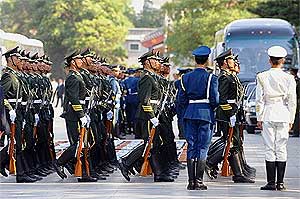 They also agree no human lives should be sacrificed in the pursuit of economic development, openly rebuking the pervasive view that the bloodshed at Tiananmen restored stability in the country. That the contents of the meeting are finding their ways to break through the state-imposed censorship and reaching target audience is clearly instructive of a society that is hungry for more truths and alternative information. From ghost, Tiananmen has transformed into spiritual nourishment for them, and the blood that was shed on that fateful night of June 4 has not been in vain indeed.
As Najib and the Chinese leaders bid goodbye, their minds are preoccupied with the growing demand for democratic change both in Malaysia and China. This is a formidable challenge as it can influence how history will judge them.
The two governments will do well to remember real economic prosperity and genuine harmony must not be buttressed by state intimidation, or the illusive peace is nothing but a lull before a violent and destructive storm.


Are you sure you want to delete this comment?
This action cannot be undone.