




Pakatan's future in wake of PAS muktamar
One thing is certain - the dynamics in PAS will shape the future of the Pakatan Rakyat opposition. The negative spillover from its 55th muktamar is already occurring as the component parties are demanding apologies and clarifications.
Some worry that this is the beginning of the end of Pakatan, paralleling the 2001 rise of the Terengganu faction in PAS which led to the end of the Barisan Alternatif. Last week’s muktamar has opened old wounds and fed insecurities, and has served to bring to the fore underlying weaknesses in Pakatan that will need to be addressed before the opposition is to move forward.
It is too early to predict collateral damage, but unless the weaknesses are addressed, the opposition will undercut itself and in the process irrevocably alienate a generation of voters.
One thing is certain - the dynamics in PAS will shape the future of the Pakatan Rakyat opposition. The negative spillover from its 55th muktamar is already occurring as the component parties are demanding apologies and clarifications.
Some worry that this is the beginning of the end of Pakatan, paralleling the 2001 rise of the Terengganu faction in PAS which led to the end of the Barisan Alternatif. Last week’s muktamar has opened old wounds and fed insecurities, and has served to bring to the fore underlying weaknesses in Pakatan that will need to be addressed before the opposition is to move forward.
It is too early to predict collateral damage, but unless the weaknesses are addressed, the opposition will undercut itself and in the process irrevocably alienate a generation of voters.
 My earlier pieces (see
part 1
and
part 2
) have highlighted the diversity in PAS and underlying obstacles the party faces in reaching its national aspirations. One critical element has been missing from the discussion – opposition cooperation. This needed a separate article.
My earlier pieces (see
part 1
and
part 2
) have highlighted the diversity in PAS and underlying obstacles the party faces in reaching its national aspirations. One critical element has been missing from the discussion – opposition cooperation. This needed a separate article.
It has been the major point of contention before and after the muktamar and ultimately will shape whether Najib Abdul Razak will face competitive polls or a walkover in the next general election.
The proponents for and against opposition cooperation in PAS are not easily lumped into camps, since their motivations and outlooks differ. While the pro-Pakatan Erdogans have more coherence, those against consist both ulama and professionals.
Reading PAS tea leaves
There are actually three decisive groups in PAS on the issue of Pakatan cooperation:
- Core Erdogans - They advocate strong cooperation based on the recognition that national power cannot be attained by the opposition without this cooperation and a shared emphasis on social justice issues.
- PAS go it alone - They oppose cooperation. Based on underlying suspicion of Anwar Ibrahim – shaped in the late 1970s – this group is unwilling to have him as prime minister and as the leader of the opposition. They prefer a more ‘pure’ position that protects the party and allows for PAS to articulate an Islamic state (also undefined), and want one of their own in the leadership position.
- Unity umbrella - They want a different type of cooperation. They are willing to engage in talks for national unity. They are implicitly talking about the unity of the Malay community, which is divided and they believe is weaker vis-à-vis the non-Malays. Some within this group believe that the unity is with all parties in Malaysia and they vary in their acceptance of Umno as a player.
The assumption is that PAS will lead the talks and gain a position of power – it will become the national leader – and with the majority of Malays behind them, be in a position to introduce some form of Islamic governance, not yet defined.
This simplification of positions perhaps overstates, but captures the extremes. Real positions are actually more fluid and complex. The motivations vary in each group, with some tied to base desire for political power, while others are more concerned with articulating their ideas.
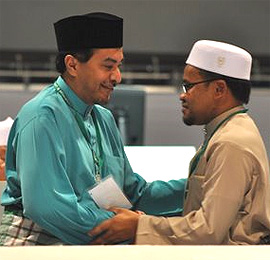 At the 55th muktamar, these fluid positions boiled down to a fight against the Erdogans, led by spiritual leader Niz Aziz Nik Mat, his protege Husam Musa and others in Kelantan, and the anti-Erdogans under the umbrella of president Abdul Hadi Awang, the leader of the Terengganu group.
Deputy president Nasharuddin Mat Isa, although he is close to the Terengganu faction and clearly a player in engaging in the ‘unity’ talks, appears to bridge positions, perhaps in part since his own position is not that clear.
The deputy presidency contest in part played out over this divide.
Post-party election confused signals
Immediately after the party polls, victorious PAS leaders touted their positions, believing mistakenly that their ideas were legitimised in the contests. The subsequent commentaries from the leaders appear more about pride than clarity of position. The end result is that the 55th muktamar has sent mixed signals to its component partners in Pakatan and muddied the waters politically.
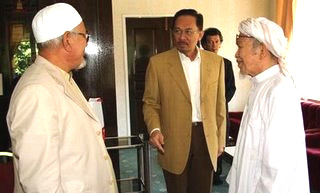
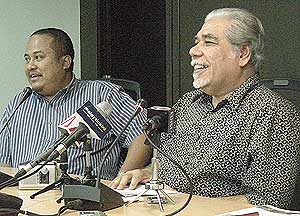 As yet, PAS itself does not have a clear position on its relationship with Pakatan or any ‘unity’ talks. Today’s call by Terengganu chief Mustafa Ali (
right in photo
)
to end comments
on such talks is indicative of how much harm the post-party elections remarks have caused.
As yet, PAS itself does not have a clear position on its relationship with Pakatan or any ‘unity’ talks. Today’s call by Terengganu chief Mustafa Ali (
right in photo
)
to end comments
on such talks is indicative of how much harm the post-party elections remarks have caused.
These confused signals reflect the ongoing divisions within the leadership, not the rank and file of the party. The problems are very much at the leadership level as conflict has deepened not ebbed, and comments since the party polls have added to differences between personalities.
It is a mistake to assume that the PAS party polls “resolved” the conflict, and that a “silence” on the matter will make it go away. PAS needs to get its house in order.
In the short-term, this will mean that PAS will be focused inwardly in resolving its differences, rather than focusing on building the opposition as a whole. Until the issue of cooperation is clarified, anxiety within the opposition will build.
As Umno Youth chief Khairy Jamaluddin’s comments suggest, Umno will likely fan these divisions to undercut PAS internally and the opposition as a whole.
Delegates message much clearer
The muktamar delegates did, however, send some important consistent messages from the floor. First, the delegates did not want talks with Umno. This theme was repetitively articulated passionately from the floor with the most vocal support.
PAS delegates understand if the party moves towards Umno it will alienate their supporters and discredit them individually as delegates. PAS leaders have yet to fully comprehend that any move toward Umno will be seen as a betrayal of both the public - who voted for the opposition - and PAS members.
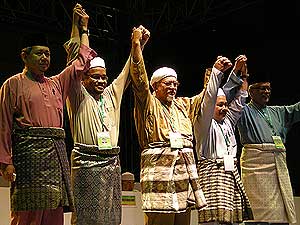 Second, the delegates elected checks and balances within the party. In choosing diversity, they expect PAS leaders to work out the solutions among themselves, rather than individual leaders spouting unresolved and unclear ‘unity’ positions.
Implicitly the delegates were sending the signal that the leadership of PAS needs to reflect not only the views of the delegates but its supporters at the polls. As many noted in one-on-one discussions, they felt that leaders who betray the public will be rejected.
The push from the floor to listen and respect not only the delegates and public was so strong that it evoked a call from deputy spiritual leader Haron Din for better respect and the need to “follow the leaders”.
The reality is that the PAS leadership has to be accountable to its members and voters or ultimately the party will split and lose support. PAS leaders still hold the respect of their members, but the issue of the ‘unity’ talks has the potential to rupture the loyalty of delegates irrevocably.
Lack of trust for Pakatan leaders
These delegate messages have yet to be fully appreciated by PAS leaders, but they are likely to gain traction as the dust settles from the muktamar. In this regard, it is important to dissect the causes of the different positions within PAS and its effect on opposition politics, to understand why the PAS leadership is not effectively listening to its members.
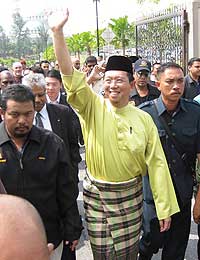 The first is political insecurity. Many PAS political leaders cannot accept a position as a secondary role. The anxiety is not just a product of PAS, but a failure of Pakatan to engender confidence and allow adequate inclusion for the Islamic party.
This dynamics is present most saliently in Penang and Selangor. The loss of Perak has added to the insecurity.
The second is a lack of adequate trust among Pakatan actors. The reformasi generation leaders across Pakatan parties work well together, but despite one year on as an alliance, there is growing uncertainty about the position of different actors among many in the opposition.
Anwar traditionally has been the source of the lack of trust from PAS, but the Islamic party’s lack of faith extends to some leaders in the DAP as well. This issue of trust will become more important as a new election nears (and seat allocation begins). Cooperation cannot exist without trust, and the reaction to the muktamar shows how easily trust can break down.
A third factor is a lack of communication. While Pakatan leaders meet, the mechanism and form in which they meet remains largely ad hoc and narrow. Without an institutionalised routine for communication, misunderstandings and confusion will reign. Ironically, at the state levels and in individual grassroots communities, there is better Pakatan communication than at the leadership level.
 Part of this is the fact that personal interests and personality differences remain a serious obstacle for cooperation.
Many PAS (and non-PAS) leaders are seen to be pushing for individual power rather than the interests of their party or the opposition as a whole, and this has taken a life of its own resulting in personal conflicts and quiet character assassination. Some leaders in PAS refuse to meet their opposition colleagues and this is reciprocated.
Another underlying reason that PAS sends confusing directions toward the opposition is a lack of a clear policy platform for Pakatan. The agenda of March 2008 has not evolved into a substantive policy programme. Beyond this deficit is a lack of inclusion in policy discussion. PAS does not see clearly itself within the platform for the opposition beyond abstract issues such as ‘change’ or issues of social behaviour that splits rather than unites opposition actors.
Sadly, PAS is not offering substantive measures that can bridge the opposition or measures that appeal to the public at large. Its national policy inputs appear limited.
Consider PAS’ economic agenda presented at the muktamar that called for the Gold Standard and did not provide any clear direction for governance. Investors will not come to Malaysia without confidence that the opposition can manage the economy. The 55th muktamar did little to evoke this confidence.
Ethnic insecurities remain strong
Among the factors underlying the issue of cooperation, one stands out as the most troubling - the continued persistence of ethnic insecurity.
The effective use of Malay rights by Umno post-March 2008 has set in and it is thus not a surprise that from the floor, PAS delegates called for restoring the New Economic Policy and defending ‘bumiputera’ positions.
Without an anchor in a common opposition platform that addresses the concerns of Malays, while simultaneously addressing the interests of non-Malays, the ethnic lens of Malaysian politics will reemerge and has done so.
It feeds into the ‘unity’ talks. None of the communities feel fully secure in Pakatan, as the debate over language and affirmative action in the PAS meeting shows. This places a difficult burden on the opposition to translate ‘change’ into something concrete that its component parties – and the public – can connect with.
The 55th muktamar brought to attention some of the struggles the opposition faces in outlining its direction. With PAS attention focused inward, and opposition efforts to rebuild cooperation, the relationship between Pakatan and the public will not be strengthened in the short term.
Pakatan faces challenges ahead as it regroups and reassesses. Opposition politics in Malaysia has never been a linear process. The PAS 55th Muktamar is a swing in the direction of opposition weakening, at least in the short term.
Whether Pakatan can emerge stronger from the setbacks as it did post-Barisan Alternatif or whether Umno can capitalise on this period of weakness will depend on the leaders in the opposition to lead.
Part 1 - Change for PAS or PAS for change?
Part 2 - Islamic party's bold national ambitions
Part 3 - Pakatan's future in wake of PAS muktamar
DR BRIDGET WELSH is associate professor in Southeast Asian studies at John Hopkins University-SAIS, Washington DC. She was an observer at the PAS muktamar. The article above is the final of a three-part series.


Are you sure you want to delete this comment?
This action cannot be undone.