




An abattoir of opportunities
comment How Pakatan Rakyat resolves its latest ‘crisis' in Kedah will be interesting. PR is reminiscent of many similar political coalitions of its age.
How Pakatan Rakyat resolves its latest ‘crisis' in Kedah will be interesting. PR is reminiscent of many similar political coalitions of its age.
A little more than a year old, PR still has alot of issues to resolve before it can move forward to being an alternative to the BN.
As things stand now, even if it does come to power in the next general election, PR would have won because the people rejected the BN and not because it represents a better option.
This means the BN may still have a chance if PR continues to trip over themselves.
 Umno, which is the dominant party in the BN, hopes to win back popular support by dismantling some of the affirmative action policies.
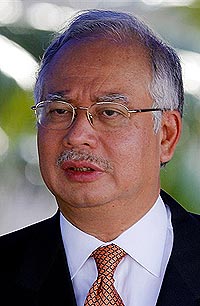
Najib Razak (right) has nothing to lose.
If he cannot win back the support of Malaysia's ethnic minorities and a more substantial share of the young Malay vote, BN's chances of ruling effectively in Peninsular Malaysia will be severely compromised.
The fracas between Umno Youth and PR over the registration of voters in Malacca recently demonstrates clearly the unease some Umno members feel about the rising popularity of the Opposition.
Particularly galling is the sight of DAP and PAS working hand-in-hand. Coincidentally, many years ago, it was such close Umno-MCA cooperation that won the many elections in the 1950s.
More cohesion needed in BN
The BN, which was a post-1969 coalition, needs to be more cohesive internally if it is going to move forward as a political entity; the more cohesive a coalition, the stronger its ability to organise and exert influence.
But there is a reason why BN did not evolve into a more equitable coalition. In fact, what PR is experiencing as it becomes a coalition of equals, the BN has decided not to put on the agenda.
Its component parties, like PR's three political partners, have very different political ideologies.
BN has functioned well because Umno has been able to dominate with its overwhelming control over parliament, government coffers and the civil service.
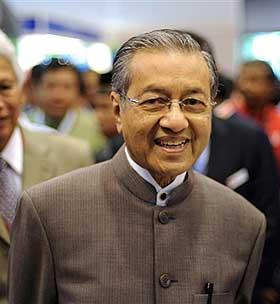 If one accepts the idea that we are an ethnic nation state, where the Malay ethnic group is the dominant and therefore defining the political force; then like Dr Mahathir
(left),
there is nothing wrong with the country.
If one accepts the idea that we are an ethnic nation state, where the Malay ethnic group is the dominant and therefore defining the political force; then like Dr Mahathir
(left),
there is nothing wrong with the country.
Ethnic-based division and control has worked remarkably well. There is really no need to liberalise the economy by dismantling the ethnic-based quota system. Partly this is true.
The current economic downturn can be attributed to larger global conditions, particularly the decline of Western financial systems.
Basically, to Dr Mahathir there is no systemic problem in the body politic. But the BN formula only works well when Umno can dominate and dictate policy. Today, Umno is but a shadow of its 2004 self.
This is not to suggest that it cannot come back. But to do so effectively, Umno must now widen its appeal beyond ethnicity and religion.
The complexity of Malaysian politics
That is precisely what Najib Razak is trying to do. If there is anyone who can reform the NEP policies, it is the son of Tun Razak.
The problem now is whether Najib can improve BN's cohesiveness without compromising Umno. He is hoping that 1Malaysia will be the clarion call to unite the nation.
To date, this policy has met with little enthusiasm. The PM now has to walk the talk or walk out of office in 2013. What has all this to do with the fragile PR coalition?
It demonstrates the complexity of Malaysian politics. If we are not a developed country, one of the reasons maybe because a substantial proportion of time is spent improving cohesiveness and political unity.
 That the PR is experiencing all this in Kedah
and has lost Perak is a good indicator that some form of political maturity will be reached eventually.
That the PR is experiencing all this in Kedah
and has lost Perak is a good indicator that some form of political maturity will be reached eventually.
For Malaysians who are feeling disheartened, they must remember that it took Britain about 600 years from Magna Carta to expanding the vote to all adult males.
The United States had to fight a bitter civil war to iron out its national identity. Similarly, France's birth as a republic was eclipsed by many monarchic resurrections.
Malaysia also has to deal with nationhood at a time of highly complex ideological wars, which were global and that continues to draw us in different directions.
In short, we may have to be a little bit more patient as this country finds its feet again after a political tsunami.
Whilst it would not be wise to draw conclusions about the abattoir issue (above) in Kedah, it is good that such things have come to light.
 The mainstream press is doing the Opposition a great service. It is shining the light at what will, in all likelihood, be an issue that will resolve itself.
As the Kedah government comes to grips with managing the state, its political leaders can now face up to the tasks at hand.
Just as Lim Guan Eng (left) in Penang is trying to solve problem after problem inherited from the previous state government, PR leadership in Kedah must resolve this matter without the need for PR component party leaders intervening.
Reduce cult of personality politics
More importantly, they must not just solve problems, they must not create new ones and demonstrate leadership for their states. To my mind, Selangor's Menteri Besar is the best performer in the leadership arena.
In the meantime, the battle-lines have been drawn for the next general election. Both coalitions know that they must build up meaningful intra-coalition collaborations and reduce the cult of personality-driven politics.
To some extent, Tun Abdullah Badawi (below) has shown the way. When he was PM, the tradition of the PM appearing all the time in the front-page of the newspaper finally came to an end.
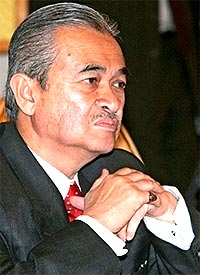 For the first time, Malaysians realised that we had ministers. This also added pressure on individual ministers to step up to the mark.
Najib Razak must put his ministers to the test. Similarly, Malaysians will expect the Opposition's massive shadow cabinet to do its job.
The last few by-elections are a clear indicator that Malaysians will not tolerate shallow opinions and bigoted politicians. Playing the race card in the BN may still make sense but in a non-sectarian coalition like the PR, it could potentially be fatal.
Malaysia, if Najib Razak has his way, is on the brink of a sea-change. Now, more than ever, we need all the talents looking into the difficult and complex issues of education, economy and environment.
It may be infinitely easier to walk on the cheaper-side of politics by championing narrow causes. But ultimately, it is the difficult route, the one less travelled by, that will make politicians into statesmen.
NEIL KHOR (PhD) (Cantab) is the co-author of Non-Sectarian Politics in Malaysia: The Case of Parti Gerakan Rakyat .


