




Sarawak media ignores pulse of a nation
The nationwide outburst of anguish and sadness following the death of Teoh Beng Hock has been largely ignored by the mainstream media in Sarawak.
The nationwide outburst of anguish and sadness following the death of Teoh Beng Hock has been largely ignored by the mainstream media in Sarawak.
Most rural folk in this enormous state rely on RTM Radio for news and a minority have access to RTM television.
Small towns, such as Kanowit or Song, receive newspapers by express boats plying the Rejang river.
People in far-flung towns like Limbang or Lawas get to read the news only in the afternoon after the post arrives by light Twin Otter aircraft.
A large number of Sarawakians may not have been aware of the rage sweeping the nation, unless they gleaned the Chinese press.
The paper with the largest circulation in English or Malay, the Borneo Post , covered the breaking news on July 17 with a small report buried at the bottom of page two, sourced from Bernama .
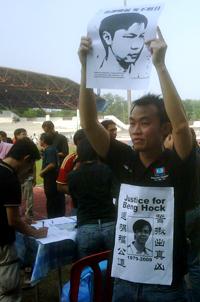 It gave a brief account of the discovery of Teoh's body, described as a 'fall'.
There was no mention of the swirling allegations of foul play, or of accusations of torture by Malaysian Anti-Corruption Commission (MACC) interrogators.
Pakatan Rakyat's denouncements of selective MACC persecution did not elicit any comment in the Sarawak media.
The following day's coverage of Teoh's death was dominated by reactions from the Prime Minister and Deputy Prime Minister.
Their calls for Malaysians not to over-react, and to wait for investigations by the authorities, barely made the inside pages.
Calls by Pakatan Rakyat leaders and Suhakam for a Royal Commission to investigate Teoh's death were given scant space.
Only one column in the Borneo Post , 'Saturday with Paul Sir', echoed the clamour in Malaysiakini, Star , the rest of the national press, and international news agencies for urgent answers to murky MACC dealings.
Sarawak press plays down Teoh's death
The Borneo Post is owned by KTS, a timber giant with close links to ruling Barisan Nasional component parties.
Another English language daily, the Eastern Times , is owned by Naim Cendera, a construction company chaired by the Chief Minister's first cousin, Hamid Sepawi.
A leading Chinese newspaper, Sin Chew Jit Poh , is owned by Rimbunan Hijau, another timber conglomerate with strong BN ties. Another large Chinese newspaper, See Hua Daily News , is also a KTS newspaper.
It is not surprising, then, that news and analysis of Teoh's premature death were played down in most of the Sarawak press.
At least the Sarawak slant given to the MACC role in Teoh's death has not been overtly racist, unlike the propaganda spewed out by the Berita Harian and Utusan Malaysia.
The Borneo Post 's Sunday edition headline on July 19, shortly after the discovery of Teoh's body, made no mention of Teoh at all.
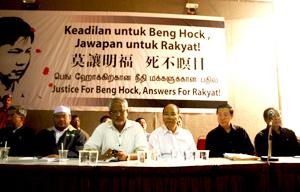 While the rest of Malaysia mourned and raged, the
Sunday Post
headline screamed that Naim Cendera was building a very large dam in Bengoh, using a particular type of concrete.
While the rest of Malaysia mourned and raged, the
Sunday Post
headline screamed that Naim Cendera was building a very large dam in Bengoh, using a particular type of concrete.
Among the full-page story's highlights was the information that Naim Cendera had enlisted a foreign engineer.
There was no mention, either, of the anger felt by Bengoh communities towards the mammoth dam displacing them from their Native Customary Right (NCR) land, or the financial improprieties surrounding the RM310 million dam.
The Sunday Post article also ignored the legal morass surrounding the quarrying work begun by Naim Cendera in the Bengoh area.
It disregarded ongoing demands by local villagers that the stone-blasting work should cease until the NCR land court case is settled.
The paucity of Sarawakian coverage of Teoh's death - a death that has moved and infuriated Malaysians - can be explained by a cavalier disregard for profits.
Damming the flow of information
These newspapers do not give a convincing impression of being run as proper businesses or as a service to society.The Sarawak newspapers are but a tiny part of a well-oiled corporate machine.
The conglomerates that own these newspapers would not mind losing money on these media ventures, as long as damming the flow of information remains feasible.
The national mainstream media, on the other hand, despite its subservience to BN parties, has been forced to provide prominent coverage of Teoh's premature death.
The national media could not ignore the tide of anger rising among Malaysians, because of injustice against Teoh, a fellow human being abused by state machinery.
Online news penetration in Sarawak remains low. Access of rural communities to the internet and the alternative media has been limited by poverty and lack of education.
Despite the explosion of Sarawakian political blogs, readership is far lower than in Peninsular Malaysia.
 Political time bombs such as Altantuya Shariibuu's murder, Kugan Ananthan's (
right
) death in police custody, the Perak constitutional putsch, the Port Klang Free Zone financial disaster, and now Teoh's brutal death, have been largely filtered out by the Sarawak mainstream media.
Political time bombs such as Altantuya Shariibuu's murder, Kugan Ananthan's (
right
) death in police custody, the Perak constitutional putsch, the Port Klang Free Zone financial disaster, and now Teoh's brutal death, have been largely filtered out by the Sarawak mainstream media.
There are those who hope that Teoh's mistreatment at the hands of the MACC will spur political awakening throughout Malaysia, including Sarawak, a vital swing state in the next parliamentary elections.
Pakatan Rakyat hopes the awareness of Malaysia's repulsive political governance may lead to Sarawak voters supporting a two-party system.
However, poverty and inequality of access to information, among most Sarawakians, will ensure that hotly disputed national issues are not widely broadcast, particularly in rural Sarawak.
The old adage that ‘ignorance is bliss' may be false. But it is undeniable that large parts of Sarawak have been spared the misery of watching Teoh's family and fiancée grieve.


Are you sure you want to delete this comment?
This action cannot be undone.