




Ong's political 'kamikaze' attack
Comment Realpolitik can be emotionally cannibalising for the faint-hearted but any politician worth his salt knows that there is life yet beyond, despite being sacked from his political party.
Realpolitik can be emotionally cannibalising for the faint-hearted but any politician worth his salt knows that there is life yet beyond, despite being sacked from his political party.
The maxim , a human dies once but a politician dies many more times, seems to hold true in the case of former MCA deputy president Chua Soi Lek.
And for those who think politics can dispense natural justice, it can be an excruciating bitter experience without realising that an organised minority can behave like a political majority.
Particularly when a legitimately elected top-ranking leader popularly voted in by a majority of more than 1,000 party's central delegates can be expelled unceremoniously by a minority of less than 20 party officials based upon a recommendation forwarded by an even smaller minority of only five appointees.
 This is modern day democracy in a society still slumbering in a tribal political environment when the might of power often rules over reason and logic.
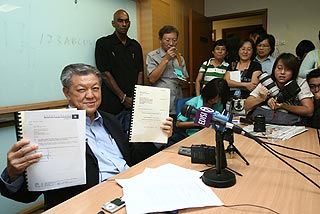
Chua waw expelled on the night of Aug 26 by his party's presidential council, endorsing a recommendation by the disciplinary board committee.
The charge against Chua for tarnishing the party's image was over a sex DVD scandal which took place more than a year ago and despite the fact that Simpang Renggam divisional chairman Eng Cheng Guan had withdrawn his complaint against Chua.
The expulsion of Chua grabbed national attention on the news headlines the morning after, momentarily overshadowing the spotlight on Teoh Beng Hock's controversial death while under MACC's investigation.
But up to this point, Chua's political expulsion has raised more pertinent questions over evasive answers. Can a minority of individuals punish a duly elected leader proven to have been forgiven, reflected by the voting support given to him by MCA central delegates despite them knowing the full background of Chua's controversy incident?
As for president Ong Tee Keat, he has not only created another infamous history by sacking Chua, the whole episode has triggered a "rethinking" process among party members on Chua's punishment under rather unusual circumstances.
Besides widely viewed as a 'politically kamikaze attack', Ong has ushered into the party's doorsteps a whirlwind of an internal "hurricane" which is fast developing into another political tsunami.
Tyrannical power brokers
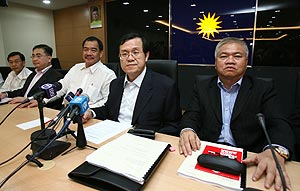
"This evening, after much deliberation, the presidential council has collectively made a decision to accept the disciplinary board's recommendation to expel Datuk Seri Dr Chua Soi Lek from the party, with immediate effect," the statement said.
In the face of it, the interpretation of this drastic move is even more ironic and contradictory when the party leadership under Ong has promised a more democratic process by introducing direct elections of the top leaders from branch levels.
Does the move to expel Chua reflect the democratic principles when a minority of tyrannical power brokers can overturn the decision of the party's annual assembly central delegates, paradoxically regarded as the highest decision making body in the party?
Was the powers delegated to the executive branch of the party by the highest decision-making body been fairly and judiciously executed?
What if the punishment or the circumstances leading to the disciplinary actions were unjust and unreasonable?
Unfortunately under present circumstances, any aggrieved member or office bearer who has been unjustly expelled is not allowed to institute any proceedings in any court of law.
 The contradiction is compelling particularly in a political landscape when civil organisations are promoting more democratic principles as part of their timetable and yet, some party organisations are contentedly basking in their tribal politics.
The presidential statement continued, "We did so with a heavy heart after giving much consideration to the damage inflicted upon the party image brought about by his sex scandal featured in the DVD. This decision has been made in the best interest of the party."
Hypothetically, what if the president can exert undue political influence upon the disciplinary board chairman to arrive or recommend an unjust decision?
The voices within the party are getting louder, questioning the current incumbent leadership whether this is the only ground for expelling Chua from the party or are there hidden motives based on unsubstantiated allegations?
A party central delegate from Perak raised this pertinent point, "by expelling Chua from his presidency post and from the party, will this move improve the party's image?
"Should the reasons established to the sacking be made public and transparent to dispel or avoid any misunderstanding that it was purely politically motivated akin to having removed a thorn in his (president's) flesh or as the Chinese idiom says, "wan rou yi chuang" which simply means "cutting the flesh to cure the boil."
On the other hand, if perceptions indeed are the basis of politics, what about the party's image affected by allegations currently stacked against Ong for having received RM10 million from CEO of Kuala Dimensi Sdn Bhd (KDSB) Tiong King Sing and using his private jets?
Is the president beyond reproach? The on-going crisis within the party will raise many more questions surrounding the high moral ground of those who had decided that Chua be expelled. Are they honest too? Who are the other top party leaders who had received donations from controversial donors?
"Wu feng bu qi lang," (there are no waves without wind), a party veteran quipped referring to other leaders alleged to have been involved in money politics during the 2008 party election as internal factionalism widen in the on-going crisis.
The truth will be exposed in the long run, as the Chinese idiom says, "shui luo shi chu."
Chua, following his expulsion, is now compared to a cat being given the keys to the dairy. The former deputy president has now a legitimate ground and a solid platform to address his expulsion, which his supporters had claimed to be "undemocratic and unjust."
The tipping point of this leadership crisis could reverse the political fortunes of Ong, the party's 8 th president with a motion of no confidence in his leadership.
Ong a failed leader
While Ong has majority support from his core leadership at the presidential council and central committee members, his detractors are claiming that there is little difficulty in petitioning for an Extraordinary General Meeting to reinstate Chua as deputy president and ejecting Ong from his presidency post.
Accusing Ong as a failed leader, lacking leadership skills in interpersonal relationship, political wisdom and incapable of bridging unity within the party may not be the main ammunition to the EGM resolution but certainly an effective material in voicing discontentment.
Compared to former president Ling Liong Sik despite facing stiff leadership challenges from his former deputies, namely Lee Kim Sai in the early 90s and much later, Lim Ah Lek, none of them, or factional leaders of Team B were expelled by Ling. But again Ling was by far a more matured, wise and diplomatic leader compared to Ong.
"If a leader fails to have compassion and unable to unite his followers, he is unfit to be the president," a party veteran lamented.
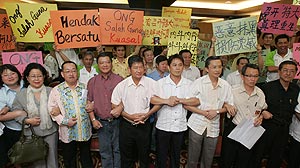 "Ong (Tee Keat) has not only plunged his party into controversy. The instability of MCA will bring no advantages to BN and the ruling coalition can ill-afford to be weak. It is already stricken with waning electoral popular support, having lost seven by-elections to the opposition Pakatan Rakyat coalition", a former state leader from Selangor added.
Meanwhile, Chua has downplayed his personal grief, despite claims of having been deliberately marginalised, victimised and criminalised by the Ong leadership.
"Today, it is not about Chua Soi Lek, neither it is about Ong Tee Keat. It is about MCA as the largest component party of BN still drifting without direction and purpose.
"It has been more than 16 months since the March 8 general election and 10 months since the last party election. But there has been little evidence of change (reforms in MCA)," said Chua.
"The MCA president outlined three main agenda for the party: Economic, politics and inter-racial harmony, but in reality, it appears that his (Ong) most important political agenda is to remove Chua Soi Lek," the former deputy president said in his statement released to the press on the night of his expulsion.
Will Chua be able to garner sufficient firepower to fight back what he deemed as a party deserving a better leadership?
Chua failed to listen to his own intuition in November last year when he confessed at a press interview, "I had doubts whether I would be accepted by the leadership. I had my reservations."
Would the political arrangements be any different had Chua acted upon it? Maybe he did, but still it takes two hands to clap.
As for Ong, a "feng shui" master once predicted that his presidency tenure may not last one term and only time will tell whether he will fulfil his own prophecy of doom.
To many other onlookers and non-partisan observers, the current internal crisis is nothing more than two politicians making waves with both claiming they are ones able to save the ship (MCA) from further sinking.


Are you sure you want to delete this comment?
This action cannot be undone.