




Penang Malay village wants heritage status fast tracked
Kampung Melayu Tanjung Tokong village residents, said to be among the oldest living indigenous enclave in the state, will step up their campaign to get their village declared a heritage site as well.
Kampung Melayu Tanjung Tokong village residents, said to be among the oldest living indigenous enclave in the state, will step up their campaign to get their village declared a heritage site as well.
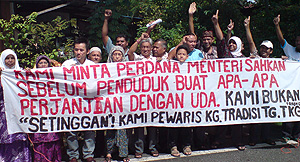
The Tanjung Tokong Villagers Association, a registered body with 500 members, has launched a nationwide signature campaign today to obtain support of Malaysians from all walks of life to back its demand.
The association aims to collect at least 3,000 signatures with help of many non-government organisations supporting the cause.
The association will also carry out a census of the village to ascertain the exact number of people who have the legitimate rights to claim any compensation if the traditional village were to be demolished by the developer , the Urban Development Authority (UDA).
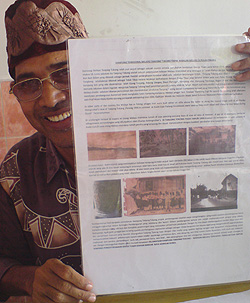 Association chairperson Mohd Salleh Yahaya (
right
) said its utmost priority is to preserve and conserve the village as a Malay heritage village.
Association chairperson Mohd Salleh Yahaya (
right
) said its utmost priority is to preserve and conserve the village as a Malay heritage village.
Since UDA had declared the villagers as squatters, he said the people as for now have lost all their rights over their own land.
"We have lost our rights even though we are the descendants of the original natives of Penang because of UDA's statutory declaration.
"The federal government must declare the village a Malay heritage for us to retain any of our legitimate rights over our traditional land," he said.
Kampung Buah Pala parallel
Referring to what had happened to the Indian traditional village - Kampung Buah Pala, and the happenings to his village he said that it seemed "the governments both at state and federal levels were not keen in protecting minority interests and rights in Penang."
He cited the recognition of a nearby Chinese fishing village - Bang Liau, and Chinese clan jetties in George Town as heritage sites to back his claim.
 "We can only restore and regain our rights by getting the federal government to declare the village as heritage living human cultural site," said Mohd Salleh when explaining to newsmen on the signature campaign.
After collecting the targeted signatures in a month's time, the association aims to handover a memorandum, enclosed with the signatures, and have a dialogue session with the Minister of Culture, Arts and Heritage Rais Yatim.
Kampung Melayu Tanjung Tokong stands on a 24-acre land with 300 houses, including 30 illegal structures without registration numbers, and about 6,000 residents,
According to a UDA census done in 2003, the village now has 1,026 families.
But the association secretary Abdul Wahab Sini Ibramsa said the list on UDA's report showed discrepancies with at least 500 house owners' names missing.
"We will carry out our own census with help from Universiti Sains Malaysia students to correct the list with the exact numbers of house owners and families in the village," he told the press conference.
One activist backing the villagers demand, Wazir Jahan Karim from the Academic of Socio-Economic Research and Analysis (Asera) finds it amusing that the authorities were keen to develop new artificial traditional villages to lure tourists when they could restructure, reorganise and refurbish the existing original villages.
Replacing tradition with artificial antiquity
"The authorities seem prefer to demolish existing ones and replace them with skyscrapers while building so-called traditional villages elsewhere for foreigners to stay," she said.
She stressed that Penang, Tioman, Langkawi and Pangkor have been suffering from such lopsided policy for years.
"Like Singapore, traditional villages in Malaysian islands have become endangered species due to high density urbanisation," she lamented.
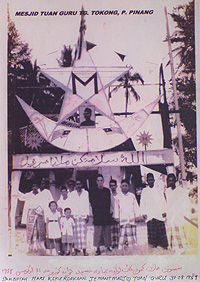
Historical facts say that Kampung Melayu Tanjuing Tokong is the oldest living Malay cultural village in the state.
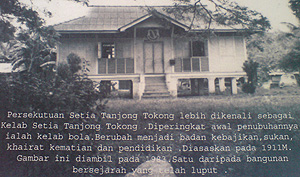 A book entitled 'Old Penang' claims that the village had existed for more than 200 years, long before the arrival of English captain, Sir Francis Light, in 1786.
However, in an affidavit submitted by the Urban Development Authority (UDA) in November last year, the government agency declared the villagers as 'squatters.'
The association has already submitted a letter on the matter to the Prime Minister's Office in May this year asking the federal government to declare the village a Malay living heritage.
However, Mohd Salleh claims that Prime Minister Najib Abdul Razak never replied to the letter.
He added that the current state government had told the association it was powerless to do anything about it.
The previous Barisan Nasional state government alienated and leased out the village land, encompassing about 64 acres (about 26ha) for 99 years to UDA in 1974 under a redevelopment policy.
Failure to implement policy
It was to create Malay settlements in George Town embarked by the late premier Abdul Razak , ironically Najib's father.
Several years ago, the previous state government had also leased out another nearby 54 acres of reclaimed land to UDA for development purposes.
 According to Mohd Salleh, under the policy, the village must be 'rehabilitated, reorganised and upgraded' to match current mainstream development in the city.
However, he said UDA failed to carry out any projects in line with its policy.
UDA instead built three phases of 650 unit low cost flats on a 40ha of land to relocate some villagers, who were not house owners.
The agency built another phase of medium cost apartments for the open market.
"All the reclaimed areas were used for profit-making housing and commercial projects in the open market," said Mohd Salleh.
He claimed that UDA planned to table a formal compensation offer this October to the villagers, promising to provide each family a flat in a future project.
"Since the state government is powerless, we want the federal government to intervene and declare the village as heritage.
"We want our rights over our traditional land," he said.
Quoting from Islamic law he said "Those who have been there before anyone else came to explore and develop the land, are the legitimate rightful owners of the land."


Report this comment
Are you sure you want to delete this comment?
This action cannot be undone.