




Penans fight uphill battle against being 'civilised'
"The Forestry officials came to our village. They asked us to persuade the Penan tana (nomadic Penan) not to hunt in the Pulong Tau National Park," said Rose, the influential daughter of Tua Kampung Melai Naa, the village chief in Ba'Tik, Sarawak.
ANTIDOTE "The Forestry officials came to our village. They asked us to persuade the Penan tana (nomadic Penan) not to hunt in the Pulong Tau National Park," said Rose, the influential daughter of Tua Kampung Melai Naa, the village chief in Ba'Tik, Sarawak.
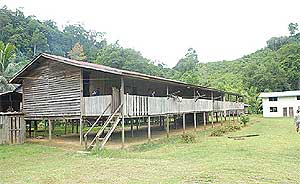 "We explained to the Forestry officials that we cannot tell the Penan tana not to hunt in the forest in the National park," Rose explained, "because the Penan have been using the forest here for many generations.
Rose is an intelligent, articulate Penan woman. She provides free informal pre-school teaching to children from the small village of Ba'Tik A and Ba'Tik B, two adjacent Penan communities of some 30 families each.
"The Forestry officers came to Ba'Tik to discuss the national park with us. They wanted to set the boundaries. They were trying to ask the Penan tana to settle down, and stop hunting animals in the park area.
"The Forestry officials offered to provide free chicks for the Penan tana to rear, to provide food for them. But Penan tana don't eat chickens, they eat only what they hunt," Rose
pointed out.
"Even the older Penan in our village refuse to eat chickens. Our chickens are not hunted for food. Because we keep them in the village, the older Penan see the chickens as pets, and do not want to see them slaughtered.
"We support the Penan tana to be able to keep hunting, as in the past," Rose said.
Cultural gulf
Rose's story illustrates the cultural gulf between the state's authorities and the rural communities in Sarawak. Even efforts like the Pulong Tau National Park are driven mainly by a paternalistic, "top-down" approach.
Catchphrases such as "due consultation" and "free, prior and informed consent" are bandied about liberally at considerable volume, drowning out the carefully considered opinions, the diversity of ideas, and the occasional cultural quirks of local communities.
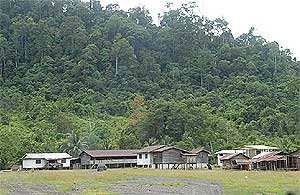 The Pulong Tau National Park, gazetted in 2005, covers an area of 59,817 hectares, including Mount Murud, Sarawak's highest peak.
The forests in the area provide material and spiritual nourishment for the Lun Bawang, Kelabit and Penan communities.
Penan communities, settled and nomadic, live off the forest in the park. They rely on its bounty. The forest provides water for drinking.
There are animals such as wild boar, monkeys, deer and fish for food. Herbs, fruits, roots and all manner of leaves are gathered for medicine. Rattan, bamboo and wood are sought for weaving, carving and building.
The Penan also love the forest's lush beauty for itself.
Ba'Tik, Rose's village, has been settled for over three decades. Rose is a leader within her community.
Like all the "settled" Penan in Ba'Tik, Rose has close ties with the nomadic Penan groups who move through.
Most Penan settlements began in the 1950s and 1960s. The colonial government encouraged the building of these settlements to counter the influence of communists, while the Sidang Injil Borneo (Borneo Evangelical Church) missionaries assisted the newly settled Penan with agricultural training and water resources.
A false dichotomy
The easy relationship between "settled" and "nomadic" Penan in Ba'Tik, and other communities, underlines the fact that there is no strict dichotomy between the two.
Both the "nomad hunter-gatherers" and the settled Penan rice farmers share a great many traits and concerns.
Conventional wisdom dictates there are only some 500 "true" nomadic Penan in Sarawak, out of a total of some 13,000 Penan. Nomads live mostly off sago, harvested from wild palms, meat, fish and vegetables such as bamboo shoots and ferns. Settled Penan enjoy these foods, in addition to eating rice as a staple.
Nomadic Penan have long participated in barter trade with surrounding Kenyah, Kelabit and Saban communities in Baram, as pointed out by local anthropologist Kelvin Egay in a recent interview with the Nut Graph.
The nomads move easily in and out of contact with a more settled, agrarian Penan communities.
Marriages and families formed between the nomadic and settled groups are a commonplace.
Similarly, settled Penan often disappear into the forests for weeks on end, on hunting and gathering expeditions.
Penan women such as Rose are equally at home hiking through the forests for days to reach a patch of high-quality rattan to make mats and baskets, even as they are teach the alphabet to pre-schoolers in the large wooden houses on stilts in the settlements.
Both settled and nomadic Penan also share the same love and respect for their forest.
'The noble savage'
Most of the highly publicised blockades against outsiders - powerful timber and plantation companies - have been erected by settled Penan communities in Middle and Upper Baram.
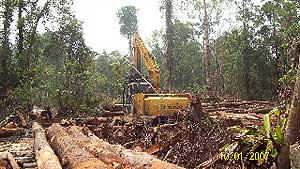 However, government ministers, such as Deputy Chief Minister Alfred Jabu, assert that the nomadic Penan are to blame.
The official line is that nomadic Penan are celebrated by foreigners as "romantic" living museum pieces or "noble savages".
Jabu blames "foreign negative NGOs" for instigating the nomadic Penan to erect blockades in order to preserve the way of life of the Penan, said to be among the last nomadic hunter-gatherers on earth.
In doing so, Jabu argues, the nomads, numbering only 3 percent of the Penan population, are depriving the settled Penan, the remaining 97 percent of the "development".
Jabu claims the nomads are brought in by logging and plantation companies.
But the Penan themselves do not see any difference between their defence of land rights and the struggles of the nomadic Penan.
"I was born in the forest," said James Lalo Keso, a Penan leader and former Penghulu of the Ulu Baram Penan, from Long Lamei.
"We do not reject development, such as schools or clinics. But the logging company does not bring us this development.
These should be brought in for the people here without asking us to give up our land, and our children's future."


Are you sure you want to delete this comment?
This action cannot be undone.