




The wisdom of the Long Lamei
The Antidote The Penan of Sarawak have been in the news for disturbing reasons. In recent months, reports of the rape of Penan schoolgirls, and the rape of the Penan forests by loggers, have burst across the front pages and screens of our new Malaysian media.
The Antidote The Penan of Sarawak have been in the news for disturbing reasons. In recent months, reports of the rape of Penan schoolgirls, and the rape of the Penan forests by loggers, have appeared on the front pages and screens of our new Malaysian media.
The media explosion has raised awareness of the twin burdens of poverty and injustice, borne by Penan and many other Dayak communities in Sarawak.
The reports of abuse of the gentle, diffident Penan by rich and powerful intruders have aroused anger and sympathy among many Malaysians.
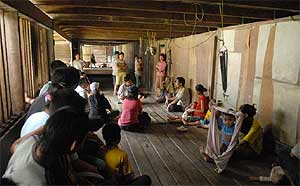 Sometimes the Penan stories engender cynicism too. A fellow reporter asked me once about my travels around rural Sarawak.
I offered her some photographs to go with an article she was planning to write about Penan communities.
"Do you have any photos that show them in a more pitiful light?" she asked.
"The Penan have always lived in dignity," I replied, frowning. "They have a tightly knit, supportive community. They look out for one another. They have a solid spiritual foundation. They're not as self-centred and introspective as the average middle-class urban Malaysian. Perhaps they are the ones who should pity you ."
"Them" and "us"
Our national media is full of accounts of the Penan communities of Sarawak, describing "them" almost as some kind of alien life form, bizarre and uncivilised. In truth, "they" are not so different from "us".
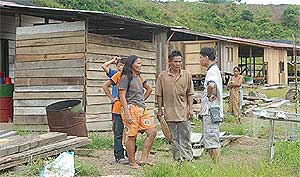 Penan parents send their children to school, as other Malaysian parents do.
Many Penan children do well in the classroom, and on the sports field, despite bullying, hunger and homesickness in their boarding schools.
Granted, the journeys to school often take many hours or even days. The children are often miserable in their ramshackle, scabies-infested dormitories. The water supply in many rural schools is the nearby river, usually polluted by sewage, or the logging companies.
School dinners are dominated by tinned food, cabbage and rice, because the Education Department refuses to allow schools to buy fresh fish, meat or vegetables locally.
Teachers say the department cites the need for central budgeting as its excuse for sending food from the towns to these remote, rural schools.
The culture shock faced by Penan children in their boarding secondary schools, as well as the bullying, the loneliness, and the alien food, lead many students to escape and head home. School absenteeism rates are high.
Some Penan parents withdraw their children from school during the rice-planting season, to provide extra pairs of hands on the farm. These parents do not see a formal education, using a curriculum devised thousands of kilometres away in Kuala Lumpur, as being of any benefit - and they have a point.
Yet many Penan parents persist in urging their children to attend classes.
"We spend a lot of time with our children," said Wilson Belare, 40, chief of Long Lamei and a pastor. "They're well behaved and listen to us, because we try to teach them all the time. Even when it's bath time, we talk quietly to them and give them pointers while we bathe them."
A journey to Long Lamei from Miri, the nearest urban centre, takes ten bumpy hours on a logging track, then an hour on a longboat, drifting through placid forest, undisturbed by chainsaws.
The forests around Long Lamei have been protected from loggers, because the villagers have been waging a desperate campaign against Samling, a logging company, since the eighties.
 Long Lamei men, women and children have set up blockades across the timber access track in the past. They have faced down police action and violence.
The villagers have taken the logging conglomerate to court. They have been told their lawsuit must first be heard through the customary court, before it can find its way to the High Court.
A visionary leader
Wilson's late father, Belare Jabu, was the revered chief of Long Lamei until Belare died two years ago. Belare was instrumental in leading his nomadic forest-dwelling community to a settled life in Long Lamei, establishing the village some 40 years ago.
He then united the Long Lamei community in their fight against Samling. After Belare died of natural causes at the age of 71, Wilson was voted in as village chief.
Belare had been one of four Penan community leaders who had launched the major land rights lawsuit against Samling.
His leadership had protected the forests and the communal land of the 500 Long Lamei villagers, providing them security to plant rice and hunt.
The growing settlement of Long Lamei had welcomed the construction of a primary school, SK Long Lamei. The school grounds today include a lily pond and a playground for pre-schoolers. There is also a football pitch, swarming with polite, but enthusiastic, barefoot teenagers, wearing colourful jerseys.
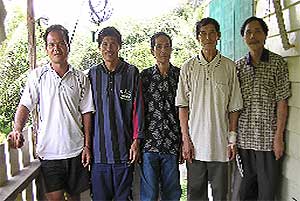
When Belare was alive, he took his son Wilson out to Kuching and Miri on several occasions, to teach him the ropes of campaigning, and the pursuit of legal action against the logging company threatening his community.
On one of these visits, Belare said with a wry smile, "I feel lost when I'm in the town. If you leave me in the forest, I can find my way around with my sight and hearing and smell. I can recognise the trees and the direction of the sun.
"But if I am left in the town, among all these houses and buildings" - he waved his hand - "I don't know how to get around," he went on.
"I prefer life in the village," he said. "There, we can find food and water, if we go out to look for it. It's free. Here, even drinking water costs money," he screwed up his serene eyes.
Wilson joined in, explaining that the Penan had abundant food before the logging company moved into their area.
"The Penan enjoy hunting for game," Wilson said, "because the hunt provides for their families and community. We do not waste food. We share what we hunt."
In our age of global climate change, individual greed and unlimited consumption, we can learn a few lessons from the unassuming Penan. Perhaps, in this way, instead of their usual portrayal as helpless victims in our society, "they" can help the rest of "us".
KERUAH USIT is a human rights activist - anak Sarawak, bangsa Malaysia . His 'The Antidote' column, which appears in Malaysiakini every Wednesday, is an attempt to allow the voices of marginalised people to be heard all over Malaysia.


Are you sure you want to delete this comment?
This action cannot be undone.