




Change we can see, feel and touch
The future of Malaysia depends on a credible two-party system. We all know that an alternative government will help keep politicians honest.
The future of Malaysia depends on a credible two-party system. We all know that an alternative government will help keep politicians honest.
If too much power has made some politicians deranged, a spell in the opposition bench might help them regain their sanity. Malaysians owe it to them to provide this healthcare service.
In the last two years, we have had time to evaluate for ourselves the performance of both the BN and Pakatan Rakyat.
Both have had
 the experience of being in government and in the opposition. Except for Perak, where Pakatan had only 11 months, the other Pakatan states seem to be functioning well despite the smokescreen and propaganda by certain parties in the mainstream media.
The reality is that Malaysia can function with or without politicians. But to move ahead of the pack, to escape the "middle-income trap" and to be a more equitable society, we need astute political leadership. This, sadly, has been sorely lacking.
Instead, a lot of effort and resources are currently invested in a perception war. The BN is desperately trying to claw its way back into the middle ground by allowing others to lead certain right-wing initiatives.
Relying on outward appearances
By tacitly supporting the outfit of Ibrahim Ali, Umno is hoping to appear moderate without actually making any real commitment to change. Perkasa, which has the patronage of Dr Mahathir Mohamad and several other Umno leaders, has been presented as an over-night sensation.
To reassure the middle ground, an aide to Prime Minister Najib Abdul Razak resigned after allegedly making racist remarks. Again, this ‘proves' the credentials of the BN as a moderate coalition of ‘friends'.
The problem is that there is so much cynicism and distrust especially after the Perak power-grab, the unresolved death of Teoh Beng Hock, the oil royalty fiasco and now, the second sodomy trial of Anwar Ibrahim, that most Malaysians cannot quite believe the government.
A more serious matter is that funding and aid are not reaching the needy. The prime minister should not forget the downfall of Abdullah Badawi, who relied too much on the goodness of people and not nearly enough on firm controls.
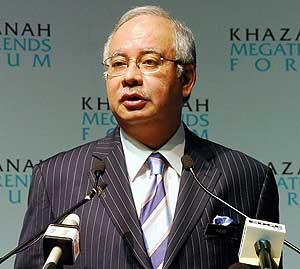 The result is that whilst the statistics say one thing, the reality on the ground is something else. The best thing Najib (
right
) can do is to reform the BN by starting with his own party machinery. Anyone caught hijacking even a single school uniform meant for the needy should immediately be reported to the MACC.
The result is that whilst the statistics say one thing, the reality on the ground is something else. The best thing Najib (
right
) can do is to reform the BN by starting with his own party machinery. Anyone caught hijacking even a single school uniform meant for the needy should immediately be reported to the MACC.
Bigger fish should be exposed and competently prosecuted. If it becomes necessary, lawyers from outside the present attorney-general's chambers should be appointed as prosecuting officers.
Tunku Abdul Rahman allowed David Marshall to act as prosecutor in a delicate case involving the trade unions. Najib should realise by now that confidence-boosting is necessary especially in the institutions that have lost the people's respect. This special team of prosecutors can then take on special cases like the PKFZ, VK Lingam and other controversial cases.
Stamping out corruption
Now that there is a strong opposition in parliament, the PM has wisely chosen to maintain a delicate balance between being consensual and stern when necessary. He must continue to lead by ideas and be as articulate as possible.
Unfortunately for him, the days of sloganeering are long over. Even in Penang, where Ibrahim Ali recently visited and many slogans were used, the ground has not stirred. All one has to do is to visit the urban villages around the Komtar area to realize that a lot of the displaced and under-privileged are there because of past BN policies.
The present state government is channeling a lot of aid to these people and in a refreshingly non-racial manner. The contractors are not upset because finally connections to politicians no longer matter so much.
Moreover, the refusal by the chief minister to give contracts out to a company where the son of a politician has shares may upset that political leader but demonstrates the reason why Penang is getting good marks by both Transparency International and Malaysia's own auditor-general.
It may be more profitable for a reforming Umno to emulate the methods and policies of the Penang state government. The BN should seriously reassess its relationship with the MCA and MIC as well.
Corruption is not compatible with a high-income economy. Global talent will not relocate to a city where officials demand coffee-table money when carrying out their duties. Of course, Malaysia can legalise some forms of corruption by turning them into taxes but that requires clean and respectable governmental machinery.
From now till the next general election, the BN has a lot to do by way of putting its house in order. Playing the race and religious cards, whilst generating a lot of cheap publicity, is not helping Malaysia's image overseas; and it is not really helping needy Malaysians including the Malays.
Throwing money at problems like urban poverty, falling standards in schools and universities, is not helping either and may actually increase the opportunities for corruption.
Instead, the government may want to take the opportunity to form a national commission to examine key problems in the administration of justice, education, our narrow tax base and corruption.
The time for substantial change is now. 1Malaysia may be a nice albeit misunderstood slogan but will remain one if the government does not follow up with positive action. Malaysians want to be united and the BN should allow us to be a united nation.


Are you sure you want to delete this comment?
This action cannot be undone.