




'U-turn on GST was waiting to happen'
exclusive The abrupt postponement of the second reading of the Goods and Services Tax (GST) Bill in Parliament comes as no surprise to Tony Pua, the DAP parliamentarian for Petaling Jaya Utara.
exclusive The abrupt postponement of the second reading of the Goods and Services Tax (GST) Bill in Parliament comes as no surprise to Tony Pua, the DAP parliamentarian for Petaling Jaya Utara.
In an interview that preceded this development, he expressed the certainty that the GST would make it to the government's list of policy U-turns.
"We have seen the U-turns in the property gains tax (and) U-turns for the tiered subsidy scheme. GST could become another U-turn," he said.
 The difference is that the
flip-flop
has come earlier in the game and not in the 18 months after the Bill is passed as predicted by Pua (
left
), an Oxford University graduate in philosophy, politics and economics.
The difference is that the
flip-flop
has come earlier in the game and not in the 18 months after the Bill is passed as predicted by Pua (
left
), an Oxford University graduate in philosophy, politics and economics.
In a press statement yesterday, he described the postponement of the GST Bill as revealing the government's mismanagement and a "hare-brained" approach to policy.
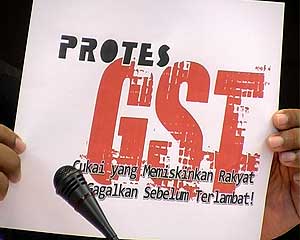
For many who are against the GST, including the Protes coalition which had planned - and then called off - a 2,000-strong demonstration outside Parliament this morning, the government's abrupt change of heart government is a "first round" win for the rakyat .
During the interview, Pua ripped up the government's argument on post-GST deflation by exposing the model as being naïve and simplistic.
A seasoned businessperson, he said prices will not automatically drop because the current sales and service tax (SST) of 10 and five percent respectively is higher than the proposed four percent GST rate.
"(As a seller, I will) sell at the price that people are willing to buy. If people are willing to buy at a particular price, I don't care if it is a taxed price or not, I will sell it at that price," he argued.
Furthermore, he pointed out that the SST system allows producers to get away with a degree of profiteering.
"The SST is an opaque tax...So the wholesaler doesn't know how the manufacturer comes up with the tax. As a result, it is likely that the manufacturer is likely to not pass on all of the savings to the wholesaler," he said.
 The average Malaysian worker can therefore expect to pay RM550 more in tax when GST comes into effect, due to an inflation rate of three to five percent, he said.
Excerpts of the first part of the interview follow, with the content edited for language and brevity.
Malaysiakini: The government argues that the GST rate will be lower than the SST and so, prices will drop and even the poor will benefit from this.
Tony Pua: The SST does not cover all products. That is why the GST is to be introduced, it covers more things. The government will not introduce a new tax if it collects less.
The argument that the 10 percent will be brought down to four percent does not hold water. The estimate is that, with the current system, they are collecting about RM11.7 billion. Under the new system, around RM13 billion, so (the GST will collect) an additional RM1 billion plus.
Besides the RM1 billion plus, there is the impact on the rakyat . (Second Finance Minister Ahmad Husni Hanadzlah) has said that exporters will gain. (Exporters) will save RM1.4 billion because they don't need to be taxed as consumption is overseas.
They are exempting professional services from charging service tax so that's a saving of RM4 billion for companies. Added up...that's a total RM6.7 billion on the people.
So they are shifting the burden from industry to the people.
Yes.
How much extra would someone have to pay with GST?
On average, a Malaysian worker will pay RM550 extra in taxes a year. That's a lot especially for those in the low-income group.
 If we call it a regressive tax, most people won't understand. But if we show ... how much a poor person spends as a proportion of their income, and then show how much a rich person spends, that's when the sense of injustice will be felt.
A report by a consultancy company showed that the prices of food, healthcare, etc will go up, but the price of tobacco and alcohol will go down. Why is that?
This probably has got to do with the SST, and the transformation to the GST. In the report by the Finance Ministry which is not publicly available, it estimates that overall inflation will drop by one percent when the GST is implemented.
It's a bit curious.
It is very curious. It's curious because the ministry assumes that any manufacturer who charges 10 percent of sales tax to the wholesalers - currently sales tax is only charged to the wholesalers - will automatically reduce the 10 percent tax.
That is a very naive assumption for two very simple reasons. First, (as a businessperson) I would sell at the price that people are willing to buy. If people are willing to buy at a particular price, I don't care if it is a taxed price or not, I will sell at that price.
Second, the previous sales tax is an opaque tax. As a wholesaler, I don't know where this 10 percent comes about. For the manufacturer, the 10 percent is not a flat tax on top of the value of the end product. The tax depends on the components are put in, how I mix the product, so on and so forth. It's not a flat tax.
So the wholesaler doesn't know how the manufacturer comes up with the tax on certain component parts of the product. As a result, it is likely that the manufacturer is likely to not pass on all of the savings to the wholesaler.
This is to be expected, and this happens not only in Malaysia. It happens globally. You would find a degree of profiteering. It won't be overwhelming profiteering, maybe three percent. How do you punish people for three percent profiteering? People escape because it's hard to detect, and prices would go up.
The ministry claims that when the GST is implemented, the largest product group to benefit will be clothes and shoes, by 2.7 percent. But I would bet my bottom dollar that this won't happen.
So you are saying that, since the wholesalers are happy to buy at a certain price, even with the 10 percent sales tax, then the manufacturers will add the 4 percent to the current price.
 Not necessarily the full 10 percent. I expect some degree of profiteering but not likely the full 10 percent. I think the modeling by the Finance Ministry is too simplistic. Similarly it assumes that once a product is exempted from GST, it stays where it is, but it won't because the cost of production would have gone up.
The government argues that producers can claim a refund on GST, but there is a worry that the system may not be so efficient. Could it be that prices will increase because businesses don't trust that they will get the refunds on time or at all?
Of course, (all businesses) will add the risk factor. They will add the factor that they will get their refund late. ‘I will get my refund late, and my cost will (not be covered), so I will increase my price so I will cover the cost'. No question about it.
Not only that, the cost of managing GST is high. This estimate is given by the Federation of Malaysian Manufacturers. The typical small- or medium-scale enterprise may pay RM1,000 in GST...it will cost them RM2,000 a year in additional administrative work in order to pay the RM1,000 to the government. The GST is not justifiable at 4 percent. We would be putting in a lot of money to get very little back.
Where do you see inflation going when GST is implemented?
There will be inflation, and particularly when GST is implemented there will be a one-off spike. I expect the implementation will bring about inflation of 3-5 percent, depending on how the items play out.
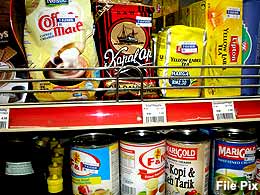 It also depends on what type of inflation we are looking at. We know that in 2007, before the (2008) elections, toll charges were going up, milk (formula) was going up, everything was going up and the government told us that inflation was one to two percent. Nobody believed that.
Why? Because the product set that the government uses to calculate inflation doesn't touch the products that the average consumer spends on. It talks about the most basic milk (formula), which people in the cities don't buy. You buy your Dumex , but this is not included in the inflation calculation. You buy clothes, the government calculates clothes of the most basic quality. Even for sugar, it calculates raw sugar, so if you buy fine sugar, it does not fall in the inflation index.
 There was talk about revamping the inflation calculator, I remember (then Finance Minister II) Nor Mohamad Yakcop (
right
) talking about this in Parliament in 2008, but nothing has been done to the index up to today.
There was talk about revamping the inflation calculator, I remember (then Finance Minister II) Nor Mohamad Yakcop (
right
) talking about this in Parliament in 2008, but nothing has been done to the index up to today.
There have been countries that have managed to contain inflation despite implementing the GST.
Look, the thing about inflation is that you'll get a one-off increase because it is a one-off with implementation. After that, once inflation has gone up, you flatten it off again. It means that the prices have gone up one level. It also means that, if the income of the people does not increase proportionally, then their real income goes down.
All this does seem rather complicated. How do you break it down to people when speaking to them at a ceramah ?
We break it down to the simplest arguments. Does the government need to tax you? Can the government earn more money by implementing a more competitive and more transparent procurement procedure? We know it can.
The operating expenditure in Malaysia, even after the recent budget cuts, is RM137 billion. What is the GST supposed to create in terms of additional income for the government? RM1 billion plus. I'm sure that can be sourced from this RM137 billion, if it implements proper procurement procedures.
There are easier ways of doing this without taxing the people. There are also other sources of revenue. We have talked about approved permits (APs) for cars. Why is the government giving this out at RM10,000 now, when the market price is RM40,000-50,000?
We also make the point that this tax is very unfair on the poor. In the overwhelming majority of cases, in this instance, the poor are the Malays and the Indians. Their votes will be critical in the next general election.
Do you think we should go to a referendum with the GST, as was done in Australia? Should people have a say?
People should have a say. There's no question about it, but knowing this country, no referendum has been conducted even on more critical issues. So I don't expect the government to conduct any referendum on GST, that's number one.
Number two, you can tell from the Bill the authoritarian manner in which GST will be implemented. Once the Bill has been passed, the minister has all the right to raise or change the tax system, to include or exclude certain items.
What can people who are against the GST do, besides writing to the newspapers?
( Laughs ) Write to the newspapers, take part in the information sessions and understand the issue. It is not an easy issue to understand. We are holding forums throughout the country.
 It's not the same as the ‘Anwar sodomy trial' forum. You can attract a large crowd to hear the Anwar (
left
) story. You don't expect that big a crowd for GST. It doesn't have that sort of bite, but in terms of real impact of the people, it is GST that will have the impact.
It's not the same as the ‘Anwar sodomy trial' forum. You can attract a large crowd to hear the Anwar (
left
) story. You don't expect that big a crowd for GST. It doesn't have that sort of bite, but in terms of real impact of the people, it is GST that will have the impact.
It affects the pockets of the ordinary person, so it is important for us to continue with the information campaign, even if the turn out might be just 300-400 people. These people will go back and spread it to others. It is not a sensational issue that will stir immediate overwhelming interest, but it is the creeping, sleepy issue, which will find its way to voters' mindset come the next elections.
So you believe that the Bill will be passed eventually?
The Bill will be passed barring a miracle. That is how BN would have it, because like it or not, after two years in this parliamentary system, I have learnt that regardless of the merit of arguments, Bills never get amended, they are always passed.
Even if BN MPs speak out and object to certain clauses, bring up arguments (opposing) a Bill...at the end of the day, they will vote to support it. Our parliamentary system, in the case of the GST, will be a rubber stamp.
Is it a losing battle then?
It is, in the short run. The Bill will be passed. The next stage is when the government commences implementation. So there are multiple stages for battles over the long term, and the issue should not be forgotten.
Once a Bill is passed, the government has 18 months to implement it, and that's where the U-turns can happen. We have seen the U-turns in the property gains tax (and) U-turns for the tiered subsidy scheme. The GST could become another U-turn.
Tomorrow: ‘GST - high costs, low returns'


Are you sure you want to delete this comment?
This action cannot be undone.