




NEM: What's in a name?
comment What's in a NEM that which we call a rose by any other name would smell as sweet, we are told?
The New Economic Model (NEM) preserves the race-based affirmative action policies that went under the former names of the New Economic Policy (NEP) and New Development Policy (NDP). Privatisation and divisive quotas that feed corruption and racial prejudice like the NEP, by any other name, would smell as foul.
"Practices that support the behaviour of rent-seeking and patronage that have long tarnished the altruistic aims of the New Economic Policy" - as Prime Minister Najib said - will continue to dominate the NEM, because there is no prospect of any change in political will in the present government.
Economist Paul Krugman argues that the political environment shapes economics, in opposition to the more conventional wisdom that economics determines political development, a view favoured by neo-conservatives and unreconstructed dialectical materialists alike...
comment What's in a NEM that which we call a rose by any other name would smell as sweet, we are told?
The New Economic Model (NEM) preserves the race-based affirmative action policies that went under the former names of the New Economic Policy (NEP) and New Development Policy (NDP). Privatisation and divisive quotas that feed corruption and racial prejudice like the NEP, by any other name, would smell as foul.
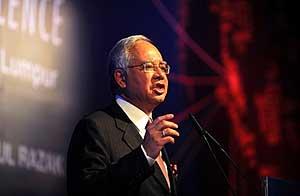 "Practices that support the behaviour of rent-seeking and patronage that have long tarnished the altruistic aims of the New Economic Policy" - as Prime Minister Najib said - will continue to dominate the NEM, because there is no prospect of any change in political will in the present government.
Economist Paul Krugman argues that the political environment shapes economics, in opposition to the more conventional wisdom that economics determines political development, a view favoured by neo-conservatives and unreconstructed dialectical materialists alike.
Our virtual one-party state cannot shape inclusive and equitable economic policy because it cannot relinquish its addiction to the politics of racial discrimination and religious posturing. Najib's speech unveiling the NEM continued the NEP narrative begun by his father, Malaysia's second Prime Minister Abdul Razak.
Without racial politics and divisive policies, Umno will not survive. This truth informs and illuminates all the hoopla about the NEM we have been reading about in the media. The catchphrases in the PM's speech, of ‘inclusiveness', ‘merit-based' and ‘needs-based' affirmative action, could not disguise the ancient obsessions with racial segregation.
These obsessions of the ruling party belong to the 19 th century, not the 21 st , but must not be surrendered for the sake of political survival. Najib made it clear that "in practice, this approach will mean greater support for the bumiputera, a greater support based on needs, not race".
Sound bites over substance
The National Economic Advisory Council (NEAC) has designed a report to appeal to capital markets and Malaysian émigrés in developed nations, hoping to attract foreign investment and reverse the brain drain. Najib's speech was crammed full of bullet points highlighting ‘fiscal transparency' and ‘competitiveness' and ‘sustainability'.
The NEAC recognises that Malaysia has lost an enormous chunk of talent (or, if you prefer, the ugly term ‘human capital') to Singapore, Australia, Europe and North America. The NEAC reports that 350,000 Malaysians were working abroad in 2008. This is probably an underestimate. In an average year, half the doctors working in the government hospitals in Singapore are Malaysians.
The NEM sound bites were not intended to spell out detail, for there will be much tinkering with the second half of the report, due in June, after the predictable rabble-rousing of sections of Umno, Perkasa and other Malay supremacist groups.
 The truism ‘the devil is in the detail' rings true in this instance. The PM may be reluctant to mention too much detail without clearance from the NEAC.
He bears the scars of his public relations mauling last November, when he mistakenly read out a poorly-prepared statement asserting that Malaysia was aiming for a ridiculous 9 percent growth rate until 2020.
The NEAC's new ‘model' is not particularly new. The NEM has borrowed market-friendly language from Singapore, from the corporate and banking worlds, and even from Dr Mahathir Mohamad's jaundiced Vision 2020. The PM's speech emphasised corporatisation, privatisation and "re-energising the private sector to lead growth", a rehash of Mahathir's policies.
The target of achieving a "high income" of US$15,000 per year per capita, amidst roaring annual GDP growth of 6.5 percent, appears to be a throwback to the Vision 2020 ideals of growth at any cost, and of achieving ‘developed nation' status.
This fixation on ‘growth at all cost' bred economic policies with disastrous social and environmental consequences. A boom in corruption, the sale of national assets to cronies, an uncontrolled influx of foreign workers and the frenzied, piecemeal privatisation of essential public services such as health care and tertiary education created enormous social injustice and discontent.
Environmental destruction has included smog and haze in the Klang Valley and nationwide, heavy metal poisoning in Papan, Perak, as well as deforestation and loss of land afflicting indigenous peoples throughout Malaysia, including in Bakun and Murum.
Rohani's fable
A cautionary tale, regarding the priorities accorded to ‘development' was published in the Sunday edition of the Borneo Post on March 28.
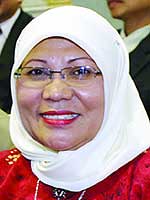 Rohani Abdul Karim, deputy federal minister of agriculture and agro-based industry gave all Malaysians an amusing, if inadvertent, insight into the mindset of our political elite.
Rohani was admitted briefly to Sri Aman Hospital, a three hours' drive from Kuching, for dehydration on March 26. After three hours in the small hospital, she arranged an ambulance transfer to a private hospital in Kuching.
"All the tests were okay except rest and water," she told the Sunday Post . The reason she gave for dehydration was that she dared not drink too much water for fear of having to visit the toilet while she was touring her parliamentary constituency, Batang Lupar.
 "You know in my
kawasan
(constituency), it is not convenient but maybe it is okay for men. But we'll slowly build up good infrastructure," she was quoted as saying.
"You know in my
kawasan
(constituency), it is not convenient but maybe it is okay for men. But we'll slowly build up good infrastructure," she was quoted as saying.
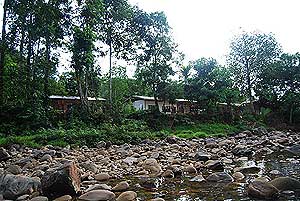
When 41.7 percent of rural Sarawak people have no access to clean water, and sanitation often means a shack with a hole in the ground and a cesspit underneath, "building up infrastructure slowly" appears to be a tongue-in-cheek understatement.
Rohani went on to promise, in response to appeals by hospital staff treating her, that plans for a new hospital in Sri Aman are afoot, part of the National Key Result Areas. "I think bigger land is needed and the resident (doctor) is working on it," she told the Sunday Post .
Is there a moral to the story? Neglect of poor communities may come back to haunt those in power, regardless of high-sounding slogans and promises. The deprivation of ordinary Malaysians does not raise an eyebrow, unless the political elite are personally affected.
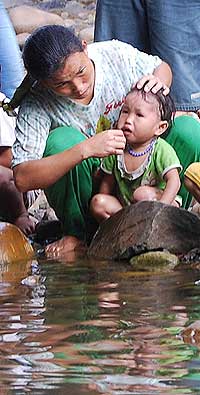 The market-friendly sloganeering of the NEM, like Vision 2020 and 1Malaysia before it, give ordinary Malaysians little comfort. Wealth distribution in Malaysia is so lopsided that millions of Malaysians do not even qualify for the ‘middle income' group; aiming for a ‘quantum leap' to a ‘high-income' nation is pie-in-the-sky.
Over the past few weeks, many Malaysians have expressed a wish that the NEM would provide for a truly ‘inclusive' Malaysia, for equitable development and concern for the poorest among the poor, in the Malay hinterland, Indian plantations, Orang Asli ghettoes, Dayak longhouses in Sarawak and Kadazan-Dusun-Murut villages in Sabah.
Any such hopes are now likely to be drowned out by the deafening repetition of NEM sound bites.


Are you sure you want to delete this comment?
This action cannot be undone.