




Looking forward to a new dawn at Easter
Malaysian Christians celebrate Easter Sunday today, the most important celebration of their calendar.
They look forward to a new dawn, based on their belief that Jesus returned to life after suffering a violent execution.
Malaysian Christians celebrate Easter Sunday today, the most important celebration of their calendar.
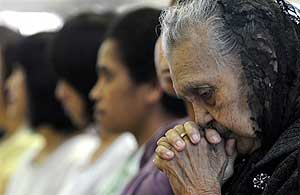 They look forward to a new dawn, based on their belief that Jesus returned to life after suffering a violent execution.
Christians make up only nine percent of Malaysia’s diverse population. Yet they certainly face great challenges.
A High Court decision against a Home Ministry ban on the use of the word ‘Allah’ by Christians was used by politicians recently to inflame religious hatred, leading to attempts to torch churches in several states.
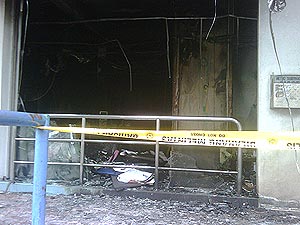 Malaysian Christians (as well as Sikhs, who use the word ‘Allah’ in their worship and whose temple was
also attacked
) met the violence with stoic pacificism. Their calls for peaceful negotiations appear to have been vindicated.
Malaysian Christians (as well as Sikhs, who use the word ‘Allah’ in their worship and whose temple was
also attacked
) met the violence with stoic pacificism. Their calls for peaceful negotiations appear to have been vindicated.
A firebombing attack on a surau in Johor was carried out not in retaliation by Christians, but as an alleged act of vandalism by young locals, according to the police.
The Home Ministry has since retreated from its tacit encouragement of angry protests.
Umno mouthpieces in the mainstream media have ramped down their level of aggression surrounding the debate. The fact that arson attacks have died down highlights the mainstream media’s deliberate role in stoking the political conflagration.
Nonetheless, the controversy regarding the use of the word ‘Allah’ remains unresolved. This issue remains available to be manipulated again in future by reckless right-wing politicians. Umno is obviously unable to encourage interfaith dialogue because its political survival depends on promoting division, not understanding.
Both PAS and PKR have accepted that the Arabic word for God should be freely used by all religions, as is the case in other nations. But dissent remains evident within their ranks.
Rich and poor Christians
Christians in Sabah and Sarawak make up almost half the population. Their discontent has been masked by their lack of access to the mainstream media, and by the deafening silence of their Dayak and KadazanDusunMurut representatives in state and federal cabinets.
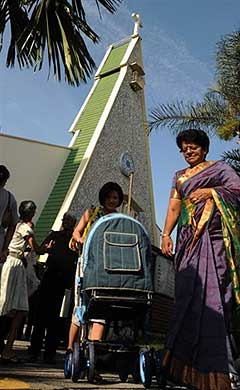 Malaysian Christians make up a high proportion of the wealthy, professional and educated groups in the country, thanks to the proliferation of mission schools in the last two centuries.
Non-Christians have been given a boost in education too,: the Prime Minister and the Home Minister, as well as Sarawak’s Chief Minister Abdul Taib Mahmud and Sabah Chief Minister Musa Aman, and a large chunk of their respective cabinets, all spent their formative years in Christian mission schools.
Yet, Christians also make up some of the poorest people in Malaysia.
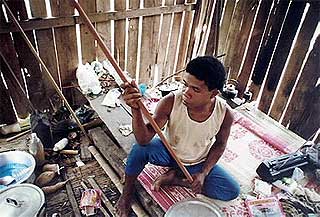
Many Christian Orang Asli, Melanau, Iban, Bidayuh, Penan and other indigenous Sarawakians and Sabahans live below the poverty line, without safe water or electricity .
In fact, they go through their daily lives without much hope, despite half a century of promises of relief from poverty for bumiputeras.
 The churches, filled to the brim every Sunday in Sabah and Sarawak, have faced criticism for not following in the footsteps of Jesuit liberation theologians in Latin America, the Philippines, and elsewhere, speaking up for
the dispossessed
.
The churches, filled to the brim every Sunday in Sabah and Sarawak, have faced criticism for not following in the footsteps of Jesuit liberation theologians in Latin America, the Philippines, and elsewhere, speaking up for
the dispossessed
.
And the Christian churches face other challenges, too. Sexual abuse of children by members of Catholic religious orders has caused a furious backlash around the world.
However, in Malaysia, many priests and religious orders still enjoy the trust and respect of ordinary Malaysians, thanks to their community work in education, health care and social welfare.
Perhaps this is the best hope for Malaysian Christians for a new dawn: Christian churches who engage themselves in the daily suffering of Malaysians weighed down by poverty, who stand up against injustice, and who eventually speak truth to power, as Edward Said urged.
In this way, perhaps they can contribute to a rebirth of Malaysia, a beautiful country stricken by economic inequality and racial hatred.
KERUAH USIT is a human rights activist - anak Sarawak, bangsa Malaysia. His 'The Antidote' column, which appears in Malaysiakini every Wednesday, is an attempt to allow the voices of marginalised people to be heard all over Malaysia .


Are you sure you want to delete this comment?
This action cannot be undone.