




Saving the 'Star Hill' kids
special report British expat Jill McWilliam cannot stay away from the prosperous Bukit Bintang area in Kuala Lumpur, and it is not its swanky bars and glitzy shopping malls that draw her there.
special report British expat Jill McWilliam cannot stay away from the prosperous Bukit Bintang area in Kuala Lumpur, and it is not its swanky bars and glitzy shopping malls that draw her there.
No, it is the young children who are living rough in the shadowy back streets who have caught her eye - neglected or abandoned children eking out an existence from drug dealing, begging, parking cars or prostitution.
She talks of rats the size of cats, and the street children she has rescued from syndicates that operate in the area. As we drive there one night, it leaves me feeling edgy and apprehensive, but there is no hint of fear in Jill's voice.
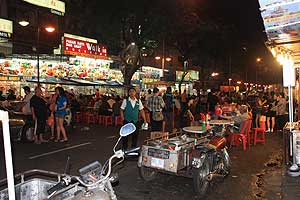 We get there just after 10pm. Two boys help us find a parking space and we wait on the corner of Jalan Alor and Changkat Bukit Bintang armed with small cash and a bag of second-hand clothes.
Watchful eyes meet ours from flats above the busy mamak stalls.
A year has passed since she discovered a group of young boys sniffing glue, oblivious to passing shoppers and tourists weaving their way up Jalan Bukit Bintang. She was celebrating Valentine's Day with her husband, but neither he nor her high heels could stop her from taking the boys to a hawker's stall to eat. Now, she is known locally as the lady who helps ‘broken' street children -they call her ‘Mummi'.
Close to 100 children ranging from seven to 22 years in age live in the area. Most come from deprived backgrounds where low income, poor education and a history of ‘traumatic experiences' feature high. Each has a painful story to tell.
"They will do anything for money," says Jill, and money is what life on these back streets are about.
According to child rights advocate Dr Hartini Zainudin, the founder of the Rumah Nur Salam shelter for underprivileged children, "children only survive in the Bukit Bintang area if they become part of its syndicates operating there".
Protection is given in exchange for a cut of the children's earnings made by parking cars, begging - sometimes with the ‘use' of babies - drug dealing or prostitution. Begging brings them about RM100-150 per day and car parking about RM50.
Three teenage boys turn up and look happy to see Jill. Introductions are made and the clothes bag handed over. They appear to trust her and she them.
 "They are my bodyguards on these streets," she says.
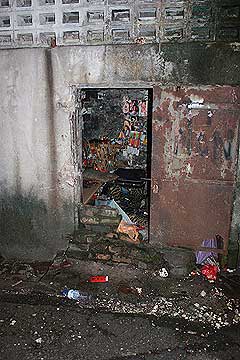
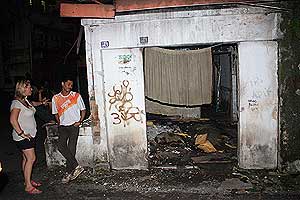
They are going to show us where they sleep, what they call ‘ports'. We are led down a dark narrow passage that opens out into an alleyway - fetid smells waft over us from rubbish heaps.
We reach a hole in a wall. This is their ‘port'. A bulbous rat scurries across the entrance, winding its way around small mounds of what looks like human faeces. It is dark inside but the flash of a camera reveals a tattered old car seat, a new-looking suitcase sitting on the floor and blackened walls decorated with the peeling pages of a pop magazine.
Our shock quickly turns to concern as we notice curious-looking figures appearing, silhouetted against one end of the alleyway...it is time to go.
‘Invaluable work'
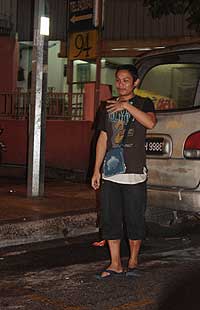
Back among the bustling fruit sellers, buskers and food vendors, we take the boys - Jawa, 17, Hazstafi, 16, and Hanify, 14 - for a plate of something hot. Scabs and scars on their arms and faces can be seen clearly now.
"Two of the boys are taking glue, possibly something stronger," whispers Jill. It is an easy habit to support - a tin of glue costs just RM3.
 The former childcare worker understands the problems faced by street children - their fears, their drug dependencies, their survival - having spent several years working with disadvantaged children in impoverished areas of Aberdeen, her hometown in Scotland.
When her family moved to KL in 2006 with her husband's work, it did not take her long to discover the Rumah Nur Salam and Sinar Salam shelters for underprivileged children located in the red light district of Chow Kit.
Her volunteer work at these shelters over the past three years "has been invaluable" says Afridah Ab Latif, the manager of Sinar Salam which houses babies and mums at risk.
She organises donations of food, furniture and clothes to Sinar Salam, and takes a very personal approach, from teaching mums how to wean babies to taking toddlers for health checks and vaccinations. She has also overseen successful adoptions of abandoned babies to expatriate families in KL.
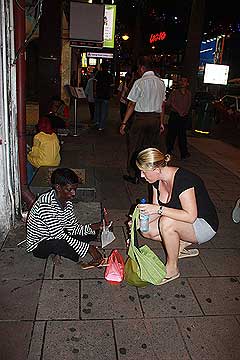 Jill still helps at these Chow Kit shelters, but her main focus now is in Bukit Bintang where she spends between 20-25 hours every week. Currently she is the only person who helps them with food, clothes and a warm embrace - a simple gesture not lost on these children.
She helps them replace their lost identity cards, encourages them to seek drug rehabilitation and helps them find employment. Where possible, this is done with the consent of the children's parents, who, often uneducated themselves, simply "don't know what to do".
But it is not easy or necessarily safe. Jill recently had her GPS stolen from her car and was "threatened with arrest by undercover police" for not having her passport with her.
Despite this, she says: "I feel so privileged to be able to help these children, they are like your and my kids but have been through difficult family circumstances."
Saved from the streets
She believes these children are trying to do their best with their life but the ‘system' is not allowing them to do so, a view shared by Hartini.
 Recently, Jill persuaded Alomg,18, the elder brother of Hazstafi and Hanify, to seek help through Nur Salam, which in turn sent him to the privately-run Pengasih drug rehabiliation centre in Bukit Tunku.
His treatment costs RM500 per month and Jill is closely monitoring his progress. This is the second child she has persuaded to go this centre. Salleem, a 13-year-old RM90 per day heroin addict, who had lived on the streets for six years, was the first.
Before we leave, Jawa tells Jill that he and Hazsafi are thinking of going to Nur Salam for help.
"It's taken eight months of persuasion for this to happen," she says beaming with delight. It is another ‘saved' from the streets.
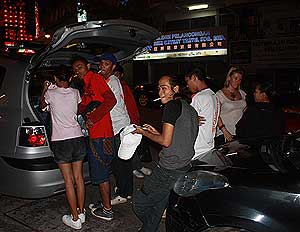 As we return to the car, word has got around of our visit. First two, then a few more new faces appear. Very soon there are half-a-dozen heads bobbing in and out of the car boot, rummaging through bags of donated clothes and shoes, laughing and smiling as they do so.
I spot an attractive and excitable teenager in the crowd: the girl fell pregnant at the age of 12 after being raped by a family friend. She married a drug dealer when she was 15 and he then tried to sell her. This is when she bolted to Bukit Bintang, but she has had a second child since.
Jill and Hartini now plan to open a drop-in centre in Jalan Alor in the next six months, where children can get a hot shower, a change of clothes, food and counselling.
HELEN HICKEY IS a freelance journalist based in Kuala Lumpur. She writes for a number of local publications including Expatriate Lifestyle, The Expat, Association of British Women and Bonda .
Those who wish to help may email: jill.mcwilliam@gmail.com


Report this comment
Are you sure you want to delete this comment?
This action cannot be undone.