




Sabah cabbies against legalising 'kereta sapu'
Cabbies in Sabah are against the federal government legalising an estimated 2,500 pirate taxis (kereta sapu) especially in the rural areas of the state. The move includes pirate taxis operating in the outskirts of Kota Kinabalu, Sandakan and Tawau that are well-served by licensed services.
Cabbies in Sabah are against the federal government legalising an estimated 2,500 pirate taxis (kereta sapu) especially in the rural areas of the state. The move includes pirate taxis operating in the outskirts of Kota Kinabalu, Sandakan and Tawau that are well-served by licensed services.
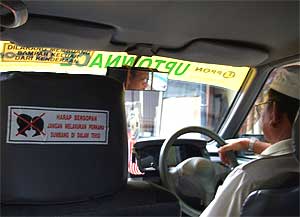 Under the plan, pirate taxi operators can also apply for public transport licences for mini bus and charter vehicles.
“Legalisation is nonsensical. It would not be able to eradicate pirate taxi operations in the state,” said Sabah United Taxi Association (Suta) president Wong Yit Ming. “There’s no assurance that there will be no more pirate taxis in the streets after the legalisation exercise.”
He was commenting on the move that the federal government reportedly intends to complete before the year is out.
He pointed out that pirate taxi drivers were not willing to take up other jobs because most of them are low-paying. The right thing to do, he stressed, would be for the government to create better-paying jobs so that people won’t resort to illegal activities.
Wong also saw no reason why the federal government should legalise pirate taxis when it is stamping out other illegal activities like smuggling of contraband cigarettes and beer and illegal gambling activities. He called on all cabbies in the state to reject the legalisation move.
‘Cabbies not choosy’
Wong denied that taxi drivers were choosy, leaving rural folk in particular completely at their mercy. The association, he assured, would not hesitate to take action against any of its members if the public lodged complaints against them.
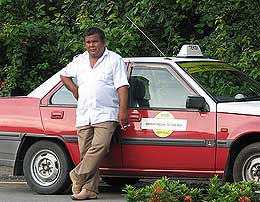 “The authorities should also simplify the application process for operating outside the designated boundary, waive the need for additional insurance and extend taxi permits from the existing seven to ten years.”
The main worry, according to Wong, is that legalising pirate taxis would seriously affect the livelihood of existing operators who are already finding it tough to make ends meet.
He cites Lahad Datu as a case in point where the 141 legitimate taxi operators are outnumbered by an estimated 500 to 700 pirate taxis. The market is overcrowded with taxi drivers earning between RM70 to RM100 daily, and this is somewhat on the low side, he added. “Out of this, they have to pay for fuel, food, loans, inspection and other fees and payments.”
The tourism boom in the state, it is claimed, has not benefitted taxi drivers since visitors generally hire drivers through travel agents or rent a tour bus.
The police has come out on the side of the legal cabbies but for different reasons. They reckon that many of the pirate taxi drivers are illegal immigrants with no driving licences. Keningau district police chief DSP Zahari Mohamad disclosed that 23 private vehicles used as pirate taxis were seized last month alone, and 14 of the drivers were found not to have valid driving licences while four vehicles did not have valid road tax.
“Most of those rounded up were illegal immigrants,” said DSP Zahari. “Investigations are continuing under the Road Transport Act.”
In Kota Kinabalu, police confiscated 11 vehicles during a recent operation: five vans, four cars and two multi-purpose vehicles.
‘Only short-term solution’
The state Commercial Vehicle Licensing Board (CVLB) has a different take and sees legalisation as “a short-term solution to address the rampant pirate vehicle activities in the state”.
“The existence of the pirate taxis is due to the lack of proper public transport services in certain areas,” said a CVLB spokesman. “This has increased the people’s dependence on the illegal services, particularly those living in remote villages.”
The CVLB will not legalise pirate taxis operating in the main urban areas of the major towns like Kota Kinabalu that has 550 mini buses, 438 express buses and 769 legally-operating taxis.
Pirate taxis are very popular in Sabah, especially in the rural areas and the outskirts of the main urban centres. They offer personalised services and flexible fares that are half those levied by the legal operators.
For a monthly fee, pirate taxi operators and mini buses are willing to go deep into the kampungs, fetch passengers from their door-steps and drop them off at their work places in the towns. Pirate taxis are also willing to cruise unlike the legal operators who operate from stations.
Pirate transport operators caught can be charged under Section 23(2) of the Road Transport Act 1987 that provides for a maximum penalty of RM2,000 or six months’ jail or both.
Alternatively, they can be charged under Section 33 of the Vehicle Licensing Board Act 1987 that, upon conviction, carries a fine of between RM1,000 and RM10,000


Are you sure you want to delete this comment?
This action cannot be undone.