




Mudball campaigns to clean up Sabah rivers
Green activists and volunteers in Sabah have taken to tossing effective microorganism (EM) mudballs into local rivers to get them cleaner than they are now.
Green activists and volunteers in Sabah have taken to tossing effective microorganism (EM) mudballs into local rivers to get them cleaner than they are now.
EM mudballs are made of top soil into which wheat bran and activated effective microorganism-1 - a consortium of good microbes that can degrade pollutants - are added.
Tawau is the latest municipality in the state to join the bandwagon with a 100,000 EM Mudball campaign to be launched on Oct 2. The hinterland is a natural habitat for prawn and fish farming that remains among its core activities.
"It's our jurisdiction to ensure the cleanliness of Tawau town and its surrounding waters and gardens," said Tawau Municipal Council (TMC) president Ismail Mayakob. "The mudball campaign is an initiative of the private sector and NGOs."
The mudball campaign, he added, was a follow up to the TMC anti-litterbug campaign launched last year to transform Tawau into a clean town as the gateway to major agro-tourism attractions in the state.
Tawau, surrounded by the Sulawesi Sea, is the take-off point for the 588.4 sq km Maliau Basin Conservation Area - Sabah's 'Lost World' - one of the oldest rainforest jungles in the world. The state cabinet nominated Maliau Basin earlier this year as a world heritage site.
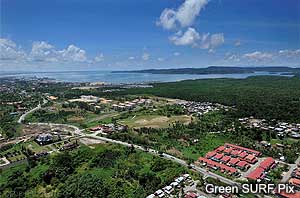
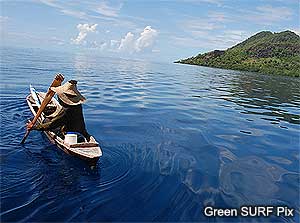 Scents of Borneo (SOB) founder Clarence Chiuh, an activist, said the mudball campaign in Tawau will be carried out along the coastal highway from the Ba Zhong Commercial Centre to the fish market. Tawau, according to Chiuh, is among the first to make a stand for the environment. "We aim to educate the people to keep the waterways clean and avoid polluting the environment."
EM mudball not cure all solution
Chiuh warns that the EM mudball is not a panacea. It only treats the organic waste that produces sludge and not the non-organic waste. He favours other measures which treat the source of pollution problems along waterways. "Residents living around riverbanks and coastal waters can help by not littering," said Chiuh. "The government must be tough to ensure the proper disposal of rubbish."
"Organising the 100,000 EM Mudball Campaign in Tawau is not for parade," said Steven Ong, the president of the Rotary Club of Tawau Tanjung. "It won't be the first and the last. There will be other follow-up actions. We are in for the long-haul."
 Co-organisor Paul Liang of the Junior Chamber International Tawau (JCI) is currently getting members, volunteers, NGOs, high schools, churches and clubs to join in the effort to make the mudballs. "We want our youth leaders to participate in the mudball campaign," said Liang. "This is in line with our motto that service to humanity is the best work of life."
After kneading the three main materials in mudballs - top soil, wheat bran and EM-1 - into the shape of a ball, it is left to ferment for a week before use. The mudballs, it is said, can clean up bodies of water where there are concentrated deposits of slime, the cause of bad odour, and sludge. The EM mudballs are not there indefinitely and need to be periodically added to clean up the sludge.
"The application of EM is not limited to waterways," said David Yip of SOB Tawau. "It can also be used in and around the house, hospitals, hotels, offices plantations, farmland and other areas with a problem."
The Tawau campaign apparently takes its cue from a similar successful campaign recently in nearby Lahad Datu, sandwiched between Sandakan and Tawau, and others on a smaller scale in Kota Kinabalu. These campaigns have provided valuable lessons for Tawau.
Catching them young
2,780 volunteers in Lahad Datu recently threw 109,000 mudballs over nine days into the sea at six different locations. Three days later, according to a sponsor, the smell near the chicken market was considerably reduced.
The habitual dumping of rubbish into the sea off Lahad Datu over the years has caused a major build-up of sludge, usually camouflaged by the high tide, in this coastal town.
 In Kota Kinabalu, the mudball campaign is a modest operation by a five-star hotel and a high school. The Shangri-La Tanjung Aru Resort has been throwing between 50 and 100 mudballs every week into the drains leading to the sea to observe its effectiveness. Guests are encouraged to volunteer for the campaign.
Students of La Salle Secondary School in Tanjung Aru are also chipping in with their own mudball campaign. So far, they have tossed 2,000 of them around the Tanjung Aru Apartment area. This is a joint effort with students from the St Francis Convent closer to the heart of the city.
Mudballs are not exactly cheap but costs can be reduced by employing volunteers and relying on corporate sponsors. An environmental engineer estimates that the EM solution costs RM22 per litre and can be mixed to make up to 20 litres.
"The EM technology is among the cheapest methods to clean up rivers," said the engineer. "However, the mudballs must be tossed continuously into waterways for it to be effective. This calls for long-term commitment. Otherwise, the water would revert to its polluted state."


Are you sure you want to delete this comment?
This action cannot be undone.