




New MyKads: Best to rectify mistakes quickly
The National Registration Department (NRD) in Kota Kinabalu has advised new applicants not to go home without checking their MyKads after collecting them. They are cautioned against coming back months or even years later to rectify any errors in their MyKads.
The National Registration Department (NRD) in Kota Kinabalu has advised new applicants not to go home without checking their MyKads after collecting them.
They are cautioned against coming back months or even years later to rectify any errors in their MyKads.
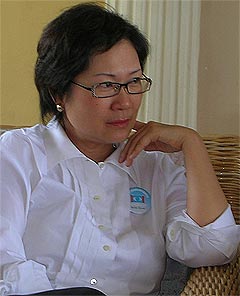 This was the advice yesterday from retiring Sabah NRD director Abdul Jaffear Henry after
meeting
with senior lawyer Christina Liew Chin Jin Hadhikusumo (
left
) who handed him 162 problematic MyKad cases from the interior areas of the state.
This was the advice yesterday from retiring Sabah NRD director Abdul Jaffear Henry after
meeting
with senior lawyer Christina Liew Chin Jin Hadhikusumo (
left
) who handed him 162 problematic MyKad cases from the interior areas of the state.
"If there is any error in the spelling of the name, address or religion stated, we can correct it then and there," assured Jaffear. "It doesn't take months and years."
Still, the Sabah NRD has a special committee within its Customer Service Office to look into problematic - technical or otherwise - MyKad and birth certificate cases.
Those in the interior needn't to come to the state NRD headquarters in KK, said Jaffaer, as they can get seek assistance at the district Sabah NRD offices in Ranau, Tongod, Telupid, Beluran, Kundasang, Kota Marudu and Pitas.
"Since January, I have directed the district offices to handle matters involving problem MyKads themselves and send me a report," said Jaffear.
Touching on the 162 cases handed to him by Liew, he gave an assurance that the department will make every effort, "not just try" but to have the problems rectified.
Ten cases involve cases of Christians who have been listed as Buddhists. The others are Christians listed as Muslims, apparently because they had a "bin" or "binte" in their names.
Due diligence
Jaffear cautioned, however, against expectations that the information on such documents as MyKads can be changed without due diligence.
"We simply cannot change the religion of a person on the MyKad, because it's a sensitive matter that can be misunderstood.
"We have to compare the claims made by the applicants with what we have in our records to be fair to the department. If necessary, we will conduct interviews," said Jaffear.
Technical errors will be rectified but only upon re-application, he added.
Jaffear also indicated that rectification of the 162 cases would not be made in one go, but on a case-by-case basis since "there are certain procedures to follow". He noted that the 162 cases were accompanied by supporting documents.
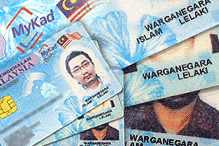 If Sabah NRD records state that an applicant to change the information on a MyKad is a Muslim, the matter will have to be referred to the religious authorities for determination, said Jaffear.
The Sabah NRD records date back to 1914.
"We can't promise how long it will take to settle a case as it will all depend on the department's investigation," said Jaffear who claimed that the NRD was "very professional". "It could take as little as a month. We will give a reply as we settle each case."
Jaffear, the first local to head the Sabah NRD, was appointed last year in the wake of a controversy over the categorisation of a local native as permanent resident after she lost her MyKad.
Liew was accompanied to the Sabah NRD headquarters in KK by leaders from various communities and church representatives from the interior.
"The department has given an assurance that they will rectify the errors within three months," said Liew on her meeting with Jaffear.
"I have a second batch of cases for the department but these will be handed over once the first batch is cleared."
Liew fumed that the use of "bin" and "binte" in Sabah had been used to determine the religious status of applicants.
"When an application with bin or binte from Sabah goes to Putrajaya, it's automatically changed to ‘Muslim'," said Liew. "This perception needs to be corrected."
Liew said that the issue over MyKads and similar problems must in the future be avoided or corrected as soon as possible.
Otherwise, she stressed, they could continue to be a problem from "birth to death".
Problems in acquiring a proper birth certificates for children and opening bank accounts are some of the consequences of MyKads containing errors.
Lack of recognition
A related issue is the lack of recognition accorded to marriages between Muslims and non-Muslims.
"A child born under mixed marriages in Sabah will follow the mother regardless of the status of the father," said Liew based on what Jaffear told her.
"A child must be registered within 42 days with the department, or problems may arise."
However, if one parent is a Muslim, the matter would involve the Syariah Court, Liew discovered. "They will have to register according to the Islamic law, according to the department."
The Sabah NRD ‘investigation' will include such matters as whether a grandparent or great-grandparent had converted to Islam.
The presence of even one such Muslim individual in the family "could complicate matters", said Liew, suggesting the disparity between the treatment of those with Christian family members as against those with Muslim relatives, no matter how remote.
In Sabah, many non-Muslim natives use ‘bin' and ‘binte' in their names.


Are you sure you want to delete this comment?
This action cannot be undone.