




'Sabah container facilities in dismal state'
Shippers in Sabah are unhappy over allegedly inefficient container facilities at ports in Tawau, Lahad Datu and Sandakan.
They add that while the Sepanggar Bay Container Terminal (SBCT) just outside Kota Kinabalu that has a seaport fares slightly better, it has its shortcomings as well.
Shippers in Sabah are unhappy over allegedly inefficient container facilities at ports in Tawau, Lahad Datu and Sandakan.
They add that while the Sepanggar Bay Container Terminal (SBCT) just outside Kota Kinabalu that has a seaport fares slightly better, it has its shortcomings as well.
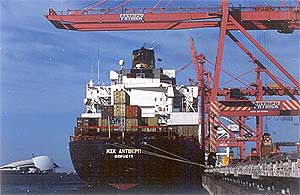 The shippers want the Sabah Ports Sdn Bhd (SPSB) to provide better facilities, especially harbour cranes, to cope with the increasing container cargo traffic handled at all Sabah ports.
Other crucial port equipment in dire condition includes stackers and prime movers, reportedly in less than tip-top condition and frequently breaking down.
The shippers say that they are not pointing fingers “but if the government did not develop the ports in tandem with the rapid growth of business, the losers will be the people who will have to pay for higher costs”.
“Inefficiency in handling containerised cargo at the ports was really burdening importers and exporters,” said Sabah Shipping Agents Association (SSAA) president Lo Shu Kiong. “The congestion is especially bad in Sandakan and Tawau.”
The delay in discharging containers cost the importers money, continued Lo, “which in the end would be passed on to the consumers”.
'Authorities evading responsibility'
Lo was taking his case public over the slow efforts in making good the mobile crane in Tawau that broke down in Sept 18. The shippers have since been told that it will take another three weeks to repair the mobile crane.
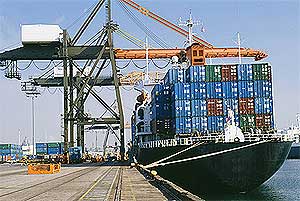 Tawau, like Sandakan, has only one mobile harbour crane, lamented Lo. “There is no back-up in case of breakdown like what is happening in Tawau now. There should be at least two harbour cranes in operation with one functioning as a back-up to avoid congestion (that will be a) burden to the shippers.”
As one result, gearless vessels (vessels without onboard cranes) are unable to load and unload their cargo in Tawau and are forced to divert to other ports to transfer their cargo to a geared vessel for onward shipment to Tawau.
Lo blamed the problem on SPSB’s policy to compel all ships to use the port’s mobile crane regardless of whether they had their own, and impose the compulsory crane hire charge.
He claimed that SPSB even encouraged ship owners to bring in gearless vessels claiming that they are able to achieve higher productivity on gearless vessels as compared to geared vessels.
In the wake of the mobile crane incident, ship owners have also been asked by the port manager in Tawau to make their own arrangements for stevedores and crane operators.
This, believes Lo, was a way for SPSB to evade responsibility for any incident that may result in claims.
Costs spillover downstream
To compound the ship owners’ woes, the double handling cost and the cost of delays due to the crane breakdown is not recoverable.
The situation also affects importers and exporters whose cargoes are delayed, wreaking havoc on their schedules and letters of credit with expiry dates or sales contracts cancelled for missing the delivery deadlines.
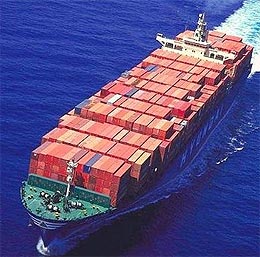 Lo said the situation at Lahad Datu was no better than that at Tawau, with waiting period for cargo loading and offloading between 10 to 14 days.
In addition, Lo stressed that the government needs to upgrade the Sandakan and Tawau ports that were built in the 1970s and were outdated within the following 10 to 15 years.
The general cargo berths at these ports, for example, have never been expanded or upgraded in the last 30 years despite the rapid annual growth of cargo volume.
“Container yards at these two ports are also insufficient to cater for the growing containerised cargo throughput,” said Lo. “Ports need to grow in tandem with the industry and not become limitations to growth.”
The sore point at Sepanggar is that only two vessels can berth and work concurrently unlike at Kota Kinabalu (KK) Port, that can accommodate three vessels at one time when it hosted the container terminal.
Lo estimates that Sepanggar, given its new facilities, should be able to accommodate four vessels at a time. “It‘s not justifiable that the move from KK to Sepanggar has created a worse situation at the new terminal vis-à-vis the old terminal,” said Lo.
“We hope that the SPSB will spare some time to meet us to thrash out the many problems confronting ports in Sabah.”
The Federation of Sabah Manufacturers (FSM), in defending the ports, said the turnaround of containers at Sepanggar was 18 to 20 compared to 35 to 38 at Port Klang where the business volume was greater than that at Sabah ports.
“A comparison with Singapore will show that Sepanggar is more efficient than Port Klang,” said a FSM spokesman.
The FSM returned the volley to the shipowners saying they should invest in new vessels as most of their present fleet is slow and fuel inefficient.
The FSM spokesperson pointed out that rather than doing this, ship owners plying the route between Port Klang and ports in Malaysian Borneo were instead investing in the transportation and freight forwarding business in Sabah “in direct competition with local operators”.
“Ship owners are also not doing anything about training locals to man their vessels,” said the FSM spokesperson. “Foreigners make up more than 60 percent of the workforce manning local ships.”


Are you sure you want to delete this comment?
This action cannot be undone.