




Why is 'March to Putrajaya' banned?
COMMENT In the book March to Putrajaya , author Kim Quek asks some hard questions and got the reply he may not have wanted - a government ban on his book. But it is a decision as baffling as the controversies Quek broaches.
COMMENT In the book March to Putrajaya , author Kim Quek asks some hard questions and got the reply he may not have wanted - a government ban on his book. But it is a decision as baffling as the controversies Quek broaches.
As hard as I read, I could not find the ‘not suitable for general reading’ evidence that the authorities claimed warranted the ban. Or any hint the object of the book undermined the constitution.
Why is the book banned?
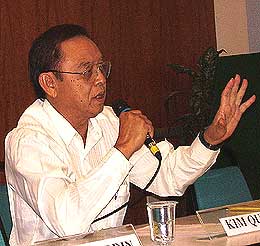 I met Quek (
left
) once at the
Malaysiakini
10th Anniversary Dinner and felt a kindred spirit not because we are both former accountants but we share a common concern for the country. As non-politicians we also like to write to newspapers in the public interest.
I met Quek (
left
) once at the
Malaysiakini
10th Anniversary Dinner and felt a kindred spirit not because we are both former accountants but we share a common concern for the country. As non-politicians we also like to write to newspapers in the public interest.
We belong to the generation that saw the hope of nationhood and the Merdeka vision dissipate before our eyes and corruption ruin the country. Armchair critics that writers often are may still prove the pen is mightier than the sword when their literary efforts awaken a people to act justly, not incite to hatred.
If readers expect saucy stuff in Quek’s book they may be disappointed. It is all stern stuff told in the serious but easy to read style of a writer who shows a command of the English language gained from the old British education system, as much as prowess in articulating his ideas.
He asks tough questions not only of the incumbent government but the opposition and their ability to occupy the seat of power at Putrajaya and provides convincing arguments. He relies on the facts verifiable from public records.
Figures tell the shocking truth
The accountant in him deftly uses the figures to tell the shocking truth about the disproportionate funds the federal government extracts and returns to Pakatan-government controlled states.
For example, in 2009, Penang - a leading industrial state - only got RM477 million from a Federal Budget of RM216 billion; Selangor got RM1.4 billion (2008) and the states experience obstacles from a centrist government intent on undermining instead of cooperating with their state counterparts.
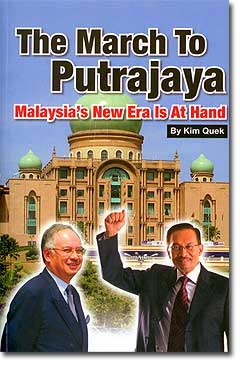 There is no bombshell or leaks provided by a ‘Deep Throat.’ In fact I found the book relatively pedestrian in pace yet highly informative; I read it in less than two hours. It was gripping in some parts and mostly related to events bygone albeit providing distasteful morsels of scandal and Quek’s interpretation of certain events filled the missing gaps in the political jigsaw.
The government’s claim that the book contains “baseless” accusations against national leaders and inciting public hatred and anger against the federal constitution looks like a misguided missile that has backfired. Overnight, after the ban and the book went online , it must have circulated the world many times instead of lying on store shelves to be purchased one by one.
I found my unsolicited copy waiting for me in my email inbox this morning and like an excited child opening a present, I quickly delved into its contents and was not disappointed. Unlike others who sometimes run amok in their writing against the government, Quek is professional, even-tempered, and convincing. He not only opines but appeals to our intelligence after a consideration of the facts, which makes his writings compelling.
Road to political perdition
Quek’s March to Putrajaya reads like the ruling power’s road to political perdition as he takes the reader from one shameful scandal to another, from Sodomy 1 and 2 to the death of Teoh Beng Hock and the notorious Altantuya murder trial. While some individuals are mentioned it is the collective responsibility of the government that is on centre stage under scrutiny.
 You may ban a book but not its message. And I think those of us who received a free copy of the online book should donate something to a fund that Quek may need to defend his freedom of speech, if in fact needed at all.
I found the first section ‘Making the Right Political Decision’ encapsulated the theme of the book and its title. The rest of the articles may have been published elsewhere before but are still useful in a compilation. Everything dovetails toward the reader, the voter being adequately and accurately informed to make the right and wise choice.
That is the citizen’s fundamental duty and Quek was spot on in reminding his readers. It is something that politicians also tell the people - ‘to vote wisely’ but without giving them the full story. Quek is about giving the other side of the story.
The road to Putrajaya is perilous as is the road to just and accountable governance. A country is still more important than its elected politicians and needs just governance, something still elusive today, and patriotic writers may be a thorn in the side of the politicians but they can help curb the insanity by being catalysts for change, if they write responsibly and professionally, without fear or favour, and above all - truthfully.
A tacit admission of defeat or guilt
Writers are not infallible. Their ideas may be challenged, even be fallacious. But an outright ban of a book like Quek’s looks likes a tacit admission of defeat or guilt by its detractors. Those criticised could have produced a reply even one as ridiculous as The Blocked March to Putrajaya . They have the money. They could have employed the best ghost writers. So once again there are more questions than answers and we can’t help asking, ‘why is the book banned?’
Quek however is unequivocal about his mission: “I have written this book with the purpose of offering commentaries and insights that are otherwise hidden by the notoriously sycophantic local press and television channels, but may be important for the making of balanced judgment.”
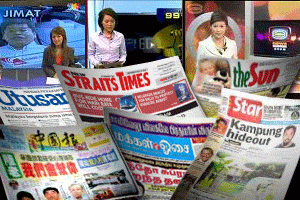 Most readers will agree. The ‘bastardisation of the NEP’ has destroyed the credibility of all the politically controlled media which have seen drastic drops in their circulation. That is the price for purveying propaganda as news.
As an outsider, I benefited from the author’s insights into the many controversial incidents that the newspapers omit. Because Quek is first a patriot and a trained professional used to sifting through the wheat and chaff, his writing achieves credibility, though March to Putrajaya is patently partisan and intentionally so. If there is a deficiency, it is the absence of a bibliography, if only to cite the reliable sources where possible.
As the country moves ahead it can’t afford to retrace its steps into the past, where outright ‘censorship’ that the Internet has removed to a considerable degree, robbed the people of the truth. Malaysians are no longer frogs living under coconut shells though there are still many monkeys around making mischief.
If the government thinks the book is poison then it must give us the antidote, just in case. A ban is not the antidote. But visible, just and blameless governance is. Who can undermine a government and fool the people when there is open and transparent governance?
The book’s ban is a badge of honour that Kim Quek can wear proudly. He must be rolling on the floor with laughter for the unexpected boon in publicity from the ban even if he does not make a commercial killing from the book now that the publisher has availed it free online and read even more widely. So why is the book banned?
STEVE OH is the author of Tiger King of the Golden Jungle . He is a business and property developer, singer, composer, and certified Master Personal Fitness Trainer, and charity worker. He wants Malaysia to be the Promised Land and not lost Land of Promise.


Are you sure you want to delete this comment?
This action cannot be undone.