




Sabah acts on Sg Segaliud pollution woes
More than a year after fending off recurrent public concerns over the state of the Sungai Segaliud in Sandakan, state authorities are swinging into action now.
More than a year after fending off recurrent public concerns over the state of the Sungai Segaliud in Sandakan, state authorities are swinging into action now.
The Sabah Environment Protection Department (EPD) has confirmed that a private firm has been appointed to follow-up on public complaints that the river stinks from pollutants.
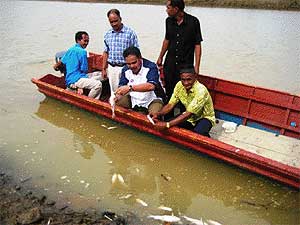 Sungai Segaliud is the main intake point for Sandakan's newly-commissioned water treatment plant. It has encountered continuing flak from the public since becoming operational late last year.
The plant can produce 125 million litres of water a day. This is sufficient to cope with increasing demand until 2020. The plant can also be expanded to produce 250 million litres of water a day.
"The private firm will act as consultants to the EPD and will furnish a report on Sungai Segaliud by the end of this year," said EPD director Abdul Razak Abdul Manad. "It will assess the varying pollution levels in the river."
He was clarifying an EPD announcement in the local media earlier this week that the authorities are seriously looking into public complaints on Sungai Segaliud.
It is hoped that an external study will ease some of the public fears about the quality of the water piped to their homes from the river.
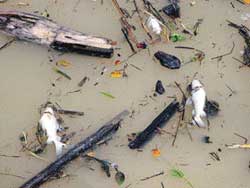 The public has so far not bought any of the explanations from the EPD and the Sabah Water Department (SWD) on river pollution.
Sungai Segaliud, according to Abdul Razak, is the second river in Sabah to be audited in this manner, the first being Sungai Kinabatangan in the lower reaches of the east coast. The Kinabatangan is Malaysia's second longest after the Rajang in neighbouring Sarawak.
The EPD director wants an education campaign to coincide with the external consultant's study of the Segaliud "as the public, factories and firms need to play their role in keeping rivers clean and free from pollutants".
Oil palm factories under close scrutiny
He disagrees with the public perception that Sungai Segaliud is highly polluted and not fit to be the intake for the new Sandakan water treatment plant. The public's understanding of pollution is not the same as that understood by environmental quality scientists, he added.
"We disagree with various complaints in the media that discharge from oil palm factories is polluting the Sungai Segaliud," said Abdul Razak. "There's no permanent cause for river pollution and we don't issue waivers or give exemptions. No one can get a licence to pollute the environment."
The EPD, he warned, will act against oil palm factories compromising the integrity of the river and has in fact done so in the past.
The operating licences of two factories were suspended last year, he said, and one of them resumed business recently after modifications to make their sewerage system to operate on a closed cycle basis. "Five other factories are currently under close scrutiny."
Likewise, tributaries feeding the Sungai Segaliud are also under close scrutiny.
Citing the tea-like colour of the river, he reckons that it stems more from the opening of land near the river for various purposes "and not necessarily because of pollution".
He concedes that fish and prawns have been found floating dead in the river but this was confined to stretches near the water intake plant which restricts the flow of polluted water to the sea and where the oxygen content is low.
Abdul Razak stressed that factories polluting rivers can be fined up to RM25,000 or their chief executives jailed two years or suffer both penalties under Section 16 of the Environmental Quality Act 1974.
The fine under Section 18 of the same Act is RM50,000. Unlicensed factories face fines up to RM100,000 under Section 25 of the same Act while the maximum jail sentence is five years.
Activist: Public complaints valid
Activist Samsudin Yahya, who heads the Sungai Segaliud Anti-Pollution Action Committee, welcomes the EPD study of the river. The committee comprises representatives from the EPD and various state government agencies.
"The public complaints on pollution are valid. I have seen it for myself," said Samsudin. "Dead fish like the lampang jawa, tilapia, baung and also prawns can be seen floating along entire stretches of the river and not just at the water intake point."
Samsudin, who is also the chairman of the state-sponsored Ko-Nelayan or Fishermen's co-operative, explained that Sungai Segaliud provides a livelihood for 1,300 people in Kampung Sungai Segaliud alone.
"Unfortunately, they can no longer depend on the river because of the increasing pollution level in the water," charged Samsudin. "Sixty fishermen in the Kampung have lost their livelihood."
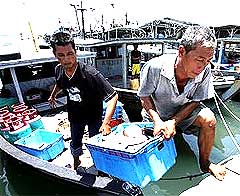 He estimates that the fishermen used to earn at least RM2,000 per month each from the river "but today, they are lucky if they can eke out RM400 every month".
The water near the treatment plant's intake point is also treacherous to navigate for the fishermen, according to Samsudin. A local, one Maidin, had a narrow escape last year when his boat overturned near the intake point and broke into two.
The villagers have since constructed a 200m alternative route from the river to the sea, by-passing the water treatment plant's intake point. However, this means dragging their boats onto land before they can reach the alternative channel to the sea.


Are you sure you want to delete this comment?
This action cannot be undone.