




7-year problem continues to bug poor villagers
Thirty-one Indian families with land titles in Kampung Sri Klebang Tambahan 1, Ipoh, are trapped in a seven-year-old problem of being unable to build their own houses - all for the lack of the necessary infrastructure.
Thirty-one Indian families with land titles in Kampung Sri Klebang Tambahan 1, Ipoh, are trapped in a seven-year-old problem of being unable to build their own houses - all for the lack of the necessary infrastructure.
These low-income villagers had stuggled over the years to fill the four acres of what was once a mining pool, where most of the lots are located, at a cost of RM200,000.
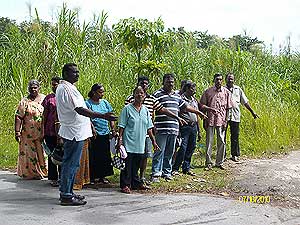 They received their land titles in 2003 but have been crippled by the non-existence of a drainage system, roads, electricity and water supply.
Initially, there were 175 families in the village, formally known as Kampung Chepor, but later 144 of them paid their development cost of RM5,800 each to the Kinta district land office and built their houses.
The remaining 31 families were unable to meet the payment deadline but later managed to off-set the setback by filling up the mining pool at their own cost.
They then wrote to former menteri besar Mohammad Nizar Jamaluddin, the incumbent Menteri Besar Zambry Abd Kadir and the Tambun MP, Ahmad Husni Hanadziah, to tackle their drainage and other infrastructural needs.
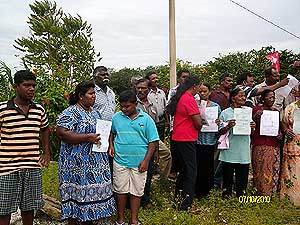 Although all three of them had written to the Kinta land office to settle the issue, that office appears to have put the problem in the back burner.
According to the village committee spokesperson S Sivasamy, 52, it is the duty of the land office, which has a special allocation for planned villages, to provide the infrastructure.
"What has happened to the 'People First, Performance Now' concept of Prime Minister Najib Razak in his attempts to woo the Indian voters to support BN in the coming general election?" asked Sivasamy who is also Parti Sosialis Malaysia Bercham branch secretary.
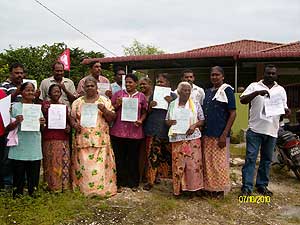
Kampung Chepor comes under Husni's Tambun parliamentary constituency and the 31 families are appealing to Husni, who is also second finance minister, to intervene and help solve their problem.
These people are also are paying double, a monthly rent of RM250 for temporary homes outside the village as well as assessment fees for their undeveloped lots, which they said was a heavy financial burden for them.


Are you sure you want to delete this comment?
This action cannot be undone.