




Rungu: She changed the way Penan babies are born
I first heard of "Rungu" in the remote jungle hamlet of Long Kerong, just north of the equator, near the border of Sarawak and Kalimantan.
An old nomad told me of an Australian woman who had lived and travelled with them many, many years ago, before they were forced to settle.
I first heard of "Rungu" in the remote jungle hamlet of Long Kerong, just north of the equator, near the border of Sarawak and Kalimantan.
An old nomad told me of an Australian woman who had lived and travelled with them many, many years ago, before they were forced to settle.
The story seemed too extraordinary to be true. Even today the region is rugged - the last preserve of the tropical jungle - with huge 60-metre dipterocarp trees perhaps 300 years old still surviving the threat from loggers.
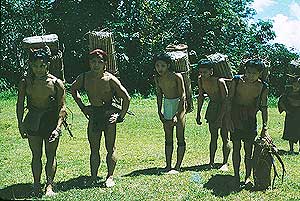 In this hot, wet region, leopard, wild boar, snakes and perhaps even rhino, roam the forest. But it is not these that threaten and make life difficult. It's the little things - the malaria carrying mosquitoes, other insects and the leeches.
Could a woman have made it up the rivers, when no logging roads existed, through the rapids and mountainous jungle to the region where the nomadic Penan wandered?
Sensing my disbelief perhaps, the old woman returned to her hut and produced a tattered letter sent in November 2002 from Margate, Queensland. This was hard evidence.
But in 2008, chasing the never ending story of the Penan's battles to save their forests from loggers, and the specific story of the tragic death of one of their leaders, Kelesau Naan, it was just another thing for me to jot in the notebook to be followed up at a later date.
Inquiries on my immediate return to Australia led to nothing. It was not until I was planning my next trip to Sarawak that I re-discovered my note on Rungu, or Mary Webster, and thought it worth trying again.
Lucky break in search for 'Rungu'
Luck was with me this time. One scrap of information was that she had translated the Bible into Penan. I had made inquiries in this area before but I thought it worth a few more emails. One went to Steve Davies, executive director of the Bible Society in Queensland.
In a flash he was back. Only days before a Baptist pastor had contacted him about an elderly parishioner who, as one of her last acts, was keen to have her new Penan Bible translation made available to the people.
But it wasn't Mary Webster, as I had noted, it was Phyllis, and by the way, he said, she had told him that none of the native people would have known her Australian name because in Borneo they had called her "Rungu". If I needed any confirmation, this was it
.
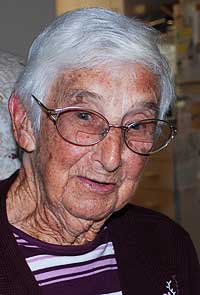 Phyllis Webster (
left
) was born in Red Cliffs, Victoria, on June 3, 1922, but spent the war years in Alice Springs. Today she lives in a retirement village in Brisbane.
Phyllis Webster (
left
) was born in Red Cliffs, Victoria, on June 3, 1922, but spent the war years in Alice Springs. Today she lives in a retirement village in Brisbane.
The war and its aftermath had a profound effect on her and she was left questioning the meaning of life - the deaths of so many people, the messed up lives of those who returned and the chaos and industrial turmoil in post-war Australia.
She did the rounds of the churches but nothing they had to say made sense to her. And then she met a woman who asked, "Have you read the Bible?" At the time she thought "What a silly question?" but she did go home and read the Gospels and was particularly moved by John 15, interpreting it as calling her to be a missionary.
Phyllis, undertook missionary training in Melbourne and, along with two colleagues, was sent by the Borneo Evangelical Mission to Lawas in Sarawak in 1951. Both her former colleagues are now dead.
Initially the three stayed with two other missionaries, Hudson Southwell and his wife, who had been interned by the Japanese during the war. They studied Malay, took exams, and Phyllis was posted to a Kayan community at Long Tebangan on the Akah River.
Two or three years later, she says, the needs of the remote jungle nomads, the Penan, were brought up at one of the mission conferences. In the 1950s the Penan were thought of as wildmen.
One early commentator, who probably had never seen them, said they were little better than monkeys living in trees, eating without cooking and being hunted by other tribes.
The big question was who could the mission send to them? It was new work and all the other missionaries were totally committed working with other settled tribes. Phyllis does not say it, but knowing the extreme difficulties of the task, few would have sought the job.
"Anyway it boiled down to the fact that the only one they seemed to consider was me," she says.
33 years old, and no clue about the tasks ahead
Phyllis (
right
) was about 33 at the time and had no idea how to carry out
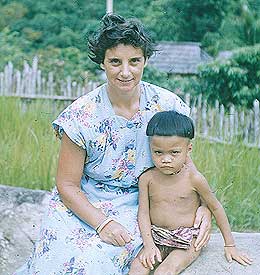 her task. She decided to go to the village of Lio Matu, high on the Baram River, to live with a missionary couple working among the Kenyah.
Here there were periodic "tamu," or market days, when the Penan would bring in jungle produce. When they appeared, Phyllis tried to get to know them and their language.
Some of the men could speak Kenyah but she couldn't. None could speak Malay but a few could speak the other language she had worked in, Kayan. Slowly, she learnt their language.
After several months, a girl, Até - the old woman who had first told me of Rungu - Singin, her sister, and another teenager befriended Phyllis and agreed to take her to where their band was camped in the jungle.
"There were no paths, nothing," she says. "The main thing I remember about it is being pushed and pulled and dragged up river banks and so on."
Gradually more and more contact was developed until eventually she went travelling with them.
Because of her extreme modesty, her story is known only to a few in her immediate circle. "Do you really want to know all this?" she asked on a number of occasions as I interviewed her.
When I told her she was extraordinary she said, "I don't think I'm at all unique. I had a whole lot of records about this kind of thing, diaries and things and I burnt them... nobody wanted them."
A brief note she has kept from that time recalls her sitting wet, cold and hungry, wondering why on earth she had ever come and observing the little children who were taught not to whimper or cry when hungry.
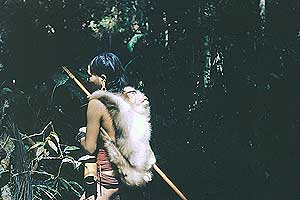 At night the jungle noises played on her nerves so that every creaking branch or falling leaf was a bear or leopard.
Deaf and frail now, a tiny five foot two inches or 155 cm, but as sharp as a knife, Phyllis remembers the dense canopy of the jungle trees, the rotting undergrowth, the silence, the smoke, the smell of singed hair, the night sounds, the screeching of hidden insects and the peculiar bird sounds.
How Penan babies were born, then
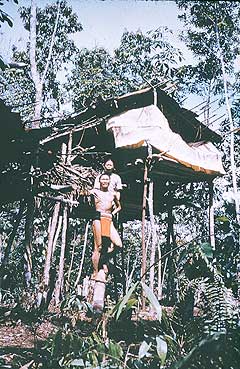
"Do you know what they used to do when a baby was being born?" she asks. "They always build a special hut for the girl, and when she came into labour, the husband would sit behind her so that she could lean back on him in between the labour pains.
"And when it came to the actual birth, because they believed it would get stuck if the floor was not opened up to allow the baby to go through, they would pull the branches apart so that the baby could fall (about one metre) through to the ground.
"Provided the placenta was ready to come, miraculously it didn't seem to cause much problem. But if the placenta was not ready to come, the weight of the baby falling tore the placenta out and the women bled to death in minutes... just like that," Phyllis says.
"I experienced that and that's the most dreadful thing that you can experience. I will never forget it. I witnessed it several times. It nearly always happened, either with a young girl with her first baby, or in some cases with women who had had a number of children and everything went wrong."
Phyllis says it took her years to persuade them to change their birthing practice. "The Penan are very, very resistant to change, change of any sort," she says.
 She is not the only one to make such an observation. A Lundayeh man I interviewed, Jayl Langub, who speaks Penan and worked with them as a government officer for 30 years, said they were peaceful, but argumentative. ‘‘I don't think I ever won an argument with them.''
But in all his time with them, Langub added, he never saw a Penan man hit another, confirming an observation that many have made that they are the most peaceful of people.
Phyllis says that gradually, mothers decided that the system they used was not good, and one by one, they stopped the practice. It's rarely practised now.
Medicine and home comforts were few and far between in the late 1950s jungle.
"Antibiotics and that sort of thing came later. You see, when you go to these places, especially then, you could only take with you what was absolutely essential, the very basics of life. You couldn't take a whole lot of medical equipment."
Providing education and medical services
Matches were always short. If the fire went out you could take a fire stick to someone else's coals to light your fire. The "essentials" she brought were "a change of clothing... aw I might have taken two, I can't remember."
Initially she was away for a week at a time, and then up to a month, where she would walk and move camp with her band.
Between 1955 and 1970 Phyllis observed many rituals and traditional practices while providing education and medical services.
Men sometimes got massive gaping wounds from cutting down the palm with their parangs.
"If they were away, which often was the case, and they had tobacco they'd stuff the gap with that to stop the bleeding. If they didn't have tobacco, because a lot of them didn't smoke, then they would pack it with mud.
"Sometimes, it would be weeks and the person would be carried in to you. You had to get all that out in order to treat the thing. And of course the moment you got it out, it would bleed, bleed like mad. That was the thing that frightened them more than anything else."
Part 2 tomorrow: 'One of the hardest things I ever had to do...'
PAUL MALONE, 60, has been a journalist for over 30 years in Australia. This article first appeared in the Canberra Times .


