




'One of the hardest things I ever had to do...'
Before leaving Melbourne, Phyllis had done a three-month medical training course conducted by doctors who had been interned by the Japanese during the war.
Before leaving Melbourne, Phyllis had done a three-month medical training course conducted by doctors who had been interned by the Japanese during the war.
“We had hands-on in the casualty. You could do almost anything under supervision.
“.... they taught us a lot, how to treat people without proper medication and proper equipment, such as they had been doing in the camps.”
 One doctor who had been on the Burma Road (she can’t remember his name) taught the use of soap and salt in treating infections, particularly the big infections on legs and arms.
“You used to make a salt mixture and constantly wash the puss out of things. And depending on what the thing was, you’d make a thick lather covering of soap over a wound or a sore to prevent it from getting more open and getting more infected.”
Midges, which swarm around the river banks, would burrow in around the wounds. But thick soap lather could be used to keep them off.
In one group she visited there was a small boy lying on a heap of rags, ill with dysentery and fever. His parents were some distance away working sago and he was being cared for by his grandmother. Phyllis had no idea how to care for him.
“I treated Lukat for a few days and he was still very, very sick and I
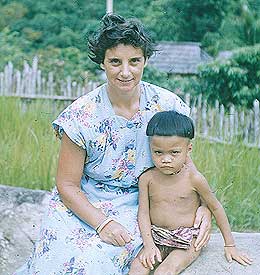 asked could I take him back to the base where I was living so that I could treat him. It was a big long walk, about half a day and then several hours in the canoe down river. I carried this child, on my back. See, I was fit then.”
He was with her at Long Tebangan on the Akah River for three months.
“It was one of the hardest things I ever had to do, to give him back,” Phyllis ( left in pic ) says.
Today Lukat lives in the Long Lellang area.
‘More dead than alive’
On another occasion, a small girl about three years old was brought to her with an infected tooth and bone, with pus coming out of the side of her mouth, and a hole in the side of her face. Her whole face was swollen up like a balloon and she was more dead than alive.
Phyllis cared for her for a couple of days and was able to arrange for her to be flown out to Seria Shell Hospital in Brunei where they operated and eventually did a bone transplant and skin grafts. She was in hospital for eight or nine months being treated. She came back to her family and was to have gone back to the hospital when she was about 11 or 12 for more skin grafts and more bone treatment, but that never happened.
The last time Phyllis saw her she was an adult, a little scarred, “but as scarring goes in that part of the world, it wasn’t too bad and she was still alive.”
In this region today, leeches still bother the jungle walker and I have had dozens on me at times so I asked about them in my first interview. She responded as though it was nothing to be concerned about. “Aw yes. Aw yes. We used to have all of that.”
In her second interview she was a little more forthcoming when asked if she got many on her.
 “Of course! Of course! You can’t go in that part of the country and not get leeches. Sometimes you don’t see them until they fall off and then you’re bleeding like mad and everybody’s bleeding. Wherever you sit down there’s blood everywhere, always.”
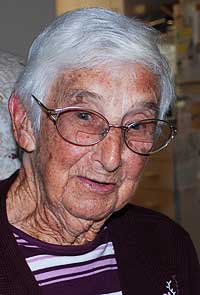
Phyllis ( left ) tells me she was blessed with very good health, for which she thanks the Lord.
“A million times things could have happened to me and I was completely isolated, but I was a naive person. It never ever occurred to me that something terrible could happen.”
Again she mentions later in passing that she got malaria several times and adds that the people looked after her in times of trouble.
‘Penans the most egalitarian of people’
She confirms the oft-reported observations that the Penan are the most egalitarian of people.
“They always shared all their food with you and you shared whatever you’ve got, which isn’t much, like your cake of soap. You’d have these half dozen other women sharing your cake of soap, when you had a bath. You had that kind of relationship.”
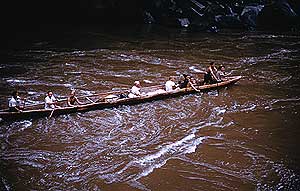 She also observed the equality of the relationships and roles of men and women.
“You rarely heard an argument because everything was community.”
A woman would sometimes go hunting with a man but a lot depended on whether she had a baby, or toddlers. Some women used blowpipes for small game but it was rare.
They had no equal in the jungle, moving silently on their prey.
But Phyllis also saw another side to them. The further they went into the jungle the more they would speak out.
“They’re not noisy, but they laugh and carry on, joking among themselves.”
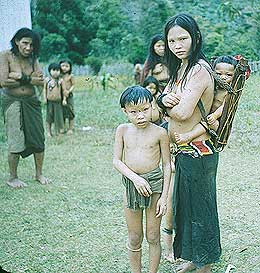 “They could move through the jungle and you wouldn’t hear a leaf move, whereas I go through it’s like a herd of elephants. They could frighten the Hell out of you. Yeah, suddenly you’d feel a presence. You don’t know where they’ve come from.”
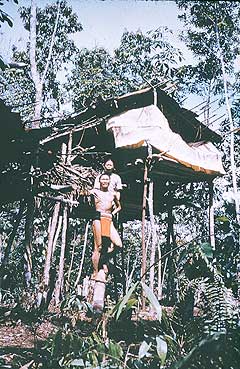
The men were, and are, incredible tree climbers, getting up into the canopy of the massive jungle trees to harvest fruit.
Other tribes tended to look down on the Penan, but also feared them for their prowess in the jungle. They were aware of the slur that they were “like monkeys” and Phyllis says they were probably deeply hurt within, but they didn’t show it. “It was a talking point and they would joke and laugh about it.”
At times, especially in the earlier days, the Penan feared all sorts of things related to the spirits. Phyllis was shocked by a practice of all the tribes to abandon one baby when a mother had twins. An omen bird could also cause the baby to be discarded. The newborn would linger two or three days while the mother had to sit there hearing the weakening crying of her child. Thankfully she witnessed this only once.
Although the Penan are the preeminent jungle hunters, they do not kill indiscriminately.
They never killed or ate the animals they took as pets. Phyllis observed that once they fed an animal, whether it was a dog, a bird, a monkey or even a rescued piglet, they would not kill it.
Today this even goes for chicken that roam around the houses where some of the Penan have settled.
Tepun - the owner, the carer
“It’s part of your family. The person who has a pet is called the Tepun - the owner, the carer - but the primary meaning of the word is like grandmother, or grandparent.
Older Penan like her first acquaintance, Até, refer to Phyllis as their ‘Tinen’, their mother. But their grandchildren who send her emails by the dozen refer to her as their Tepun.
In the early days it could be a struggle to get to the Penan camps up-river. On one occasion there had been a lot of rain and the river was coming up and was going to flood. The Kayan boatmen were in a hurry because they could have been stuck for days and, in the rush, her small box of provisions was left behind.
 British soldiers were working in the river some distance from where she finally camped and about a week later a captain approached and told her they were moving.
“We’ve got a few things left over. Can you use them?”
Phyllis says not only had her stuff gone missing, but she had had a hankering after chocolate
“I was asking the Lord for the provision of my needs - my daily food. I thought I can’t ask for chocolate, because that’s not a need. That’s just a want. .... but the very first thing I opened from this parcel was a tin of chocolate. I will never forget that.”
At times she was lonely and missed such things as her parents and music.
In those days radio were big and there were no small batteries. Nothing lasted.
“It’s wet. Everything’s wet. You’re wet. And everything around you is wet. And everything smells and everything goes mouldy. These are the sort of things that after a while they get on your nerves. And the drip, drip constant drip, drip, drip in the jungle. It’s like a dripping tap and there’d be times when you’d think you’re going insane.”
 Phyllis never married but she says she has no regrets about her years in the jungle. Today at age 88, she lives in a retirement village in Brisbane.
She left Borneo in 1973 but did not resign from the mission until 1975.
Getting a job back in Australia was difficult.“Every time I went seeking employment they wanted to know what I had done before and of course the moment you say that you’ve been a missionary you’re wiped off because you’re brainless if you’re a missionary”.
Finally she got a job with a firm of solicitors and worked with legal firms until her retirement.
She returned to the Penan in her holidays, last going back in 2000. She would like to return but recalls what it was like and how there were no paths, the roots and the slippery mossy logs.
“You know I would even have trouble getting into the canoe. I’m not very good at all without help. Around here if I go shopping I’ve got to take a walker.
“There’s plenty of people that would carry me. But I don’t wish to be carried.”
Part 1: Rungu: She changed the way Penan babies are born
PAUL MALONE, 60, has been a journalist for over 30 years in Australia. This article first appeared in the Canberra Times .


Are you sure you want to delete this comment?
This action cannot be undone.