




'Friending' the PM: Social media and politics in Asia
Unlike their European counterparts, Asian governments are still cautious about harnessing the power of social media, said an expert.
Unlike their European counterparts, Asian governments are still cautious about harnessing the power of social media, said an expert.
 In fact, said widely published social media guru Madanmohan Rao, besides being behind their European counterparts, Asian governments are also not in tune with their citizens which have taken to social media quickly, and large scale.
"Like it or not, people are talking about you, and you have no control. The balance of power has shifted to the people.
"A good way to use social media is to monitor what people say about you, clarify and jump in to give new information where required," he said during a workshop at the Asean Media forum in Bangkok on Wednesday.
Like corporate brands, Rao added, governments must understand the sentiments of its citizens through meeting them at the "watering holes of citizens" to know how policies are received by the population.
In Malaysia, for instance, Twitter Jaya as the thriving Malaysian Twitter community calls itself held nothing back as they ripped apart the 2011 budget as it was announced in Parliament.
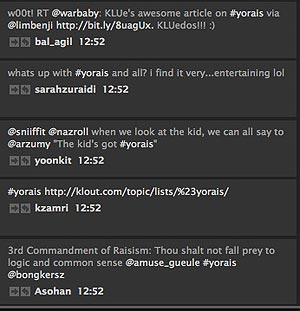 And when the same community was vilified by Information Minister Rais Yatim for abandoning "Eastern culture" for the "Western" social media technologies, jokes about the same minister made it to the top ten trending topic for the day.
Conversations, not just dissemination
An ‘outdated' Information Minister notwithstanding, it appears that Prime Minister Najib Razak's administration could be the very first government to be taking a large step towards transparency by way of social media.
In fact, perhaps a major factor for Twitter Jaya's quick response to budget was the fact that the Prime Minister's Office had tweeted Najib's budget speech line by line as he delivered it in Parliament.
The prime minister's blog also receives hundreds of thousands of hits, with comments which range from brickbats, bouquets and most importantly, recommendations which some argue have made it into policy.
But if Najib's government is to truly embrace social media, interactivity is the key and this remains a gaping hole in its social media approach which is more about disseminating than conversing.
Stray dogs and hostage takings
A good example of such could be found across the South China Sea to Asean neighbor, the Philippines.
Jay Micheal O Jaboneta and his young team are the eyes, ears and mouth of the president on social media like Twitter , Facebook , Youtube and through his website.
And even though only two out of the team of six monitor and produce content for the President's social media network, Jaboneta claims to have been able to respond to the majority of comments.
"Some of the questions or requests actually doesn't need to be solved by the president, like ‘Mr President, can you please solve the stray dog issue in my area?'
"So what we do is we inform the corresponding authorities and inform the person who sent the query about who they can and should contact," he said.
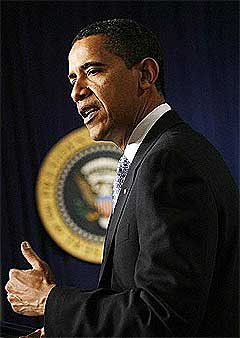 Quick to point out that they do not disseminate propaganda, the team has also taken a leaf out of the US President Barack Obama's (
right
) playbook, but posting ‘behind-the-scenes' videos of their boss-serving largely to build a more personal connection between him and the population.
Quick to point out that they do not disseminate propaganda, the team has also taken a leaf out of the US President Barack Obama's (
right
) playbook, but posting ‘behind-the-scenes' videos of their boss-serving largely to build a more personal connection between him and the population.
But the biggest challenge the team has had to overcome since its inception four months ago was the hostage situation involving Hong Kong holidaymakers in the Philippines, which saw the death of several tourists.
"There were just too many postings on the Facebook wall that we couldn't monitor them so we had to disable it, and only show official postings," he said.
Keeping the president grounded
For Jaboneta's team, monitoring feedback is a major part of their job as top three ‘trends' be it complaints, praises or observations, as well as samples of comments are presented to the president on a daily basis.
And with 24 million of the Filipino population connected to the Internet, this would mean that the President would more or less know what is on the minds of about one-fifth of the population feels.
Eventually, Jaboneta, they would also hope to move into mobile text messaging, reaching about 75 percent of the population who have access to mobile phones.
"How scientific this is is questionable, but these are the views of people who don't work for (the President). It puts him on the ground," he said.


Are you sure you want to delete this comment?
This action cannot be undone.