




Will Malay land rights victory in S'wak galvanise voters?
A Malay landowner, Mohamad Rambli Kawi, has won a groundbreaking Kuching High Court judgment upholding native customary rights (NCR) to land.
A Malay landowner, Mohamad Rambli Kawi, has won a groundbreaking Kuching High Court judgment upholding native customary rights (NCR) to land.
These rights are guaranteed by Sarawak's land code and the federal constitution, but are given scant recognition by the executive.
Mohamad Rambli, 63, sued the state government, after the Land and Survey department had declared that 1010 acres he owned in Loba Rambongan was in fact ‘state land'.
 He argued, successfully, that he had acquired an NCR claim to the land, after having compensated the local Malay landowners for their ancestral land or
tanah pesaka
, over the past quarter of a century. He had obtained the NCR land under the Malay custom of
serah
or transfer of ancestral land.
He argued, successfully, that he had acquired an NCR claim to the land, after having compensated the local Malay landowners for their ancestral land or
tanah pesaka
, over the past quarter of a century. He had obtained the NCR land under the Malay custom of
serah
or transfer of ancestral land.
Baru Bian ( right ) and See Chee How, state PKR chairperson and information chief respectively, represented Mohamad Rambli.
The two lawyers are non-Malays fighting for the land rights of all Sarawakian natives, including Malays.
Baru Bian described the NCR ruling as highly significant. "The Malays are also accorded with native customary rights premised upon custom or adat , which is in accordance with the Sarawak Land Code."
High Court Justice Linton Albert found that the local Malays had established NCR claims to land by settling the area, as well as using adjacent swampland or forest, as a source of charcoal, building materials, and food.
Aerial photographs from half a century ago had demonstrated the area had been settled by the natives, proving they had established rights to the land, as specified under the land statutes.
According to the judge, these claims to land used for foraging are as strong as the Iban NCR claims to virgin forest or pulau . The Iban leave certain forests undisturbed to allow sustainable gathering of food and jungle produce, a custom known as pemakai menoa.
"The acquisition of native customary land has lately gained prominence and (has been) consistently recognised by our appellate courts. It is now well defined and firmly established and is an integral part of the corpus of our substantive laws," Justice Linton Albert pointed out in his 13-page judgment.
Court ruling opens floodgates
Sarawak's government must now be anxious that independent-minded judges have opened the floodgates for Malay landowners to mount legal challenges. The government also faces further judicial curbs to its cavalier acquisition of natives' land for so-called ‘development'.
Even now, there are over 200 NCR lawsuits against the state government and associated companies percolating in the courts. Native communities throughout the state, including Malays in Lundu, Iban in Sebuyau, Penan in Baram and Lun Bawang in Limbang, have protested angrily against the government's ‘hostile takeovers' of their only assets.
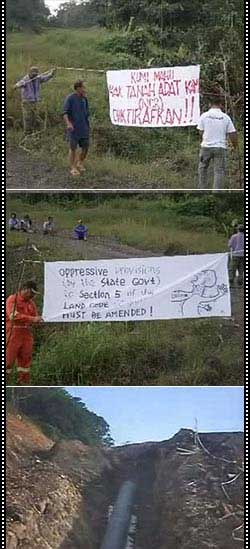 All of Sarawak's ethnic groups have felt the impact of the loss of their land to the insatiable appetite of ‘developers'.
Last week in Lawas, the police arrested five Lun Bawang protestors, Nasum Singa, Samuel Sakai, Charles Gor, Akal Kading and Sulaiman Joseph, for attempting to defend their NCR land from incursion by a contractor tasked with setting up a giant gas pipeline for Petronas from Sabah to Bintulu.
The police also hacked down the protestors' hut at the site of the blockade across the contractor's access road.
The demolition of the blockade finally allowed the pipe-laying company to bring in "mainly Bangladeshi" labourers, as reported by Sarawak Indigenous Community News.
It is ironic that state ministers had promised the pipeline would provide employment opportunities for local Sarawakians.
The five men were released without charge. Lawas police have been slated for springing into action to arrest the natives at the Petronas gas pipeline blockade, while remaining indifferent to repeated reports by the villagers regarding the contractor's incursions.
A similar pattern was seen in the arrests last month of seven Iban in Sebuyau, for obstructing a timber concession holder, partly owned by chief minister Abdul Taib Mahmud's family.
New land schemes for old
Many communities' NCR lands have been stripped of the timber from primary forests. The land is then converted into plantations of palm oil. Another new plantation scheme entails fast-growing imported tree species, to be harvested for wood.
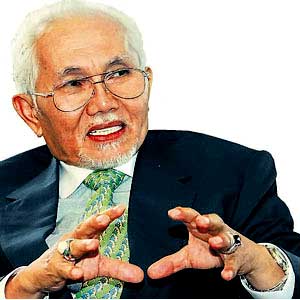 As minister in charge of natural resources, Taib (
left
) enjoys untrammeled power over granting concessions and acquiring ‘state land'.
As minister in charge of natural resources, Taib (
left
) enjoys untrammeled power over granting concessions and acquiring ‘state land'.
He is able to approve or veto even the tiniest shop-house project. He has amended the Land Code numerous times over the past 29 years, to weaken native communities' resistance to land takeovers.
Timber and plantation tycoons aligned with Taib's family have amassed staggering wealth. Taib and his family are reported to own property fortunes all over the developed world, and recently boasted casually that "I've got more money than I can ever spend."
Landowners of all races, unite?
Baru Bian must be hoping that the recent court rulings in support of NCR landowners, and police suppression of land rights protests, might galvanise Sarawak's rural Malay, Iban, Bidayuh and Orang Ulu communities into seeking a change of government in the coming state election. These groups comprise some 70 per cent of the population.
However, public awareness of these events is patchy, at best, among impoverished rural communities.
PKR has been attempting to distribute party news sheets to rural Sarawakian communities, detailing alleged corruption in the state and promising recognition for NCR landowners if PKR is elected into office.
Unfortunately, the driving force behind the news sheets was Zaid Ibrahim, now in exile from the party. It remains to be seen whether PKR will continue to pursue this effort to disseminate information to rural Sarawak.
Another channel for information is a newly established shortwave radio station, Radio Free Sarawak .
This radio station is broadcasting independently of the government-controlled media, for a modest two hours a day to rural communities. The radio station appears to aim to spread, among rural Sarawakians, the news easily accessible to internet-savvy Malaysians elsewhere.
But it remains clear to all observers that news still travels slowly in rural Sarawak.
KERUAH USIT is a human rights activist - ‘anak Sarawak, bangsa Malaysia'. This weekly column is an effort to provide a voice for marginalised Malaysians. Keruah Usit can be contacted at keruah_usit@yahoo.com.


Are you sure you want to delete this comment?
This action cannot be undone.