




Last try to save Sabah rhino from extinction
The writing is on the wall for the Bornean rhinoceros (Dicerorhinus Sumatrensis Harrissoni), a sub-species of the Sumatran rhinoceros.
The writing is on the wall for the Bornean rhinoceros (Dicerorhinus Sumatrensis Harrissoni), a sub-species of the Sumatran rhinoceros.
There are less than 40 of the endangered animals in the Sabah wild, it's only known habitat.
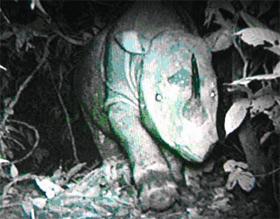 Nevertheless, the Sabah state government wants to make one last ditch attempt to save the animal from imminent extinction.
If the experiment fails, as it is expected by those involved, not much hope is held for the other threatened species in the state.
These include the Borneo pygmy elephant, Sunda clouded leopard, orang utan, the hairy-nosed otter and the otter civet. The hairy-nosed otter was in fact thought extinct for over 100 years until "re-discovered" recently in the wild.
"The state government is very seriously committed to saving our endangered Bornean rhinoceros," said Sabah Wildlife Department (SWD) director Laurentius Nayan Ambu. "This is an extraordinary programme which we have dubbed Beyond the Mile."
He was following up on the on-going debate in the local media on the pointlessness of worrying about an animal which was doomed to extinction anyway.
The time, effort and resources expended on the Bornean rhinoceros, it is felt by critics, could be better expended on other endangered species which are on the brink of extinction but stand a better chance of being saved.
Ambu conceded that attempts to breed the Bornean rhinoceros in captivity over the last ten to 20 years proved futile despite the animals involved in the experiment being healthy. Still, he's all for another attempt to save the animal.
"In previous attempts, it was found that either the male had a very low sperm count or the female had a growth in the ovaries," said Ambu. "This time we are getting foreign collaboration to undertake a captive programme."
The Beyond the Mile programme revolves around a very fertile male, Kretam or Tam in short, and a very old female, Gelegub, who may not be that fertile, and has been moved from the Lok Kawi Wildlife Park.
Other animals will be gathered as well and all of them will be placed in a special sanctuary, the Borneo Rhino Sanctuary (BRS), at the Tabin Wildlife Reserve near Lahad Datu along the eastern seaboard. However, the challenge is to find the most fertile animals from the different pockets in the protected forests.
Borneo Rhino Alliance's (BORA) executive director, Junaidi Payne, thinks that Gelegub may simply be too old to be able to produce eggs and might be treated with hormones to induce her to produce eggs to be will be artificially inseminated with sperm from Kretam.
"With the help of German experts we hope to make it ovulate," said Ambu. "After fertilisation we will freeze these eggs and later put them in Sumatran rhinoceros which will act as a surrogate mother."
The German together with other foreign experts, continued Ambu, have experience breeding African and Indian rhinoceros.
These animals are considered to be in the same family as the Bornean rhinoceros, the smallest of the species, and the Sumatran rhinoceros. The gestation period for the rhino is about 16 months and the interval between calves at least three years.
He disclosed that a female rhino, an alternative, has been spotted living entirely alone in a stretch of protected forest. However, attempts to capture the elusive animal have been going on since the beginning of this year but without any sign of success so far.
Time is up
Payne is among those who think that the Bornean rhinoceros' time on planet Earth is up.
"Based on fossils, we know that this type of rhino, or something quite similar, has been around on Earth for perhaps 20 million years," said Payne. "So, maybe it's time to say goodbye forever."
Ultimately, the argument boils down to a question of ethics, according to him. "Should humans stand by and let a species become extinct, knowing that with effort, it might be saved?"
Saving the rhino probably has only very minor economic benefits like high-end tourism or farming them for their horns.
Oil palm estates in Sabah have meanwhile fragmented the forests over the years and large areas of rhino country have disappeared.
The threat to the Bornean rhinoceros, stressed Payne, was not from loss of forest habitat or poaching but deaths exceeding births for many decades. Hence, it is held that it would be only a matter of time before the last one or two rhinos die of old age, whether or not they are poached.
The last known wild birth of a rhino in the wild in Sabah was observed sometime in 2006 by the Bora. Earlier this year, a camera trap in the wild also captured what looked like a pregnant rhino.
On a scientific note, Payne is in favour of cross-breeding the Bornean and Sumatran rhinos as the former have become inbred over the years and therefore less fertile, and susceptible to genetic disorders.
Other problems are tumours and cysts in the reproductive organs of females and this renders them less likely to have offspring.
Captive breeding, it's understood, will take many attempts before offspring can be produced. All it takes is a young pair of healthy fertile rhinos. Nevertheless, the world's attention will be focused on the BRS at Tabin over the next year or so.
The BRS is taking shape on a 20 hectare site within Tabin. The Sime Darby Foundation Board has already committed RM5 million towards BRS and a further RM2.3 million for Tabin.
Besides the SWD, Bora and Sime Darby, others involved in saving the Borneo rhino are Universiti Malaysia Sabah, Sabah Ministry of Tourism, Culture and Environment, Tomanggong Group of Estates, Sabahmas Plantations, Ladang Permai Sdn Bhd, WWF Malaysia, WWF Germany, the Leibniz Institute for Zoo and Wildlife Research and the Leipzig Zoo, (the last two also from Germany), the Veterinary University of Vienna, Austria, the US Fish and Wildlife Service and Land Empowerment Animals People (LEAP), an international NGO.


Are you sure you want to delete this comment?
This action cannot be undone.