




Affirmative action programmes need overhaul
Former Suhakam vice-chairperson Simon Sipaun suggests a drastic rethink in the federal government's affirmative action programmes.
Former Suhakam vice-chairperson Simon Sipaun suggests a drastic rethink in affirmative action programmes implemented by the federal government.
He is favour of the Malays, as the majority community being weaned off the programmes in favour of needs-based programmes.
"Affirmative action programmes are actually carried out elsewhere in the world for under-represented communities at the expense of the majority," said Simon.
"Malaysia must be the only country in the world where the majority community, the Malays, have decided that they need affirmative action."
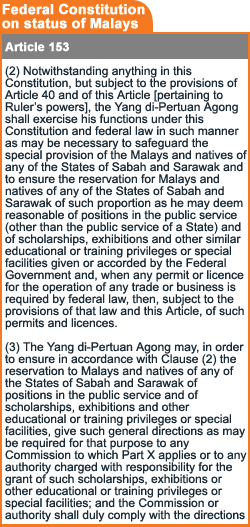 Sipaun, who is currently one of the twelve advisors at the Malaysian Anti Corruption Commission (MACC) appointed by the King, was giving his take on the ongoing debate on Article 153 of the Federal Constitution.
The Article provides for a special position for the Malays and natives in four specific areas and protects the legitimate aspirations of the non-Malay communities.
The Malays, continued Sipaun, are over-represented in every aspect of government and the reach of government. Hence, the extension of affirmative action to them exclusively on the basis of race and religion cannot be justified, he added, if considered from the standpoint of ethics and moral and religious values.
"If we look at Article 153, it's no secret that the Orang Asli and the non-Muslim native majority in Sabah and Sarawak have been left out," said Sipaun. "The 15 year shelf life of Article 153 has long been over. But it's still being applied selectively for the benefit of certain Malays to the exclusion of others."
Article 153 has even been extended, in defiance of the Federal Constitution, to every aspect of life in Malaysia, said Sipaun.
During his time with Suhakam, which extended over an unprecedented three terms or nine years until April this year, Sipaun said that he saw for himself the chronic poverty among the Orang Asli and Penan in particular "but nothing was being done to address their concerns and needs".
"In the case of the Orang Asli, the Jabatan Hal Ehwal Orang Asli (JHEOA) is supposed to assist and help uplift the community but nothing of that sort is happening," said Sipaun. "In fact, the JHEOA is the very department squatting on the community from even before independence."
The reason for the failure of the JHEOA, stressed Sipaun, stemmed from the fact that it was almost wholly manned by Malay civil servants and not the Orang Asli. Another reason was that most of the budget was swallowed up by the administration of the department itself, leaving very little for the community.
Even here, charged Sipaun, only a minority of the Orang Asli who embraced Islam benefitted while the others were left to fend for themselves.
"During my Suhakam days, we went out to the Orang Asli villages and found that the JHEOA practiced blatant discrimination," said Sipaun. "While the Muslim Orang Asli had nice houses to live in, the other members of the community had only grass huts and no opportunities for even living off the land."
Original spirit
Despite the expiry of Article 153, Sipaun suggested that its original spirit - the four specific areas - be continued and extended to the Orang Asli.
Article 153 provides that the Malays and natives be accorded a special position and are reserved a reasonable proportion of places in four specific areas viz. intake into the civil service, intake into institutions of higher learning owned by the government and training privileges, government scholarships and opportunities from the government to do business.
 Likewise, Sipaun feels that the Penan and other natives in Sarawak and Sabah still need Article 153.
"One other needs-based community is the underclass from the estates in Peninsular Malaysia who have transmigrated to the urban areas," said Sipaun. "This is the constituency represented by Hindraf Makkal Sakthi. They have real historical grievances which must be addressed by the federal government."
Instead, said Sipaun, he has seen the police picking on the urban Indian poor especially the youth and "intimidating and browbeating them into submission".
"Unfortunately, the police seem to have a problem with the Indian community," said Sipaun who witnessed the brutality of the police towards the community as the Suhakam vice-chairperson. "It's not good for race relations when the police are seen as always picking on a defenceless group of Indians."
If crime is the issue, pointed out Sipaun, it's not peculiar to the Indian community. However the really big criminals including the white collar types and triads, noted Sipaun, get away even with murder.
In summing up, Sipaun opined that "the most ashamed people" in the country must be the brightest and best Malays who have to put up with the indignity of tolerating the undeserving members of the community who only get opportunities because of their race and religion.
"We need to be led by the brightest and best from all communities and not the incompetent and undeserving."


Are you sure you want to delete this comment?
This action cannot be undone.