




Semporna tops world in marine biodiversity
Eighteen international marine scientists - Dutch, American and Malaysian - have unearthed evidence that Semporna along Sabah’s eastern seaboard may have the highest marine biodiversity in the world. This means that Semporna has now dethroned Papua New Guinea and Indonesia, hitherto the top-ranked spots in the world for marine biodiversity.
Eighteen international marine scientists - Dutch, American and Malaysian - have unearthed evidence that Semporna along Sabah’s eastern seaboard may have the highest marine biodiversity in the world. This means that Semporna has now dethroned Papua New Guinea and Indonesia, hitherto the top-ranked spots in the world for marine biodiversity.
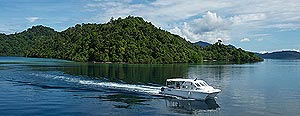 The findings were disclosed in a pre-Christmas statement in Kota Kinabalu by the Semporna Marine Ecological Expedition (SMEE) 2010. The expedition has concluded a 17-day study of the biodiversity and reef status of Semporna-Darvel Bay near Sandakan.
The scientists spent more than 1,000 hours underwater studying 12km of the Semporna reefs.
“The people of Sabah should be very proud that they own such a top marine eco-system in the world,” said expedition leader Bert Hoeksema in elaborating on the statement. “Semporna is not only a world class diving spot.”
The expedition, according to Hoeksema of the Netherlands, encountered 844 species of fish including 756 species of reef fish, 90 plus coral shrimp species and 100 plus algae species. The roving fish count, conducted by American Professor Kent Carpenter, also discovered a couple of coral shrimp and gall crab species that were new to science and a rare mushroom coral species, the lithophyllon ranjithi.
“Fish species counts, in some of Semporna’s diverse reefs, were greater than what we have encountered in Indonesia and the Philippines,” confirmed Carpenter.
However, while biodiversity is extremely high, the downside is that the population is glaringly low due to over-exploitation, noted Universiti Malaysia Sabah macrobenthos lecturer Muhammad Ali Syed Hussein.
43 species of mushroom corals recorded
Initial coral counts by Hoeksema’s expedition shows that Semporna also leads in the 5 sq km Coral Triangle with the highest coral biodiversity. “We recorded 43 species of mushroom corals in Semporna compared with 40 in Papua New Guinea and Indonesia, the previous recorded richness of this family,” said Hoeksema.
He explained that where there’s a high richness of mushroom corals, there’s usually an extremely high richness of other corals as well. Mushroom corals can be used as proxy (representative) for other coral richness. Mushroom corals apparently live freely on the sea bed from the shallow reef flat down to the sandy reef base.
Again, there’s a downside. A modified ReefCheck methodology was used to assess reef health during 60 dives across 12km of transects. The reef checks ranged from poor to excellent which only showed five percent live coral cover i.e. 75 percent to 100 percent. The other 95 percent of the reefs showed good, fair and poor in almost equal amounts. The reef checks were conducted by a Coral Reef Status team led by Universiti Malaya coral ecologist Affendi Yang Amri.
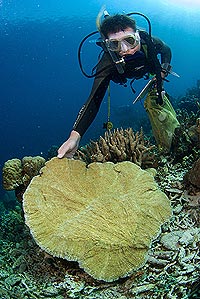 Aside from the few sites showing good coral covers in Semporna, stressed the scientists, nearly all sites showed significant human impact caused by fish bombing, discarded fishing gear, solid waste and impact of climate change such as coral bleaching.
Adding more stress to an already stressed overshoot, they added, would only hasten their demise. “Much restorative work is needed to address its declining health which faces critical stress and threats.”
The scientists came across four unexploded fish bombs during their study and heard 15 fish bombs exploding.
Coral reefs provide a haven for fish and other creatures, and larger fish tend to congregate around reefs because they are good places to feed. Bleaching - a whitening of corals that occurs when symbiotic algae living within coral tissues are expelled - is an indication of stress caused by environmental triggers such as fluctuations in ocean temperature. Depending on many factors, bleached coral may recover over time or die.
Semporna is within the 5 million sq km of sea straddling the waters of Sabah, the Philippines, Indonesia, Timor Leste, the Solomon Islands and Papua New Guinea. These waters contain the Priority Conservation Area designed under the Sulu-Sulawesi Marine Ecoregion and the larger Coral Triangle initiatives funded by the respective governments and the international community.
In addition, Sipadan Island and the reefs inside the Tun Sakaran Marine Park have been protected under Sabah Parks. The remaining reefs need to be managed for sustainable use which includes sustainable fishing, tourism and aquaculture.


Are you sure you want to delete this comment?
This action cannot be undone.