




Suluks in Sabah struggling for state-wide platform
The Suluks in Sabah still want to gather the flock under one platform despite the Registrar of Societies (ROS) rejecting their bid to form the apolitical Ikatan Bumiputera Sulu Sabah or Sabah Sulu Bumiputera Network.
The Suluks in Sabah still want to gather the flock under one platform despite the Registrar of Societies (ROS) rejecting their bid to form the apolitical Ikatan Bumiputera Sulu Sabah or Sabah Sulu Bumiputera Network.
The rejection appears linked to the failure of the deregistered United Sabah National Organisation (Usno), a Suluk-dominated political party, which made way for Sabah Umno, to revive itself, after the ROS twice rejected attempts by the pro-tem committee.
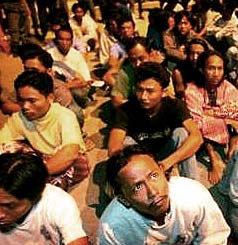 They also want to actively engage themselves, through a formal association, with the issue of illegal immigrants who are mostly from the Sulu Islands in the southern Philippines.
The Sulu Sultanate once ruled over the eastern and northern portions of Sabah. The heirs of the sultanate still receive a pension from the Malaysian government and are pursuing their claims to the Philippines regarding their sovereignty over eastern and northern Sabah.
The ROS has so far only agreed to the formation of the Persatuan Bumiputera Suluk Kota Kinabalu, Sabah or the Bumiputera Suluk Association of Kota Kinabalu, Sabah (BSA).
This was in October 2009. The pro-tem group, now recognised as BSA, are not sure why the ROS is against an all-Sabah vehicle for the Suluk community.
The ROS was not immediately available for comment.
Socio-economic problems
"While waiting approval from the ROS, we visited many areas in Sabah where our people reside," said Rethaudin Jasmil who assists his father Jasmil Sirad who heads BSA. "We saw at first hand the predicament of our people in many areas of life."
He was giving an update on the efforts being made by the Suluks to band themselves together to raise and address issues of common interest in housing, education, health and other socio-economic problems.
They visited Kota Kinabalu especially Pulau Gaya - the hotbed of illegal immigrants - Likas, Penampang, Luyang, Kinarut, Telipok and Karambunai, followed by Sandakan, Lahad Datu, Telupid, Kudat, and Dusun Tuaran, further up the west coast from KK.
The duo claim that 3,000 Suluks have since signed up as members of BSA. They expect membership to reach 20,000 by the end of next year.
They did not state where the members were coming from, but it's believed they are mostly ex-Usno people who did not join Sabah Umno, or have since left the party with feelings of alienation and marginalisation the likeliest reasons.
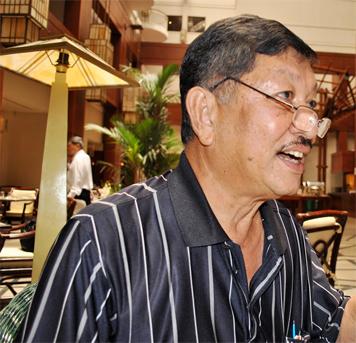 The most famous ex-Usno exit from Sabah Umno was the initiator Karim Ghani (
left
), an Indian-Dusun, who recently joined Parti Keadilan Rakyat (PKR).
The most famous ex-Usno exit from Sabah Umno was the initiator Karim Ghani (
left
), an Indian-Dusun, who recently joined Parti Keadilan Rakyat (PKR).
Even so, the BSA will focus on the Suluk community which has long been in Sabah even before the arrival of the British North Borneo Company.
The general stereotyping of the Suluks (in Sabah), admits Rethaudin, "is one of the major challenges facing the association".
For many Sabahans, the term Suluk is synonymous with illegal immigration from the Philippines and dubious citizenship.
"It's the continuous inflow of our brothers and sisters from the Philippines that contributes to the misconception that the Suluk in Sabah are not bumiputera," said Rethaudin. "They are coming here in search of a better life but unfortunately, illegally."
The original Suluks in Sabah, continued Rethaudin, are genuine Malaysian citizens and bumiputera "on the basis that we have been here long before Malaysia and the coming of the British".
He conceded that as a responsible association, the BSA would not turn its back on the issue of illegal immigration which has plagued Sabah for decades "and would help deal with it in any way they can".
Rethaudin wants non-Sabahan Suluks as well, besides Sabahans, to turn to the association for help.
His younger brother Sadam Jasmil, BSA deputy secretary-general, feels that the illegal immigrants in Sabah must be seen as part of the solution and not the problem.
"In order to do that, we need to help them," said Sadam. "We would not resort to unconstitutional action. We will help them to understand and appreciate Malaysian law."
He thinks that this could be done by communicating with those Suluks who are illegally in Sabah and educating them on ways and means of entering the state legally.
He does not think that sneaking in illegally without any travel papers is the right thing to do since it means courting arrest and deportation, which in any case, "has not solved the problem either".
Lost heritage
The BSA has also mandated itself to deal with the wider question of re-introducing and preserving the lost heritage of the community.
This means Suluk culture and tradition, its songs, dances and poetry.
They also have a pre-Islamic Buddhist heritage in their culture, customs and traditions as for example in the Vidhyadhari dance form.
"It's a distressing fact that many Suluk today are no longer familiar with their culture and some can no longer speak their native language," coninued Sadam. "The challenge is also to gain recognition for ourselves as part of Sabah's colourful past, as well as the present and the future."
 The most famous Suluk in Sabah was Usno president Mustapha Harun. Mustapha, who has also been governor and chief minister, has been linked with the illegal immigrant issue and fueling the Muslim rebellion in the southern Philippines.
The newly-installed governor, former state assembly speaker Juhar Mahiruddin, is also a Suluk.
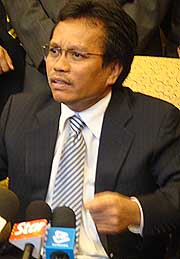
There's also a Suluk - Shafie Apdal - who is a federal cabinet minister. Shafie ( right ), also an Umno vice-president, is a nephew of Sakaran Dandai, a former chief minister and governor.
The other major Muslim community in Sabah is the sea-faring Bajau, which is larger than the Suluks. The Bajau first arrived in the state more than 300 years ago from the Philippines.
The Suluks, in an effort to be more acceptable to the general population, sometimes try to pass themselves off as Bajau or Bajau-Suluk.
There are also many Bajau illegal immigrants in the state.
Indeed many Sabahans have blood ties across different ethnic groups. For example, when a person says he or she is Suluk, the mother may not be one.


Are you sure you want to delete this comment?
This action cannot be undone.