




LKY's take on 'political stability' an anachronism
COMMENT The most significant news coming from across the causeway over the weekend was Minister Mentor Lee Kuan Yew peering into his political crystal ball.
He sees everything coming up roses in the city-state, for at least another 10 to 20 years.
Beyond that, it is anybody’s guess, as Lee himself readily concedes. He is pragmatic enough to realise that every organisation contains within itself the seeds of its own destruction.
COMMENT The most significant news coming from across the causeway over the weekend was Minister Mentor Lee Kuan Yew peering into his political crystal ball.
He sees everything coming up roses in the city-state, for at least another 10 to 20 years.
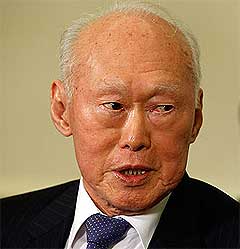 Beyond that, it is anybody’s guess, as Lee (
left
) himself readily concedes. He is pragmatic enough to realise that every organisation contains within itself the seeds of its own destruction.
Beyond that, it is anybody’s guess, as Lee (
left
) himself readily concedes. He is pragmatic enough to realise that every organisation contains within itself the seeds of its own destruction.
No political party, he observed, has ruled indefinitely anywhere in the world and cites the Liberal Democratic Party of Japan as a case in point which failed to buck the trend.
On his own People’s Action Party (PAP), Lee does not rule out a natural decline of the talent pool as new blood prefers to make common cause on the other side of the political divide.
This, if coupled with the boredom of the people with prolonged “political stability”, could see voters bringing the opposition to power for “no rhyme or reason”. If that happens, Lee does not rule out Singapore “going to the dogs”, so to speak.
“Going to the dogs” is a favourite theme with Lee. He has previously declared that history is against Singapore in noting that “there had always been an India throughout history”.
In the case of Singapore, he sees it as an artificial place, which may not last like the historical states like India.
It’s difficult to say that Lee is not speaking the truth, or more accurately, a half-truth.
A bout of scare-mongering?
Still, the jury is out on the question of whether he is, “as usual”, indulging in a bout of scare-mongering to make Singaporeans sit up and take notice to drag out the PAP’s days in power.
There are even others who swear that Lee’s message is directed as much at Malaysia as much as Singapore.
In the case of Malaysia, the prognosis is that the ruling party may not have the luxury of another ten to 20 years in power before its past catches up with it in the present to haunt its future.
For Malaysia and Singapore, taken together, students of political science will dismiss Lee’s notion of “stability” as an anachronism.
History shows that the longer a political party stays in power, and enforces a kind of artificial instability, the greater the instability that follows upon its eventual and inevitable exit.
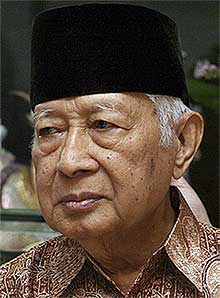 Examples abound in the region and include Indonesia after over 30 years of Suharto (
right
) and the Philippines after 20 years of Marcos.
Examples abound in the region and include Indonesia after over 30 years of Suharto (
right
) and the Philippines after 20 years of Marcos.
Elsewhere, we have the example of Yugoslavia which disintegrated into civil war after 50 years of Tito of Croatia.
Yugoslavia was the most developed and westernised in the communist block during Tito’s time. It was even held up by naive western writers as a model of sorts for the rest of the communist world.
Along with Nehru’s India and Sukarno’s Indonesia, Tito helped forged consensus amidst the Cold War years for a non-aligned block of nations. Those were the heady days for Yugoslavia when its national flag-carrier could be seen girdling the globe with its bevy of incredibly beautiful air stewardesses.
Then it all ended in rape, mutilation, and genocide in the killing fields of Bosnia-Herzegovina as intolerance replaced tolerance amidst an experiment to declare the first Islamic state in a Christian continent, Europe.
Malaysia and Singapore could have evaded the certain instability that lies ahead if both had decided early on from independence that there should be at least competing vehicles in the political space.
Instead, as in Yugoslavia, Indonesia and the Philippines, the ruling parties have engaged in the systematic destruction of opposition parties. The troubles that they have stored up from the past are yet to visit them and will surely do so in the near future.
Allowing for managed chaos
The transition of power from the ruling party to the opposition, every ten years or so, lessens the destabilising shocks to the system and allows for a kind of managed chaos.
A regular change of government is also part of the checks and balances in any genuine democracy and, in turn, allows for public accountability, transparency and good governance. Nothing of that sort transpired in Singapore to a certain extent while Malaysia is a big, fat zero.
Malaysia has degenerated under a one party-state over half a century into a unitary structure which is the very antithesis of a federation. The states have lost their powers, especially Sabah and Sarawak, and compliant local governments are installed by the federal government.
The doctrine of separation of powers, whereby the legislative, the executive and the judiciary act as checks-and-balances on each other, has become a figment of the imagination.
Parliament has been reduced to a rubber stamp more intent on muzzling the opposition. The judiciary has become a department of glorified government clerks under the thumb of the executive.
The result, combined with a two-thirds majority in Parliament until 2008, has allowed the executive to indulge in gross abuses of power and exercise absolute power.
Is it any wonder, therefore, that the corruption levels have breached the stratosphere? Power corrupts and absolute power corrupts absolutely.
There should be no illusions that what has been happening in Malaysia has not been happening in Singapore.
The city-state is a mirror image of Malaysia, but being a tiny place, it has allowed itself to be micro-managed to the extent that its economy in GDP terms eclipsed Malaysia’s last year by US$5 billion. Singapore’s GDP is US$210 billion while Malaysia’s is US$205 billion.
Ready to be a nation with soul and character
Lee knows that the people of Singapore cannot be fooled forever with recurrent bouts of carefully-engineered hype. PAP can no longer flog the dead horse of development and political stability.
The people of Singapore are ready to step out of their cocoons and live, willing to certain risks to experience life for what it’s all worth. They are ready to be a nation with a soul and character, not a sterile experimental antiseptic test-tube for PAP.
Order comes from chaos. If there’s no chaos, where’s the need to bring about order?
Similarly, as the great Cambridge University physicist Dr Stephens Hawkings has observed, “the only predictable property of the universe is chaos”. How much more so in the affairs of men as the Book of Genesis begins . . . “there’s a tide in the affairs of men . . . a time to weep, a time to laugh . . .”
The writing is on the wall in Malaysia as in Singapore. Change comes but seldom and when it comes it’s sudden.
The ruling BN is headed for the dustbins of history, if not today, then tomorrow. It can no longer promise development as a panacea.
In peninsular Malaysia, voters are no longer buying the BN’s propaganda barrage on development.
In Malaysian Borneo, after 48 years of so-called “development”, Sabah and Sarawak are the poorest states in the federation as confirmed by the World Bank recently.
Their positions at the bottom of the economic dung heap are a humiliating comparison with Singapore which left Malaysia after two years and Brunei which stayed out of the federation at the eleventh hour.
It’s by no means certain that the opposition alliance, the Pakatan Rakyat (PR), will replace the BN in Putrajaya. It hopes to come to power in alliance with the BN in Sabah and Sarawak. Already, PR appears to be paying lip service to the agenda for change and reform.
Meanwhile, the Third Force of betrayed Dusuns and Dayaks in Malaysian Borneo is throwing a spanner in the political works.
JOE FERNANDEZ is Malaysiakini 's pointman in Sabah. Occasionally, he writes for others upon request.


Are you sure you want to delete this comment?
This action cannot be undone.