




Study: Rule of law worsening in Malaysia
The rule of law in Malaysia took a turn for the worse last year, says a study that ranks 16 Asian countries on their levels of freedom and liberty.
The rule of law in Malaysia took a turn for the worse last year, says a study that ranks 16 Asian countries on their levels of freedom and liberty.
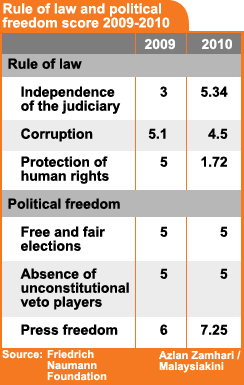 The rule of law section of the study measures three indicators, independence of the judiciary, prevalence of corruption, and the protection of human rights.
In 2009 Malaysia's score for the rule of law section was 13.1 plummeting to 11.52 for last year (left) .
However, the report Freedom Barometer Asia 2010 gives better marks to Malaysia for the independence of the judiciary, recording this at 5.3 last year from 3 in 2009.
Nevertheless, it notes that the independence of the courts is still heavily compromised by the influence of the executive branch of government.
Malaysia did especially bad in the protection of human rights, plummeting to 1.72 in 2010 from a score of 5 in 2009, on a scale of zero to 10, the Freedom Barometer Asia report for 2010 says.
The report measures freedom from a liberal perspective, compiling data from other respected indices that reflect a liberal notion of freedom.
Released by the Friedrich Naumann Foundation for Liberty (FNF) today, this is the second edition of the annual report since the 2009 report released last year.
The report cites "severe flaws in terms of human rights protection" in Malaysia, pointing to the prevalence of executions under the death penalty and convictions based on alleged sexual orientation, namely the sodomy trials of opposition leader Anwar Ibrahim.
"According to Amnesty International, there have also been reports of degrading and inhumane treatment of suspects as well as arbitrary detention," the report states.
This situation, it says, has been worsened by Malaysia's refusal to ratify the relevant United Nations conventions on human rights, such as the Convention Relating to the Status of Refugees, the Covenant on Civil and Political Rights and the Covenant on Economic, Social and Cultural Rights.
'Interference in electoral process'
Corruption has also worsened, according to the report, which gives this area a rating of 4.5 against last year's 5.1, saying corruption "remains a serious problem among the political and business elite of the country".
On political freedom, it says Malaysia continues to raise concerns over government interference in the electoral process.
"The BN has been accused of tampering with voter registration lists. Repressive laws limit the chances of the opposition," is what the Freedom Barometer Asia says about Malaysia.
The report points to the prevalence of non-constitutional 'veto' players in the form of extremist NGOs, "powerful Islamic groups which frequently put pressure on the government to pass legislation in their favour and have gained increasing influence in the past years".
 Malaysia maintains a score of 5, both in electoral freedom and existence of non-constitutional ‘veto' players.
'Press freedom ranks higher'
Curiously, press freedom ranks higher in 2010, scoring 7.25 out of 10, from 5 in 2009, though concerns are raised about the spectre of the Printing Presses and Publications Act that continues to dog the media.
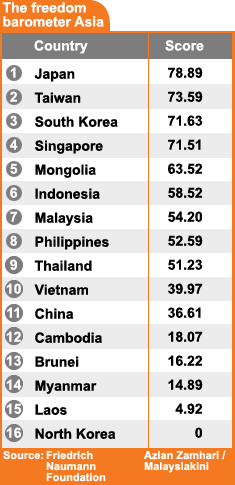
Malaysia remains static however at the seventh position among the 16 nations, the same as the 2009 ranking.
It scored a total of 54.20 in the Freedom Barometer Asia ranking, which ranges from zero to 100 (right) .
The country is ranked above the Philippines, Vietnam and China, but below South Korea, Singapore, Mongolia and even neighbouring Indonesia.
Japan leads the pack with a score of 78.89, followed by Taiwan with 73.59.
The barometer's indicators are political freedom, rule of law and economic freedom, which its originators declare as prerequisites for liberty.


Are you sure you want to delete this comment?
This action cannot be undone.