




Love Taib, or hate him, but he's THE leader
On the surface, Abdul Taib Mahmud's repeated declaration that he will not step down as the chief minister of Sarawak just yet because he has not found a qualified successor will be difficult for many to swallow.
On the surface, Abdul Taib Mahmud's repeated declaration that he will not step down as the chief minister of Sarawak just yet because he has not found a qualified successor will be difficult for many to swallow.
Having held political office for 30 years, why has it been such a headache for him to groom someone from his all-too-powerful Parti Pesaka Bumiputra Bersatu (PBB) to take his place? This is what many people are wondering.
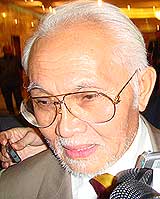 It is not as easy as anyone would like to think. After all, there are many highly educated second and third echelon leaders who can easily step into Taib's shoes.
That is true, if you are talking about someone taking over as chief minister. You don't need a person with a doctorate degree to be successful as head of government in this (once?) wealthy state.
One can look at Penang Chief Minister Lim Guan Eng and Selangor Menteri Besar Khalid Ibrahim as people with exceptional leadership qualities in administering their states.
What is important is honesty, integrity and a person with high moral character, plus, perhaps, political charisma.
PBB has its deputy president Abang Johari Openg, who holds a masters' degree in business administration from the United Kingdom, who can easily be Sarawak's next chief minister.
On closer examination, it appears that Taib is not so much concerned about who can, or will, succeed him. The successor is not expected to face serious administrative problems, one reason being that Sarawak has an efficient, and strong, civil service.
Political observers believe Taib is more concerned about who will be the next PBB president. By publicly stating several times that had he has not found a person qualified to succeed him, they said, he was in more concerned about who would succeed him as PBB president.
PBB chief gets chief minister's post
Of course, it is no doubt that whoever is PBB president will automatically become Sarawak chief minister since the party, being the backbone of the State BN, has 35 seats in the 71-member legislative assembly.
Even without the support of the Sarawak United People's Party (Supp), which has 12 state assemblypersons as well as the Sarawak Progressive Democratic Party (SPDP) and Parti Rakyat Sarawak (PRS), each with eight elected rpresentatives, PBB can still form the state government with a simple majority.
PBB draws its members from the Malay, Melanau and Dayak communities. It came into being in 1973, upon a merger between Parti Bumiputra led by Rahman Yaakob and Temenggong Jugah Barieng's Parti Pesaka Anak Sarawak.
The Malays and Melanau are grouped under the Bumiputra Wing of PBB while the Dayak group comprising Ibans, Bidayuh and other non-Muslim natives come under its Pesaka Wing.
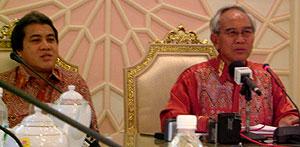 Deputy Chief Minister Alfred Jabu (
right in picture, with Awang Tengah
) is leader of the Pesaka Wing of PBB, while Taib heads the Bumiputra Wing.
Deputy Chief Minister Alfred Jabu (
right in picture, with Awang Tengah
) is leader of the Pesaka Wing of PBB, while Taib heads the Bumiputra Wing.
Since, the Bumiputra Wing has more assemblypersons and members, the party president comes from this wing while the deputy president (I) comes from the Pesaka Wing, while the powerful Bumiputra Wing also takes the deputy president (II) post.
PBB, therefore, has a unique system of using ethnic lines to allocate senior posts and ordinary seats in the supreme council.
This is also true in the cases of Wanita PBB and PBB Youth. The head of Wanita PBB is Alfred Jabu's wife Empiang Antak, while the Youth wing is headed by Fadillah Yusof, the deputy minister of science, technology and innovation, who is from the Bumiputra Wing.
These unique allocations will continue, for so long as the bumiputra and Pesaka wings are respecting each other, playing their respective roles and so long as the ethnic groups within the party do not quarrel for posts.
The main concern for Taib now is how long will this PBB unity last? Probably, he knows fully well that any serious disunity will break up the party.
Taib has been the uniting factor in the party, tying and binding all the different ethnic groups in the party. It is for this reason that he, with the strong support of other party leaders, remains at the top for as long as he wants to - and for as long as the members do not openly object.
The undisputed president of PBB
PBB is a party with many factions. One of the powerful factions is led by Abang Johari, and with him are the Malays from Kuching, the PBB power-base.
The other powerful faction is led by Taib's trusted man, Second Minister of Planning and Resource Management Awang Tengah Ali Hasan, who is the party's senior vice-president.
Then, there is the Melanau faction, which wants to see another Melanau becoming party president, and therefore, chief minister. Taib and his uncle, Rahman, are Melanau.
Taib also knows that should he were to step down as party president now, in-fighting among the faction leaders will definitely occur.
Not many leaders supported him when he took over the leadership from his uncle in 1981, with PBB facing serious internal squabbles between 1981 and 1987.
Among those who questioned his leadership qualities and credentials were former vice-presidents Salleh Jafaruddin, Wan Habib Syed Mahmud, Wan Yusof Tuanku Bujang and Bujang Ulis, as well as Wanita chief Hafsah Harun, who were later joined by Rahman Yaakub, who went on to lead the Taib opponents.
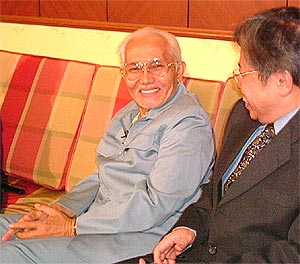 The squabbles led to a constitutional crisis in 1987 when 28 state assemblypersons, some from PBB, PBDS and SNAP, called on Taib to step down as chief minister.
Taib retaliated by calling for snap state elections. The BN under him won 28 seats while the Opposition, led by PBDS, secured 20 seats in the 48-member State Legislative Assembly.
Swift blows to those who undermine Taib
Not wanting such a political scenario to recur, Taib after the after the 1987 state election took a tight grip over the party, dealing swiftly with those trying to cause trouble or undermine his leadership.
Political observers believe the next internal squabble in PBB would be more serious, even fatal. However, this will not happen as long as Taib is party president.
Any new squabble may even cause PBB to break up, and factions unhappy with the new president will break away to form their own parties.
Taib does foresee what will happen when PBB breaks up. It will create political instability in the State, and even affect the rest of the country. The large number of native peoples, who have been depending on PBB for protection all this while, will become politically vulnerable.
Then Umno, on the pretext of trying to protect the Malays and other bumiputra groups, may want to come to Sarawak. Umno has all this while agreed not to come to Sarawak, for as long as PBB remained strong and relevant.
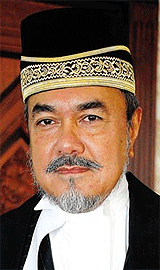 Among those who have expressed their objections to Umno spreading its influence to Sarawak are Taib, Jabu, State Assembly Speaker Asfia Awang Nasar (
right
), Awang Tengah and Wahab Dollah.
Among those who have expressed their objections to Umno spreading its influence to Sarawak are Taib, Jabu, State Assembly Speaker Asfia Awang Nasar (
right
), Awang Tengah and Wahab Dollah.
They say the time is not right now for Umno to come to Sarawak. What they possibly mean is that the time is only right when PBB breaks up and is no longer relevant to the Malays and bumiputra.
The possible entry of Umno is the kind of scenario that many PBB leaders, including Taib, want to avoid. To them, Sarawak's uniqueness and status quo must be protected and safeguarded by all Sarawakians, with PBB leading the way.
They do not believe Umno can safeguard not just the interests of the Muslim as well as the non-Muslim natives. They fear Umno will bring with it the unhealthy politics of Peninsular Malaysia, and they see no difference between Umno and PAS.
Even leaders of other political parties, share this sentiment, especially when it comes to immigration control and employment of non-Sarawakians.
Unlike Sabah, Sarawak maintains a very tight control over the entry of people from Peninsular Malaysia deemed to be "undesirable".
Taib is also a uniting factor for the component parties of the state BN. It is public knowledge that some of the component party leaders do not see eye-to-eye with one another. Jabu and PRS president James Masing, for example, are not the best of friends.
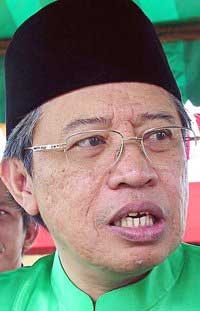 None of the State BN leaders dare to challenge or question Taib as chief minister and State BN chairperson, but they stand strongly behind him whenever the opposition accuses him of corruption, nepotism and abuse of power to enrich himself and his family members.
Can Taib's successor as PBB president bind the leaders of the BN parties together when they are always suspicious of one another? It is a fact that some State BN leaders do not have much respect for Awang Tengah, one of the second echelon PBB leaders tipped to succeed Taib.
It is also doubtful whether Abang Johari ( above ), another potential successor to Taib, can command the same respect Taib does from the state BN leaders.
As long as Taib is PBB president, and by extension, state BN chairman, Sarawak BN will remain politically stable and strong.


