




Judge delivers damning judgment in NCR land case
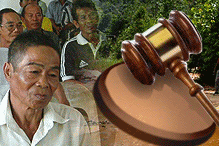
The Kuching High Court has made a damning judgment against the Sarawak government, state-owned land agency Land Custody and Development Authority (LCDA) and Pelita Holdings Sdn Bhd (PHSB) over the principal deed signed with a group of landowners claiming native customary rights to land.
The court also attacked a joint-venture agreement (JVA) between PHSB and plantation company Tetangga Arkab Sdn Bhd (TASB) and Tetangga Arkab Pelita (Pantu) Sdn Bhd (Tetangga).
 Tetangga is a joint-venture company between PHSB and TASB that undertook the development of an oil palm plantation project involving the NCR land in Pantu district.
The principal deed and the JVA were signed on Sept 3, 2004 for the development of 7,000ha of NCR land.
Twelve NCR landowners have sued the LCDA, PHSB, Tetangga and the state government as first, second, third and four defendants respectively.
PHSB is a wholly-owned subsidiary of LCDA, a state government land agency.
The plaintiffs are Masa Nangkai, Christopher Ambu, Engkana Talap, Sinju Senabong, Uban Bundan, Albert Waler Skinner Tulis, Jacob Emang, Len Jubang, Liap Giling, Ivanhoe Anthony Belon, Morice Renggi and Gima Belon.
They were suing on behalf of themselves and 90 other occupiers, holders and claimants of NCR land situated at or around Kampung Tekuyong, Kampung Dadak Aping, Kampung Aping, Kampung Lubok Abok, Kampung Sungai Tenggang, Kampung Limau and Kampung Pantu.
The plaintiffs are ethnic Ibans, natives of Sarawak, who claim to be entitled to native customary rights over land in an area described as ‘the disputed area land’ in the Pantu land district.
The plaintiffs claimed various declaratory reliefs relating to their native customary rights over land in the disputed area land which was established to be within the oil palm plantation project and for restraining orders against LCDA, PHSB and Tetangga and for them to give vacant possession of the plaintiffs’ native customary rights land and damages.
Ministry’s handbook extols such development
The genesis of the oil palm plantation which is at the centre of the present action is the ‘New Concept of Development on Native Customary Rights (NCR) Land’ under the auspices of the state Land Development Ministry, which published a handbook extolling the benefits of such development to the rural people, primarily to eradicate rural poverty.
In his judgment yesterday, Justice Linton Albert said the principal deed and the JVA had deprived the plaintiffs of their native customary rights land which is a source of their livelihood and lost the rights to their property which are violations of Articles 5 and 13 of the constitution.
 “Irrespective of the cleverly devised legal mechanism and legalistic language which constituted the principal deed and the joint-venture agreement, they are mere fig leaves too scanty to conceal their violations of Articles 5 and 13 of the constitution because the sum total of the rights of the landowners, to put it crudely, and for want of a better word, is zero,” Albert said when deciding in favour of 12 NCR landowners.
He said this is patently demonstrated by the following aspects of the principal deed which is briefly set out for emphasis and at the risk of repetition.
“Firstly, PHSB was to receive and collect the benefits of the development of the native customary rights land into an oil palm plantation, not the landowners;
“Secondly, the commercial development of the native customary rights land into an oil palm plantation was to be carried out by a joint-venture company formed by PHSB and TASB, a company exclusively chosen by PHSB under a joint-venture agreement in respect of which the landowners are not even a party to.
 “Thirdly, the native customary rights lands are immediately amalgamated and title is to be issued in the name of the ‘joint-venture’ company and the landowners would have no beneficial legal equitable or caveatable interest in the land to be issued with title.
“And one can go on and on to illustrate how the terms of the principal deed have stripped the landowners of their rights in every conceivable way and reduced those rights into nothingness.
“The fact that the landowners were not parties to the agreement between PHSB and TASB, under which it was agreed for the commercial development of the native customary rights land by Tetangga, meant that the landowners’ rights in and over the oil palm plantation was also definitively zero.
‘Neither TSAB nor Tetangga had been declared a native’
The judge said the JVA was also in contravention of Section 8 of the Land Code because neither TASB nor Tetangga had been declared a native at the time of the JVA and it did not matter that Tetangga was subsequently declared a native because it is a principle of antiquity that things invalid from the beginning cannot be made valid by a subsequent act.
Albert noted that the evidence adduced by witnesses for the plaintiffs was credible and unvarnished.
“Their evidence established with some measure of certainty the plaintiffs’ acquisition of native customary rights land within the oil palm plantation.
“Their testimonies were not materially contradicted by the witnesses called by the defendants who were willing participants in the oil palm plantation at the Sungai Tenggang NCR Development Area where the plaintiffs claimed to be entitled to land under native customary rights.
“If anything, the defendants’ witnesses reinforced the plaintiffs’ claims. For example, the defendants’ star witness Beliang Anak Jubang, an area chieftain, whose jurisdiction extended to the areas where the plaintiffs claimed to be entitled to land under customary rights, despite his reprehensible reticence and sparingness for the truth, did admit that Len Jubang was his own brother and whose claim to land under native customary rights he did not directly deny.
“Beliang had also unashamedly made the astonishing admission that even though the plaintiffs and their witnesses complained to him when their lands were forcibly cleared for development into an oil palm plantation he did not pay any attention to those complaints because he did not want to be a ‘busybody’ and did not care a hoot where the complaints ought to have been made, which put paid to the accusation that the plaintiffs did not initially complain about the encroachment by LCDA, PHBS and Tetangga.
“Beliang was an enthusiastic participant in the development project and had surrendered 24 hectares of his native customary rights land for the oil palm plantation and was happy with the benefits he received,” he said.
He said all but one of the other witnesses called by the defendants, Johnical Linggang Aman, a retired senior police officer and erstwhile group manager of Tetangga, glorified the benefits of the development project which was woefully hollow in the light of the forthright testimony of Dollah Chek @ Abdullah Chek, the general manager and managing director of LCDA and PHSB respectively, who unequivocally said that as of 2010 some six years after the first bulldozers came to initiate the commencement of the oil palm plantation and three years after the oil palm fruits were harvested, no dividends had been distributed for the benefit of the enthusiastic participants.
“Such was the measure of the benefit or lack of it of the oil palm plantation to the landowners,” he said.
Last witness ‘was in blissful ignorance’ of protests
The judge said the defendants’ last witness, Tan Thian Siang, the investor in and kingpin of the development of the Sungai Tenggang NCR land into an oil palm plantation, testified that he was in blissful ignorance of the plaintiffs’ protests and complaints relating to the indiscriminate destruction of their native customary rights land, valuable crops on their land and sacred burial grounds of their ancestors.
“He said with utter hypocrisy that he only allowed land surrendered for development to be cleared and that he had treated the Ibans there with hospitality and respect and gave good advice to them relating to disputes on competing claims and dealing only with non-disputed claims to land under native customary rights, and as a Chinese who believed that the destruction of graves was taboo as disturbing the spirits of the dead would attract ‘bad feng shui’, every allegation of such destruction was thoroughly investigated and found to be untrue.
“I found all these to be sympathy-evoking fabrications. The truth was his understandable admission that he was ‘only interested in doing business’ because LCDA and PHSB had given him ‘the go-ahead to develop’ the native customary rights lands.
“That would unarguably explain why the relentless complaints and protests including the barrage of numerous police reports by the plaintiffs had been totally disregarded because they constituted impediments to his ‘doing business’.
“These are cries for justice and the court must respond even if no one else does because one cannot simply throw one’s hands in the air and say that is how life is,” Albert stressed.
He said the plaintiffs’ account of the oral tradition handed down from their ancestors and how they came to be entitled to their respective individual and communal land under native customary rights were not disputed in any material particular.
He added that the question as to whether the lands claimed by the plaintiffs were under native customary rights did not arise because their claims were confined to lands within the 7,000 hectares under the Sungai Tenggang NCR development which the defendants had unequivocally stated to be the case.
“Equally irrelevant is the question of the allegedly overlapping claims of the plaintiffs and the participants in the oil palm plantation, a matter on which the defendants placed much importance and which according to them ought to have been confined to adjudication before the Native Courts, because at least notionally, the participants’ native customary rights lands are non-existent as these have been surrendered and extinguished when they as landowners entered into agreements with PHSB and the state government for the establishment of the oil palm plantation.
“This is clear from the provisions of Clauses 4.1 (c) (i) and 5.1 of the principal deed, which render them incompetent even to claim native customary rights land because they no longer have any interest or right to native customary rights land in the oil palm plantation.”
‘Parisitic role of PHSB’
The judge said the salient aspects of the principal deed and the joint-venture agreement make it perfectly clear that the erstwhile landowners do not have any right whatsoever.
“The parasitic role of PHSB, which had nothing to begin with, has relegated the landowners into absolute obscurity under the principal deed and as the landowners are total strangers to the joint-venture agreement, the defendants cannot be heard to say that TASB and Tetangga had not acquired rights and privileges in the native customary rights land that they have undertaken to develop into an oil palm plantation,” he said.
He said there was no legal basis for LCDA, PHSB and Tetangga to remain on the native customary rights land which has been acquired by the plaintiffs from which they must inevitably leave.
He ruled that the plaintiffs are entitled to their claim to land under native customary rights in the Sungai Tenggang NCR Development area at Pantu.
He also stated that the destruction of the plaintiffs’ respective native customary rights land by the first, second and third defendants was unlawful and damages to be assessed by the deputy registrar be paid by them with interest at four percent per annum from the date of the judgment until settlement;
He also ordered that the three defendants vacate possession of the plaintiffs’ native customary rights land and they pay costs to the plaintiffs.
Representing the plaintiffs were Dominique Ng Kim Ho and Daniel Tajem while the first, second and third defendants were represented by Arthur Lee. The state government was represented by state legal counsel Dayang Jamillah Salahuddin.


Report this comment
Are you sure you want to delete this comment?
This action cannot be undone.