




Dayak and mixed rural seats the real battleground
ANALYSIS Parti Rakyat Sarawak (PRS) president James Masing was right with his political analysis that the upcoming state elections will be fought in the rural constituencies, to be more precise where the Dayaks form the majority of the voters.
He was also on target to state that it would be an uphill battle for the Barisan Nasional, represented by the Sarawak United People’s Party (SUPP), to win back the support of the urban voters which it lost in the 2006 elections.
ANALYSIS Parti Rakyat Sarawak (PRS) president James Masing was right with his political analysis that the upcoming state elections will be fought in the rural constituencies, to be more precise where the Dayaks form the majority of the voters.
He was also on target to state that it would be an uphill battle for the Barisan Nasional, represented by the Sarawak United People’s Party (SUPP), to win back the support of the urban voters which it lost in the 2006 elections.
There are 28 Dayak-majority seats out of 71 in the Sarawak state legislative assembly.
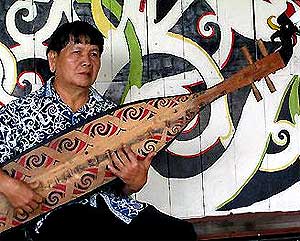 The Dayaks, comprising the Iban, Bidayuh, Kayan, Kenyah, Murut and other non-Muslim ethnic groups, are the majority race in Sarawak, forming over 40 percent of the total 2.6 million population.
The Chinese, forming about 28 percent of Sarawak, are the majority voters in 16 urban centres while Malay/Melanau, the third biggest race, are the majority voters in mostly coastal areas as well as outside Kuching City.
In the 2006 elections, SUPP lost five urban, two rural and one mixed seats to the opposition parties.
The five urban seats are Batu Lintang, Padungan, Pending, Bukit Assek and Kidurong; while the rural seats are Engkilili and Bintangor. The mixed seat is Kota Sentosa.
SUPP still not attractive enough
Although SUPP president Dr George Chan has projected an image that the party is gaining grounds in the urban constituencies due to the bigger role played by the youth members in the party, the reality is that SUPP is still not attractive enough for the vast majority of the voters.
There are many reasons for the lack of attraction.
The urban voters are very well-informed on many issues as they have greater access to information through various sources.
Hence, they can form their own opinions, after assessing all the information they have gathered.
 The urban voters, who had been supporting SUPP before, are now favouring the opposition, especially the DAP. They say the time has come for change.
They see the DAP as the party that dares to speak on issues, including on lands being placed under Sections 47, 48 and 49 of the Sarawak Land Code, land premiums and leases.
The urban voters, who are mainly Chinese, consider SUPP as a party that compromises too much on land matters, and dares not criticise the government land policies.
Moreover, SUPP is seen a party that “kowtows” to Chief Minister Abdul Taib Mahmud, which the Chinese voters believe is not good for the community.
They want SUPP to keep a certain distance from Taib, and be prepared to speak for the community when there is a need to.
Although Chan had stated that the SUPP had done a lot to help the Chinese community, it was not enough.
The DAP has been drumming for an automatic renewal of land leases before expiry dates, minimal premium when renewing land leases and extending the leases from the present 60 to 99 years.
The DAP has also been calling for government funds to be extended to Chinese independent schools as annual grants.
The issue of corruption and abuse of power allegedly committed by the BN leaders has found eager listeners among the urban voters.
The urban voters have developed a perception that BN is a party full of corrupt leaders.
 The BN leaders cannot deny that there are corrupt leaders within their ranks. They believe that Taib is corrupt and so are Chan and Alfred Jabu, both deputy chief ministers.
Whistleblower blog Sarawak Report has been coming up with reports on corruption allegations against Taib and his family members, and to a lesser extent on Dr Chan and Jabu.
There have so far been no denials by the three leaders of their involvement in corrupt practices and abuses of power as alleged by Sarawak Report .
Ageing leaders refusing to give way
Although Chan has publicly stated that more youths have been tasked to play a bigger role in the party, the urban voters do not think so. The same ageing faces are still holding important positions in the party, giving enterprising and innovative young leaders no chance to move up.
The ageing leaders, many are in their late 60s or early 70s, just refuse to give way to young leaders who can come with new and fresh ideas so the party can stay relevant.
On the other hand, the DAP has attracted more educated, professional and independent young Chinese into its ranks. These are the assets that are invaluable to the DAP.
The party is also led by young people, with the average age of its state committee members being slightly over 40 years.
Amidst this scenario, it is no wonder that Masing, the Sarawak Land Development Minister, believed that the real battle in the upcoming elections would centre in the Dayak majority and mixed rural constituencies.
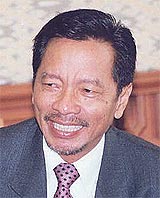 Masing (
right
) warned that there would be an opening of the rural front if the BN leaders were not respectful and sensitive to the wishes of the Dayaks.
Masing (
right
) warned that there would be an opening of the rural front if the BN leaders were not respectful and sensitive to the wishes of the Dayaks.
“Such behavior will make the Dayaks angry and lead to a second front,” he said, referring to the urban front where SUPP had lost the support of the Chinese in urban areas.
Masing did not want such to happen in the Dayak areas.
Masing’s warning could be interpreted as indirectly accusing certain leaders of Parti Pesaka Bumiputra Bersatu (PBB) of which Taib is the president, of trying to sponsor Independents against PRS candidates.
There have been accusations in the past where some PBB leaders were seen as being less than honest with the small BN partners.
There had been complaints that these leaders were tacitly supporting Independent candidates in areas contested by the small BN parties, but when confronted, they were quick to deny it.
It will not be surprising if the same thing happens again in the upcoming elections, for example, in Pelagus, Ngemah, Engkilili and Balleh.
NCR land grabs another major issue
Apart from backstabbing among the BN partners, the major issue to be raised in the upcoming elections will be alleged grabbing of the native customary rights (NCR) lands by companies linked to Taib’s family members.
Over 200 NCR land cases have been filed with the court, pending hearing. Most of the cases involved lands being leased out to plantation companies.
Sarawak PKR expects more cases to be filed in future as more NCR lands are being declared by the government as state lands and leased to private companies.
The state government wants to open up to two million hectares for oil palm plantation. Most of these lands are claimed by the landowners as their NCR lands.
If the Dayak voters are true to their words, then we can see the downfall of the BN in the Dayak constituencies.
Lack of basic amenities like piped water and electricity in the remote rural areas are also working against the BN.
They have to get their water from the rivers polluted by the discharge from the oil palm plantations and logging activities.
In Bawang Assan, for example, a large number of the longhouses have to rely on water from the wells for their domestic uses.
 The opposition and some BN leaders have accused the state assemblyperson for Bawang Assan, Wong Soon Koh (
left
), who is also the state Public Health and Environment Minister, of not doing enough to help the longhouses.
The opposition and some BN leaders have accused the state assemblyperson for Bawang Assan, Wong Soon Koh (
left
), who is also the state Public Health and Environment Minister, of not doing enough to help the longhouses.
The rural Dayaks have also expressed concern at the poor condition of or absence of roads in remote areas of Sarawak. Many longhouses are not linked to towns by roads, but rather by rivers.
Kapit is a classic example of a town in Sarawak which is not linked to any other town, despite numerous appeals by the successive elected representatives from Kapit and community leaders to have roads built to connect this town with the outside world.
The only means of going to Kapit is by river transportation. This is shameful and a disgrace considering that Sarawak, being part of Malaysia, has enjoyed independence since 1963.
“The federal government has been kind to help in such facilities but something must be done to link Kapit with the rest of the world,” Masing said.
Kapit an ‘island’ with no road links
Calling Kapit an island which had no road links to either Sibu or nearby towns, he said even Belaga was connected to Bintulu through the timber track roads.
 He hoped that infrastructure for the people would start as soon as possible as the people would presume an ulterior motive if it was started near the election period.
Political observers believe that if nothing much is done to help the rural and poor Dayaks, they may bring their frustration and anger to the opposition. This is where the danger lies for the BN.
“Perhaps, the BN is taking the Dayaks for granted. They only need us when they want our votes. Other than that, we are left on our own,” said a frustrated Iban civil servant from Betong.
Despite the numerous complaints against the BN, the Dayaks are not expected to make major political shifts to support the opposition. Or will they?
The simplest thing that the BN would normally do to ensure victory is to warn the village headmen to care of their “ anakbiaks ” (followers), otherwise the government will strip them of the positions, hence their RM450 monthly allowance. This threat works, as in the past.
Jabu is famous for giving this kind of threat to the village headmen. They have also been warned not to allow opposition workers to enter their longhouses.
Will the threat work again this time?
STEPHEN TIONG is a member of the Malaysiakini team.


