




BN to win Kerdau and Merlimau
ANALYSIS The common thread running through the two by-elections in Kerdau in the parliamentary constituency of Kuala Krau in Pahang and in Merlimau in the parliamentary constituency of Jasin in Malacca is the lack of excitement and issues emanating from both campaigns.
The only spark created from these campaigns was a speech by the wife of the Prime Minister, Rosmah Mansor, defending her recent trips to the Middle East.
The common thread running through the two by-elections in Kerdau in the parliamentary constituency of Kuala Krau in Pahang and in Merlimau in the parliamentary constituency of Jasin in Malacca is the lack of excitement and issues emanating from both campaigns.
The only spark created from these campaigns was a speech by the wife of the Prime Minister, Rosmah Mansor, defending her recent trips to the Middle East.
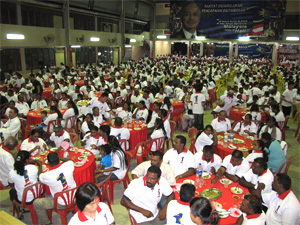 This should not be surprising given that both of these seats are in BN stronghold areas with little chance for Pakatan Rakyat to make any headway.
These seats are not located in parliamentary districts with important national leaders, a factor which made the battle for Chinese votes in Tenang particularly important.
Both these by-elections are but mere distractions for the looming Sarawak state election which is obviously more consequential both at the state as well as the national levels.
Body blows and state of party morale
The only importance I would attach to both these by-elections is the impact it may have on PAS in terms of how another couple of body blows of losing another two by-elections with larger majorities for the BN would do to its morale and its political strategy moving forwards.
It would surprise no one that the BN would win both these by-elections and with significantly larger majorities. My prediction is that the BN would win Merlimau with a 4,000-vote majority and Kerdau with a 2,500 vote majority.
Let me go through my analysis by starting with Merlimau.
Merlimau
N27 Merlimau, one of the five state seats in the parliamentary seat of Jasin in Malacca, experienced the largest drop in the percentage of votes won by the BN from 2004 to 2008.
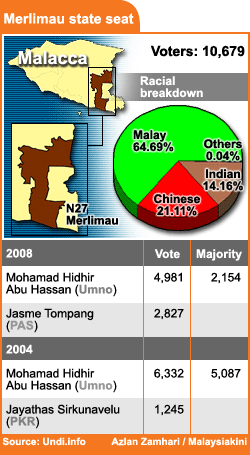 The 18.5% drop, from 81.1% in 2004 to 62.6% in 2008 was even larger than the 6.6% and the 16.7% drop in N24 Bemban and N25 Rim respectively, both seats with a larger percentage of non-Malay voters compared with Merlimau (35.3% in Merlimau compared to 40.4% in Bemban and 42.4% in Rim).
Unlike Tenang, there are no Chinese-majority polling stations in Merlimau. The polling station with the highest percentage of Chinese voters is Ayer Merbau with 31.3%.
In addition, none of the polling stations with a significant minority of Chinese voters have a record of voting for the opposition, unlike the Chinese polling stations in the Labis town centre in the Tenang state seat.
This means that the opposition, specifically the DAP, has fewer opportunities to focus their efforts in a small number of heavily Chinese polling stations in an attempt to boost Pakatan's share of Chinese votes.
Past receding as future beckons
In addition, one of the biggest reasons for the fall in the majority for the BN in this seat (from 5,087 in 2004 to 2,154 in 2008) was the swing in the Indian support for the BN.
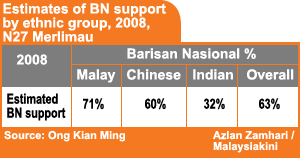 The two polling stations which experienced the largest fall in BN support (Jasin Lalang and Merlimau Utara) were also polling stations where most of the 14% of the Indian voters in this constituency are located (52.9% and 42.5% Indian voters respectively).
The even distribution of the Chinese and to a lesser extent, the Indian vote, and the limited number of polling stations in Merlimau makes estimating BN support by race very tricky.
Given the larger national picture of Indian support going back to the BN, its majority is bound to rise from a significant increase in the level of Indian support.
I expect an increase of about 6% support for the BN among the Malay voters, based on the results of the previous by-election results in Peninsular Malaysia in 2010 and 2011 in seats which the BN performed relatively well.
I also
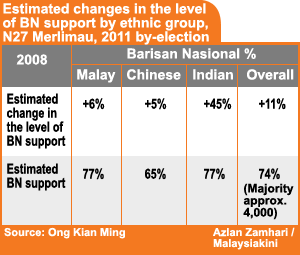 anticipate there to be an upward movement in the Chinese vote of as much as 5%, partly because of the efforts of the MCA which started even before the Chinese New Year holidays and partly due to the relative weakness of the DAP in this area.
Finally, I anticipate a large 45% swing in the Indian support for the BN partly because of the lack of a coherent strategy by the Pakatan to maintain its hold on the Indian vote, partly because of the relative success Prime Minister Najib Razak has had in reaching out to the Indian community at the national level and partly due to the recent departure of the much reviled Samy Vellu as the president of the MIC.
With a jump approximately 11% in its share of the popular vote, I expect the BN to win this seat with an increased majority of approximately 4,000 votes.
Kerdau
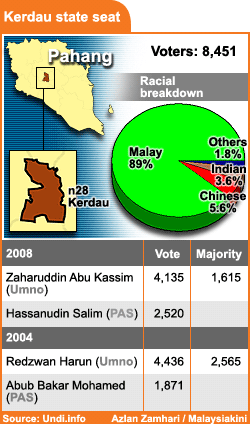 Kerdau is a 90% Malay majority seat with a number of Felda settlements which strongly support the BN. The BN experienced a fall in its winning majority from 2,565 in 2004 to 1,615 in 2008, which represents an 8.3% drop in the percentage of votes obtained.
The 2008 polling station results show that the level of BN support in the Felda polling stations is higher than the level of BN support in the non-Felda Malay-majority polling stations.
In the two non-Malay majority polling stations, the small town of Kerdau (Chinese and Indian majority) and the polling station of Kerai (Orang Asli majority), the percentage of the popular vote won by the BN in the former was 73% and 52% in the latter.
This means that the Chinese and Indian support for the BN was probably lower in 2008 in Kerdau than the Malay support for the BN.
I assume that the rise in Malay support for the BN would be more or less similar to national trends. I also assume that the BN support among the small number of Chinese voters would go up by approximately 7% because of the stronger MCA presence in the area and in this state.
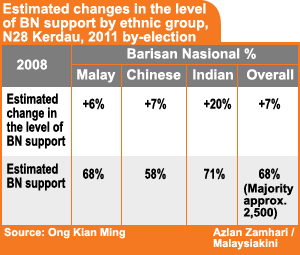 The 20% increase in Indian support is indicative of the higher level of BN Indian support in 2008 (compared to the 32% Indian BN support in 2008 in Merlimau).
Given the small percentage of Chinese and Indian voters in this seat, large variances in the BN support among these voters won't change the final majority.
What will decide the majority is the effectiveness of the Umno machinery among the Malay voters in this seat, especially among Felda voters.
My estimate is that BN's majority would go up to approximately 2,500 votes, close to its 2004 majority.
Post by-election implications
The BN would definitely receive yet another boost in its morale in winning another two by-elections making it 6 out of 7 by-election victories since 2010.
The MCA will also receive a much needed boost to its morale by increasing its share of the Chinese vote, especially after failing to make much headway among the Chinese voters in Tenang.
The MIC, led by its new president, G Palanivel, would also be encouraged by the return of the Indian vote back to the BN, despite the latest crackdown on Indian activists in Kuala Lumpur who were protesting against the inclusion of the Interlok novel as part of the national education curriculum.
 The main question of contention after these two by-elections would be whether PAS would succumb to internal pressures, especially in light of upcoming internal party elections, to once again play to the gallery and resort to its comfort zone of ramping up the use of explicitly 'Islamic' issues in an effort to regain the Malay vote.
It is hard to say if the latest crackdown on the sale of lottery tickets in Kelantan is an indication of things to come, in Kedah, for example, as part of a larger effort for PAS to flex its ‘Islamic' muscles.
This would obviously have national implications for Pakatan, most notably in Selangor, where PAS plays a small but significant role in flying the 'Islamic' flag, so to speak.
But I suspect that these issues would be temporarily swept under the carpet as the focus shifts to the upcoming parliamentary sitting and, by the end of March, speculation that the Sarawak state assembly would be dissolved soon to make way for the next state election, an election that could swing the political momentum in favor of the opposition coalition.
Pollster: Disorganised PAS to hand Merlimau to BN
ONG KIAN MING can be reached at im.ok.man@gmail.com. He holds a PhD in political science from Duke University. He hopes to extend his elections analysis to beyond race specific factors but wants readers to realize that systematic data on non-racial factors (such as income, education and rural/urban measurements) are very hard to come by.


Are you sure you want to delete this comment?
This action cannot be undone.