




No apologies for NEP, but it partly failed: Daim
Former finance minister Daim Zainuddin today defended the much-criticised New Economic Policy (NEP), but said that previous models used to build a bumiputera business class have failed.
Former finance minister Daim Zainuddin today defended the much-criticised New Economic Policy (NEP), but said that previous models used to build a bumiputera business class have failed.
Speaking to a full house audience at the sixth installment of the Universiti Tun Abdul Razak lecture series in Kuala Lumpur today, he said that in fact the NEP was a “noble effort” with logical goals.
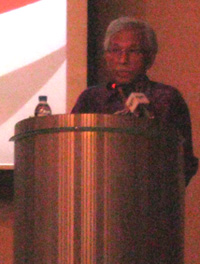 Daim (
right
) said that when the country received its independence, the British policy of divide-and-rule had caused severe income and ethnic disparity which needed to be addressed through social engineering that was the New Economic Policy.
Daim (
right
) said that when the country received its independence, the British policy of divide-and-rule had caused severe income and ethnic disparity which needed to be addressed through social engineering that was the New Economic Policy.
“Ethnic economic aspiration become an important factor in economic development policies. NEP was to expand the economy and benefit all ethnic groups.
"Malays and bumiputera (who make up about 60 percent of the population) are politically dominant. A political party not sensitive of this group cannot hope to rule the country.
“Some of the NEP exist elsewhere, in the United States it is called affirmative action... to assist the low-income group, the alleviation of poverty, to reduce regional imbalances. There is nothing wrong with eradicating poverty and reducing disparity.
“It is a noble effort and we shouldn’t be apologetic about it. It affects the whole society (regardless of ethnicity) either directly and indirectly,” he said, adding that poverty data today compared to the 1970s is evident of NEP’s partial success.
Daim, who last week broke his long silence in an interview with Mingguan Malaysia , added that when the government pursued the policy to award contracts to companies with part-bumiputera ownership, it was at a time when the community was still “weak” and had “no networks like the non-bumiputera” business community who had more experience.
“If (a project was awarded) to a bumiputera company, the bulk of work was given to a non-bumiputera company. There was still trickle down (and) no deprivation of the non-bumiputera (business class) in sharing in the spoils of development,” he said.
As evidence of this, he said, the bumiputera community has yet to achieve the 30 percent equity target set for 1990, and currently only holds 21.9 percent.
Additionally, he said, none of the top 10 companies in Bursa Malaysia are owned by bumiputera.
Need to develop a new model
All the same, he said that the old model of providing licences, subsidies and approved permits to the bumiputera in hopes of building entreprenuers had failed and is no longer sustainable given diminishing public funds.
“My main concern is the need to develop a new model (to build) Malays in business and entrepreneurship. In the past we have used licences, approved permits, financial support, etc, but has it brought about sustainable entrepreneurship? The answer is no... (and) it is no longer tenable.
“There is a need to have a Malay group that is more sustainable and less dependent on government support. This is an unfinished business,” he said in his speech.
Similarly, he said, Malay rights group Perkasa’s discontent with the New Economic Model shows a reluctance to let go of old inefficient models, which is incompatible with market needs as well as the state of public funds.
Elaborating in the question-and-answer session, Daim said Malaysia’s small economy is forcing greater liberalisation and Malays should not fear this as it is an opportunity to prepare themselves for competition.
“Have we achieved something for the Malays and the business community, yes, but when we do this there is still a gap. The only way is through education, with education you can stand on own feet. The government’s role is to provide education... and after that don’t come and say ‘I don’t have a job’.
‘I believe I am better than the Chinese’
“We have more Malay graduates compared to the 1960s and 1970s and (still) you say we can’t compete, then there’s something wrong with us. I don’t believe that we are less intelligent than the Chinese... I believe I am better than the Chinese. You can say you're clever but I say I’m cleverer [sic],” he said.
“Perkasa is looking at bumiputera interests, saying we cannot achieve 30 percent equity, blah, blah, but this is subject to debate and it is good that there is a debate so people understand... that (the government) is not depriving (Malays) of anything and if (the Malays) are good then (the government) will not stop (them) from being successful,” he said.
Amusing the audience, he said that politicians generally “don’t know nothing about the economy” and that “they only know how to spend money and please their voters”.
As such, he said that his advice is to “let them be politicians, not economists” and make sure that they have the right advisors.
The former politician, who has previously been nicknamed “ Diam Daim ” (Silent Daim) added that he is prepared to offer advice, but only if it is sought.
“I don’t want to be a busybody,” he said.


Are you sure you want to delete this comment?
This action cannot be undone.