




S'wak BN jumpy over NCR lawyers becoming reps
Sarawak’s Barisan Nasional (BN) appears jittery over the prospect of prominent native customary rights (NCR) lawyers Baru Bian, See Chee How, Harrison Ngau Laing and Abun Sui being elected as state assembly representatives on April 16.
Sarawak’s Barisan Nasional (BN) appears jittery over the prospect of prominent native customary rights (NCR) lawyers Baru Bian, See Chee How, Harrison Ngau Laing and Abun Sui being elected as state assembly representatives on April 16.
The ruling BN is funnelling enormous resources and taking extraordinary measures to try to stop Baru, state PKR leader, from entering the state assembly. Baru Bian reported recently that his constituents had said armed forces personnel working on roads in Ba’kelalan had threatened to tear down local schools if the villagers voted for Baru Bian in the upcoming polls.
 Baru was denied victory in mountainous Ba’kelalan in the last state elections in 2006 by only 475 votes. He filed a court action alleging widespread vote-buying in that election, but his election petition was unsuccessful.
Local observers say there is now a surge in the groundswell of support for Baru in Ba’kelalan. BN’s alarm is indicated by its unusual step of holding back the name of its candidate to take on the highly respected Lun Bawang PKR lawyer and church leader.
Baru and See are partners in a land rights law firm that has won a string of high profile court victories for NCR landowners over Taib’s government in recent years. The firm has some 150 land rights cases pending in the courts.
Harrison was detained without trial under the infamous Internal Security Act (ISA) in 1997, while Abun was recently arrested, but not charged, while he was carrying CDs and leaflets to rural communities describing allegations of corruption against chief minister Abdul Taib Mahmud.
New land and forestry laws
Sarawak BN’s stranglehold over the legislature has given Taib ample opportunity to bulldoze amendments to the Land Code and forestry laws through the state legislature, over the three long decades of Taibocracy.
A flurry of amended laws allowed Taib’s administration to take over NCR land with casual contempt for indigenous people’s rights to land under adat or customary law, as recognised by the 1958 Land Code and the federal constitution.
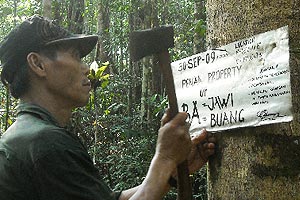 For example, a Land Code amendment in 1994 allowed the minister in charge of land matters to extinguish native rights to land by simply posting his decision in a local newspaper and on an official notice board. Another land amendment in 1996 shifted the onus for proving NCR claims from the government to the native communities themselves.
A forestry law passed in 1987 declared it a crime even to stand anywhere near a logging blockade, after dozens of barricades sprang up around Baram, fuelling international criticism of deforestation. The natives standing peacefully at the blockades were reported to have been beaten by police and loggers, and attacked with tear-gas, but the BN-dominated state assembly remained silent on the human rights issue.
When native communities succeeded in mapping their own land, winning NCR recognition from the courts, Taib’s government responded by passing a law prohibiting natives from making such maps for use in lawsuits.
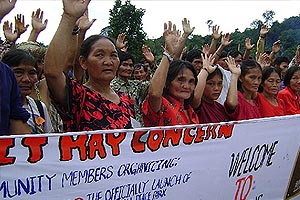 “Such amendment(s) can be seen as an effort to give easier way for the top down approach of centralisation in the implementation of (a) leader’s single-minded vision of development, rather than decentralised, diverse and dynamic systems. This will inevitably led to monoculture or (a) homogenous way of living.
“Consequently, the blessed cultural diversity of the nation would eventually be lost as a result of the denial of indigenous people’s rights,” argued seven Sarawakian land rights organisations in a joint communique in Sarawak news site Rengah in May 2000, after yet another Land Code amendment further restricted the means of identifying NCR land.
This amendment in 2000, like many before it, had been rushed into the statute books with scant time for debate. There were only three DAP state assembly representatives in this sitting. The legislature was little more than a gilded rubberstamp for Taib’s declarations.
‘Might makes right’ in legislature
The surprising opposition victories in 2006 increased the bloc of DAP and PKR state assembly representatives to seven out of 71. But the DAP and PKR still had their protests drowned out by the overwhelming majority of BN voices. The BN majority imposed their version of ‘might makes right’.
The much-derided state assembly speaker, Asfia Awang Nassar, a loyal servant of Taib, suspended several opposition representatives for speaking out against Taib during recent assembly sessions, for up to a year. The retiring speaker, recently dropped from BN’s latest line-up of candidates, even made history by deleting Pakatan speeches from the Hansard .
 But Baru appears to
relish
the prospects of confronting BN in the state assembly, promising to “bring the change that Sarawak desperately needs. We will return the trees, the lands and the rivers to the people. Corruption will stop.”
But Baru appears to
relish
the prospects of confronting BN in the state assembly, promising to “bring the change that Sarawak desperately needs. We will return the trees, the lands and the rivers to the people. Corruption will stop.”
If he and See are elected, they may be debating land and forestry legislation with Len Talif Salleh, who resigned from his position as Sarawak Forestry director to contest in Belawai. Len would certainly be an unlikely champion of the rural poor. He is a seasoned apologist for wealthy logging companies throughout the state.
Len gained international notoriety by publicly expressing doubt that Penan girls had been raped by loggers (despite a women’s ministry task force conclusion that the sex crimes had taken place).
He attacked the national auditor-general for calling Sarawak’s forestry unsustainable in its report in 2008, saying the auditor-general’s office lacked technical expertise. He also denied, famously, that last October’s disastrous Rejang logjam had been caused by uncontrolled logging, claiming instead that it had been caused by rain.
“Democracy must be more than two wolves and a sheep voting on what to have for dinner,” wrote American political author James Bovard.
On election night on April 16, we will know whether predators dominate the Sarawak state assembly, or whether a two-party system will gain a foothold.
KERUAH USIT is a human rights activist - ‘anak Sarawak, bangsa Malaysia’. This weekly column is an effort to provide a voice for marginalised Malaysians. Keruah Usit can be contacted at keruah_usit@yahoo.com


Are you sure you want to delete this comment?
This action cannot be undone.