




Staying in power forever
COMMENT All politicians aspire to wield power. Without political power, they have a slim chance of realising their political beliefs. Sometimes getting into power can be a life struggle. It can take a lifetime and most never actually make it to the finishing line.
In the ancient past, someone who aspired to power could go around finishing-off all challengers, but the life-and-death struggle in modern politics is more subtle, although not less vicious.
While there is a certain honesty in going up to someone you disagree with and breaking his head, there is something unsavoury about "killing-off" one's opponent using pornography or graphic descriptions of anal sex.
Gaining power is one thing, but staying in power is another matter altogether. We cannot keep killing people we do not like. We have to somehow win them over with soft power.
The promise of the good life (once dubbed ‘development') is a good carrot. As long as you let me rule over you, the goodies will keep coming. But even more effective are good ideas. This is why politicians banded together to form political parties. They may not all agree with one another absolutely, but they can agree on a particular worldview.
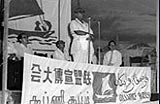 Here the power of ideas becomes all important. One can say that the former coalition Alliance, comprising Umno, MCA and MIC, like many political parties of the 1940s and 1950s was committed to the idea of gaining independence.
But more importantly, gaining independence on their terms, by integrating into a melting pot where ethnic identities would have to be sacrificed for the sake of "national" unity, could be prevented.
At other times, a strong personality can be as effective as a good idea. Strongmen and women can provide "leadership" and "direction" for a nation. The combination of good ideas and strongmen can be potent and can propel a nation in the direction of "progress" or "destruction".
This is why the legacy of the likes of Mao Zedong and Deng Xiao Ping are still controversial in China, years after they have died. The only problem is that like good ideas, strongmen grow old and good ideas can become outdated.
The drama unfolding in the Middle East and Africa vividly captures this "sudden" change of mood. It is only "sudden" to those out of touch with the ground.
Death does not figure in minds of politicians
But to stay in power forever is really an art. It is hard enough getting into power and even more difficult to implement one's ideas while being in power, but to stay in power forever is a feat that nobody has achieved thus far.
For one thing, not even Stalin could defeat death, although his reputation for cruelty and absolutism continues to fill hours in History Channel . Of course, death does not really figure in the minds of politicians. Most of them live for the moment and there is nothing more potent or addictive than being in power.
Politicians who want to stay in power forever are only being practical. Politics is like Hotel California, "you can check out but you can never leave".
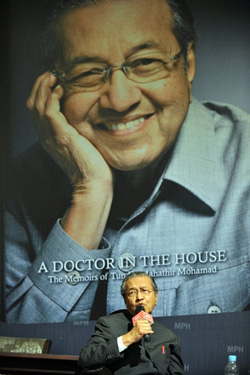
As such, really masterful politicians can resign from the highest office in a political system but still wield political power from behind the scenes. Sometimes, they can even rewrite history by creatively "producing" memoirs.
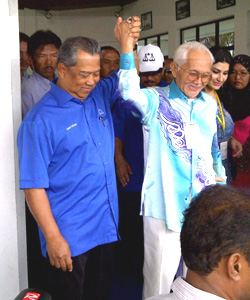 It does not matter if one is remembered for good or bad things. It is much worse not to be remembered for anything.
It is therefore most heartening to know that Sarawak's current Chief Minister Abdul Taib Mahmud is giving Malaysians and politicians around the world a good lesson in the art of staying in power forever. Those who believe that individuals who offer themselves up for public office are not hungry for power are deluding themselves.
Staying in power for 30 years and keeping the people "happy" and "satisfied" is indeed a record of sorts. Long after the chief minister is dead and gone, his legacy will live on. He will be in history books yet to be written. In short, against the odds, Taib has conquered death.
Or so it seems. The problem with forever is that it never comes. As such, it is really unpredictable. There is nothing worse for politicians than unpredictability.
So, tomorrow's challenge by the opposition in the Sarawak election, dubbed the toughest battle for the BN in the electoral history of Sarawak, will determine whether Taib really stays in power forever.
If the BN wins with its two-thirds majority intact, the Sarawak CM can afford to spend some time crafting his-story - but if the opposition is able to deny the BN its two-thirds majority, it still will not alter the fact that Taib will be remembered as the longest serving chief minister in Malaysian history.
The negative patina will not be welcomed, but most politicians can live with a little dirt. In fact, the CM will emerge battered but also wiser; at least to the ways of his "partners" from the peninsula.
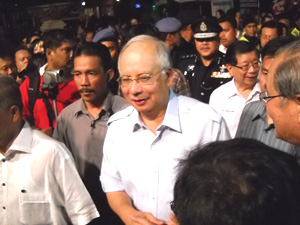 How will things pan out this weekend? The narrative is already prepared. If the BN does not do as well as it wants to, Taib will be blamed and if it does very well, Prime Minister Najib Abdul Razak takes the credit.
Najib is proving to be a most hardworking premier. If this hands-on approach continues and if the PM allows people-centric policies to be implemented without political interference, Malaysia might actually be a better place.
Sarawakians can learn a lesson from their brethren in the peninsula: a strong opposition keeps the government on its toes.
This is one idea that is blowing strongly throughout all urban constituencies in the country. It is too bad for BN parties that once counted on solid support from urban voters. They will now have to earn each and every vote that they get.
 The current political impasse is opening our eyes to the badly orchestrated attempts to "raise" discord. But on the positive side, policymakers and implementers are finding more space to get their jobs done.
While we now know that there are some politicians who want to stay in power forever, voters are increasingly confident that we do not need them to be in power for 30 years to enjoy peace, stability and development.
In fact, we can even choose not to buy their memoirs or read them for comic relief.
We should not expect mountains to move in Sarawak, but Malaysians of all political persuasions should be happy to learn that Sarawakians are smarting up to the need to retire politicians and political establishments that want to be in power forever.
NEIL KHOR completed his PhD at Cambridge University and now writes occasionally on matters that he thinks requires better historical treatment. He is quietly optimistic about Malaysia's future.


