




Gov't in a hurry to divest chosen GLCs
The government has identified a list of government-linked companies to let go and move fast to reduce its stakes there, said Minister in the Prime Minister's Department Idris Jala.
The government has identified a list of government-linked companies to let go and move fast to reduce its stakes there, said Minister in the Prime Minister's Department Idris Jala.
"I won't tell you how many, but we know the exact number of companies (which the government needs to exit from).
"We know the companies and the target price to exit. This is an idea mooted by the National Economic Advisory Council and in great haste so it becomes real," he said at a forum on the future of GLCs yesterday.
Addressing an audience of about 500 at the GLC Open Day in Kuala Lumpur, Idris said that there was nothing new in this talk of divestment but the government's sense of urgency was poor before.
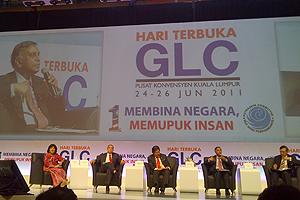 "We had talked about it for a long time. Most GLCs have a target price (at which the government is to) reduce its stakes but when we reached it the goals end up being moved. We have awakened to these facts," he said.
Clarifying this to the press later, Idris said that the government has no immediate plans to divest from successful and strong GLCs like Axiata, CIMB and Maybank, which it believes can be further assisted to grow as global champions.
Nevertheless, the government is open to discussing divesting if this is what is required by the strong GLCs for further growth, "but none have come to (the government) with the request".
Saying that more details will be revealed on July 5, Idris hinted that the GLCs up for divestment are those in "non-strategic industries which would do better without the government."
Let successful GLCs graduate
Eager to loosen ties with government was fellow panelist and CIMB chief executive officer Nazir Abdul Razak.
"As we grow regionally the term government-linked can be constraining, so I propose that a group of GLCs graduate to government -investee companies, more reflective of what is happening in CIMB, Axiata and Maybank," he said.
Also on the panel was Maybank CEO Abdul Wahid Omar and government think tank Institute of Strategic and International Studies director Mahani Zainal Abidin, who felt that the time has arrived to move out of successful GLCs.
"Government should let go, not just in name but in ownership. It must be prepared to just hold a golden share to let the companies be truly private to give it flexibility, (with the government) only exercising influence on n major issues," Mahani said.
She also mooted privatizing selected GLCs and using transparent methods invest the funds gained from that divestment heavily in strategic industries.
"Companies that invest in new technologies will have negative investments for quite sometime. This is what happened in Korea, Samsung had a long period of negative investment," she said.
No free lunch for GLCs
Likening GLCs to "children", fellow panelist and Minister in the Prime Minister's office Nor Mohamed Yakcop said that it is the government's stand to "not to be too attached to our children".
"Maybe the link is more emotional. Children should grow up. We should let them go, provided they write home often and don't ask for money," he said, tongue in cheek.
Touting the GLCs success in transforming into capable business entities in their own right, Nor Mohamed said none of the GLCs have had an advantage in terms of government preference.
"GLCs don't get a free lunch, there is no free lunch, not even free breakfast. Most contracts that the government award, GLCs...have to compete with everyone else and in some they have a disadvantage," he said, adding that the government has a no bail-out policy.


Are you sure you want to delete this comment?
This action cannot be undone.