




'BN, Pakatan budgets awash with election goodies'
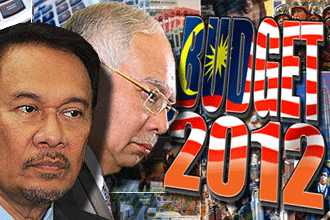
Both the opposition and the government presented a budget heavy on election goodies but slim on ideological considerations, said Tunku Zain al Abidin Muhriz.
Both the opposition and the government presented a budget heavy on election goodies but slim on ideological considerations, said Tunku Zain al Abidin Muhriz (below) .
 The founder of the Institute of Democracy Economic Affairs (Ideas) said "neither budgets broke ground" in charting a path to greater economic liberalisation.
"Although both were released with rhetorical flourishes of economic liberalisation moving towards a high-income economy, the reality is neither broke ground,” the Negri Sembilan prince said at the Economic Freedom Network Asia conference in Kuala Lumpur today.
"The government and opposition budgets are awash with goodies...for the purpose of electoral gain.”
While there has been plenty of debate on the content of the two budgets, he noted, substance has been lacking in the arguments.
“(The similarities between the two budgets) do not stop political parties from having big arguments about each others' content, but these arguments don't derive from a real ideological difference which requires one to consider decentralised individual freedom versus centralised control,” he said.
Tunku Zain al Abidin, a self-proclaimed libertarian who has previously served at the World Bank, said media coverage of both the federal and shadow budget also left much to be desired.
 He said both the mainstream and alternative media in their coverage of the federal and shadow budgets have reinforced a “parochial” perspective on the national budget.
“The mass media...are complicit in reinforcing that idea that the national budget must be seen through the lens of ‘what's in it for me’,” he said.
Nowhere in the coverage was there a discussion of protection of individual liberty and free enterprise, he said.
“Such coverage entrenches the narrow and parochial attitude towards economic policies,” he said.
Consequences ‘terrifying’ to some
Tunku Zain al Abidin observed that, for some quarters, economic liberalisation comes with potential consequences which are “too terrifying” to bear.
“They will do everything in their power to revert or stall the government policy (in order to) protect their own interest.
“Sometimes they succeed and the pro-reform among us will feel upset. We get angry that the reform previously announced isn't happening anymore,” he said, calling the relationship between business and politics “incestuous”.
 Looking back into history, however, he said one would find many examples of economic liberalism practised by Malay rulers prior to the advent of colonialism.
Among them was creation of semi-atonomous economic regions in the Kangchu system under the rule of the Johor sultanate in the 19th century.
However, this is lost on many who shun economic liberalism, as the justifying arguments for this has been couched in “the language of Western classic liberalism”.
“Frankly this is a turn-off for many of our fellow citizens who have been brought up to only idolise their own national leaders, their own ethnic heroes, their own religious champions.
“If we were only more diligent in looking back into our history I'm we'll find proponents of what we now call libertarians or what we call libertarian ideas.”
Related stories
'Vested political interests' blocking reform


Are you sure you want to delete this comment?
This action cannot be undone.